
For WHS Professionals · Australian DG & Hazardous Chemicals
Your WHS system is working. Your DG compliance may not be.
Dangerous goods regulations operate under a fundamentally different framework from WHS. Prescriptive thresholds, hard obligations, and strict liability offences exist entirely outside the reasonably practicable test. Most organisations don't discover the gap until a regulator does.
Why it matters
WHS and DG compliance are not the same system
WHS excels at managing risk. Dangerous goods compliance operates on a different logic entirely — and treating them as the same system is where organisations get exposed.
WHS is risk-based. DG compliance has a prescriptive floor and a risk-based ceiling.
WHS relies on judgement about risk and what is reasonably practicable. DG starts with fixed triggers: what you have, how much, and how it adds up. If the trigger is met, the obligation applies. No discretion.
Strict liability, no incident required
Some DG obligations are strict liability offences. No incident needs to occur. If the threshold was met and the obligation was not fulfilled, the breach may already be established.
A jurisdictional patchwork, no national standard
There is no single national framework for DG storage and handling. Each state and territory has different thresholds, terminology and authorities. A single compliance template will not meet every requirement.
The consequences extend well beyond workplace injury. Regulatory prosecution, facility shutdown, fire authority enforcement, and insurance invalidation are all live risks — even without an incident.
Check your exposure →Who this is for
Built for the people who own DG compliance in practice
Dangerous goods compliance typically lands with the safety function because chemicals are hazards and WHS manages hazards. That's a logical home — but the technical and regulatory demands go well beyond standard WHS practice.

WHS Managers & Safety Professionals
You're managing DG compliance as part of your broader WHS role. You need to understand where your current framework is and isn't enough — and what a parallel DG governance structure actually looks like.

Operations & Facilities Managers
You own the site. Regulatory inspections, fire authority visits, and insurance requirements land with you. You need to know your actual compliance position — not a consultant's annual snapshot.

EHS & Compliance Leaders
You're building or improving a compliance programme across multiple sites or states. You need the prescriptive DG layer running alongside your EHS system — not buried inside it.
Quick self-check
How exposed is your organisation?
Answer yes or no to each question. No login, no data saved — just an honest starting point.
We don't have a current, accurate picture of all dangerous goods on site tracked against our state's regulatory thresholds.
Our last facility assessment against Australian Standards wasn't done by someone who could identify prescriptive DG gaps.
Our SDS, dangerous goods register, and manifest may not be accurate, current, and compliant for every state we operate in.
We don't have a process that identifies when a placarding or manifest notification threshold is crossed in real time.
It's unclear who owns DG compliance in our organisation — or whether they have the authority and budget to act when a gap is identified.
These five questions are drawn from the five pillars of good DG governance. Download the free 101 Guide for the complete framework.
Free resources
The WHS professional's DG toolkit
Two practical documents built specifically for WHS professionals managing dangerous goods and hazardous chemicals compliance.
101 Guide
DG Compliance 101 Guide
A4 · Printable reference guide
- WHS vs DG framework comparison — side by side
- The prescriptive floor and risk-based ceiling explained
- Compliance trigger hierarchy: baseline → placard → manifest → MHF
- Jurisdiction snapshot — all 8 Australian states and territories
- 5 pillars of good DG governance · 5 questions to ask this week
- Compliance maturity model — where does your organisation sit?
Checklist
Hazardous Chemical Register Checklist
A4 · Printable Checklist
- Confirm whether a register is required at your workplace
- SDS currency and Australian compliance requirements
- Accessibility and format obligations under WHS Regulations
- Ongoing maintenance and review responsibilities
- Common gaps inspectors find — formatted for self-audit
- Checkboxes for printed use
Your details are used only to deliver these resources. We do not share your information.
About DGXprt
Purpose-built for Australian DG compliance
DGXprt was built by qualified DG consultants, trainers, and enterprise compliance software veterans. The co-founders include dangerous goods experts with decades of on-the-ground experience in Australian DG regulation, enforcement, and consulting. They're still here — actively involved in maintaining the regulatory logic that powers the platform.
DGXprt is a gold corporate member of the Australian Institute of Health and Safety.
What the platform does
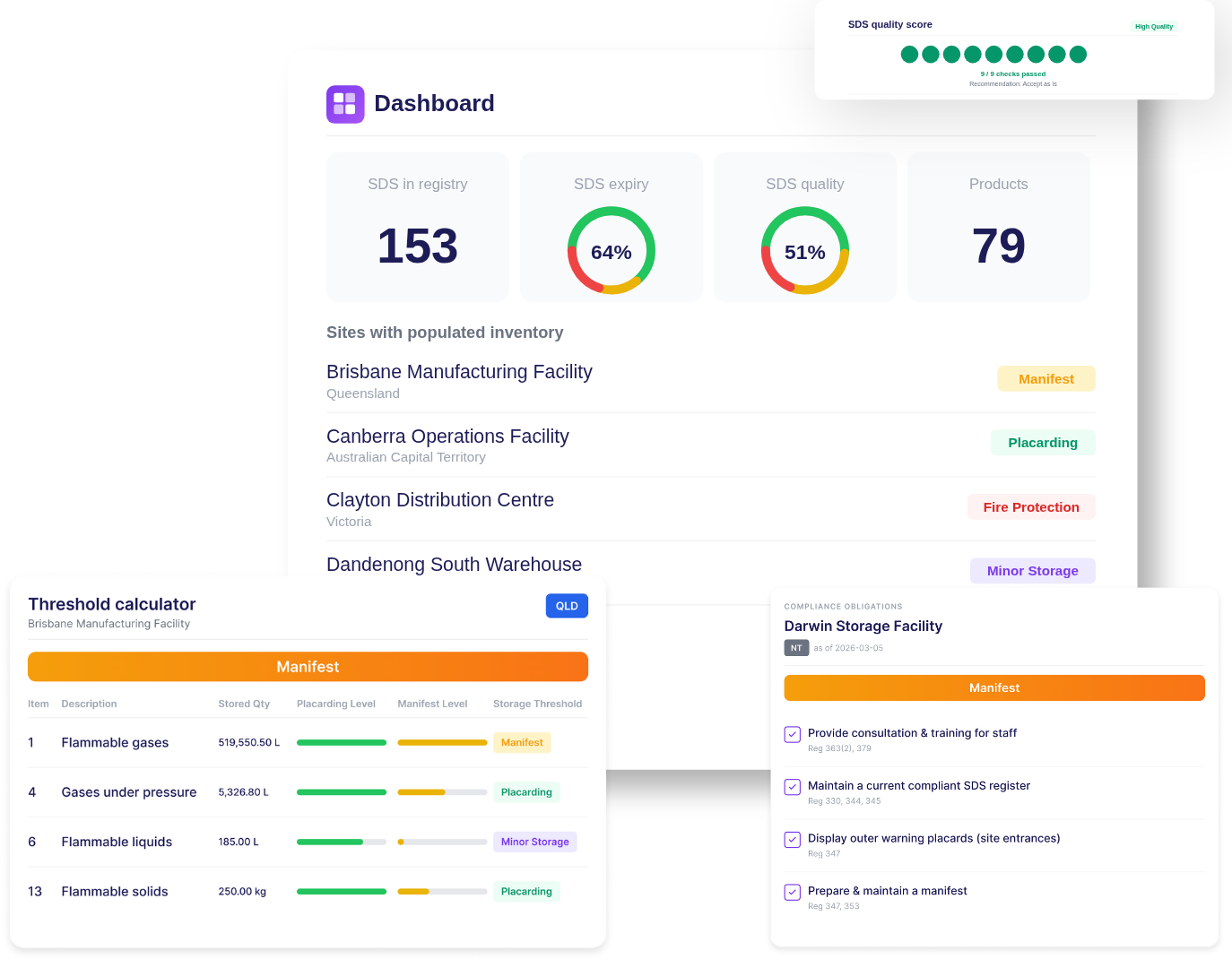
DGXprt automates the prescriptive floor of DG compliance so expert effort goes where it belongs — on the risk-based decisions that actually require judgement.
- 01
Identify
Upload your inventory and SDS. DGXprt extracts GHS and DG classifications automatically. Every SDS is assessed against WHS regulatory requirements.
- 02
Classify
State-based threshold calculations run automatically across all Australian jurisdictions — including placarding, manifest, and Victoria's fire protection quantity.
- 03
Understand
Threshold outcomes are translated into plain-English obligations linked to specific regulations — written for the people who need to act, not the people who wrote the legislation.
- 04
Act
Regulator-ready registers, manifests, and compliance documentation available on demand. Continuous monitoring so threshold breaches, SDS expiries, and inventory shifts surface before a regulator finds them.
- 200+
- Active sites under management
- 5,000+
- SDS managed and validated
- <8hrs
- Average onboarding time
- 8
- Australian jurisdictions supported
The next step
DGXprt 60-Day Managed Compliance Pilot
If this page has raised questions you do not have the time, capacity or specialist knowledge to answer alone, the DGXprt 60-day pilot gives you a practical way to get started without doing it all yourself.
We help you build the foundations of your dangerous goods and hazardous chemicals compliance in DGXprt, from inventory and SDSs through to thresholds, documentation and regulator obligations. At the end of the pilot, you'll have a clearer view of where you stand, what gaps exist, and what needs to happen next.
What's included
- DGXprt platform setup and single-site onboarding
- Inventory build and threshold assessment for your jurisdiction
- SDS library and hazardous chemical register setup
- Access to DG expertise during the pilot
- End-of-pilot compliance posture summary with recommendations
All states and territories. Single site only. No lock-in after the 60 days.