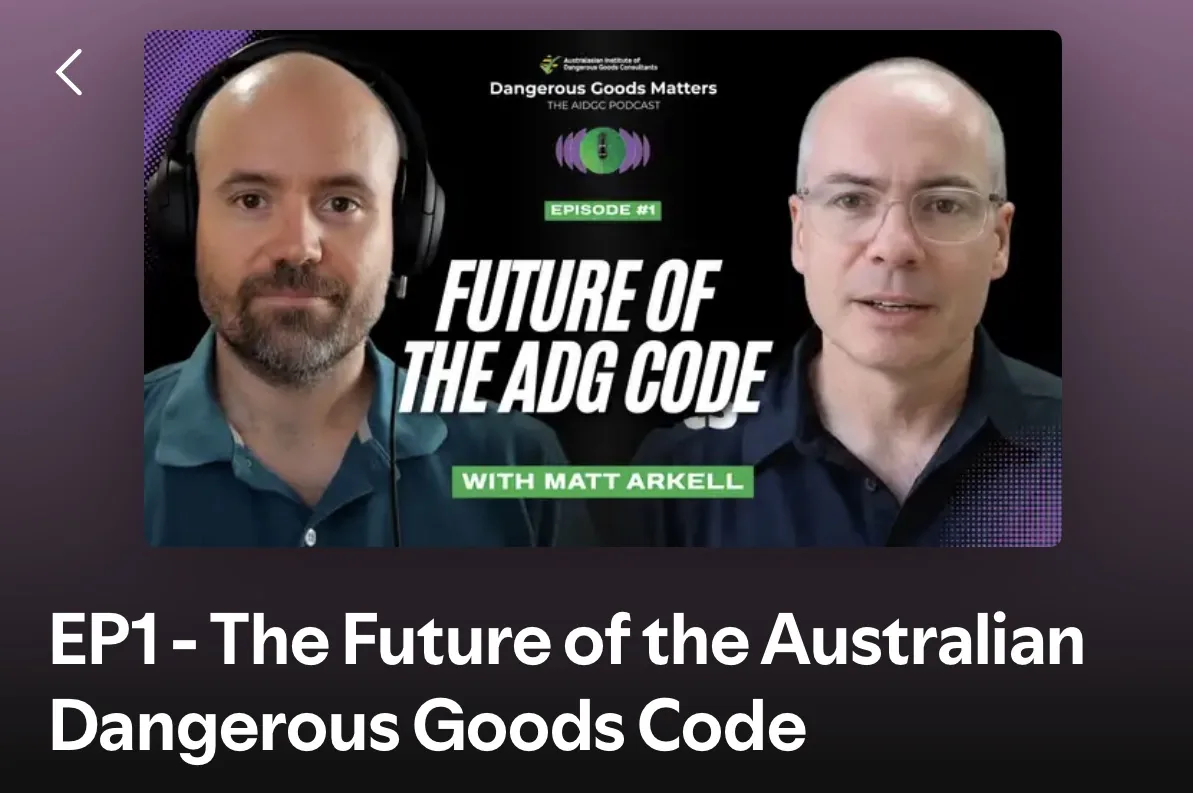
In Episode 1 of Dangerous Goods Matters, the AIDGC podcast, host David Irvine spoke with Matt Arkell, Principal Policy Advisor for dangerous goods transport at the National Transport Commission (NTC). The discussion covered the most significant rewrite of the Australian Dangerous Goods Code in over two decades. The ADG Code governs the transport of dangerous goods by road and rail across Australia, and for compliance professionals, logistics operators, consigners, and transport managers, now is the time to understand what is changing, why, and what to expect.
The blog below covers the key takeaways from that conversation, including what is changing, why it matters, and what people working in dangerous goods transport need to be aware of as the new code moves towards commencement.
Why the ADG Code is being rewritten
The current ADG Code, version 7, has been in use for nearly 20 years. While the UN model regulation-derived sections have been kept reasonably current through a two-yearly update cycle, a significant volume of Australian-specific content has not kept pace. That content, covering areas such as placarding, segregation, and certain carriage requirements, was increasingly difficult to maintain, creating gaps and inconsistencies that industry has felt for some time.
Alongside the maintenance challenge, Australia's trading environment has changed substantially. Chemical import volumes have roughly quadrupled over the past 20 years. Much of that freight arrives already marked and labelled in compliance with international codes, particularly the IMDG code. Where Australian-specific requirements diverge from international norms, significant costs are imposed on industry at the border.
The NTC's response was to revisit an idea that had been considered when ADG 7 was first written: aligning the ADG Code more closely to ADR, the international road dangerous goods code used across Europe and a growing number of countries globally. That decision has now been made and implemented, and the new ADG Code is going through the approval process.
What alignment to ADR actually means
Australia will not become a signatory to ADR. The decision was deliberate. ADR was written for European transport conditions, which differ from Australia's in some fundamental ways: European freight tends to move point to point, vehicles are smaller, and hub-and-spoke consolidation of the kind common in Australian logistics is far less prevalent. Signing up to ADR wholesale would have required a parallel set of Australian modifications that would have created more complexity, not less.
Instead, the NTC has used ADR as the technical foundation for the new code, incorporating the structural logic and maintenance discipline of ADR while retaining and refining the Australian-specific content that is genuinely necessary.
The practical benefit is significant. ADR is maintained by dozens of countries, each contributing incident data, policy analysis, and technical refinement across a two-yearly update cycle. Australia now gets to draw on that collective work without needing to replicate it independently, allowing policy work to focus on the areas where differences remain necessary.
What is actually changing
Structure and layout
The most immediately noticeable change will be the layout of the code. ADG 7 is around 1,300 pages and has long been criticised for requiring users to navigate back and forth across sections that do not follow a logical operational sequence.
The new code is restructured to follow the transport chain. Classification and identification of goods sits at the front. Packaging requirements follow. Then marking and labelling, transport documentation, loading and carriage requirements, and finally the obligations of the vehicle operator. A truck driver will primarily need Parts 7 and 8. A consigner will focus on the earlier parts of the code. The intent is that users can find what is relevant to their role without working through the entire document.
Special provisions for carriage
The new code introduces special provisions for carriage, a concept borrowed directly from ADR. These sit alongside existing special provisions in the dangerous goods list and are designed to direct transport operators to specific requirements or exemptions for particular materials. Where relevant, these will now need to be noted on the transport document, giving drivers and loaders a clearer signal about what additional considerations apply to the load.
Removal of Australian-specific requirements that caused trade friction
One of the more contentious changes involves emergency information panels on intermediate bulk containers. Australia is currently the only country in the world that requires these panels on IBCs. Containers arriving from overseas, fully labelled in compliance with the IMDG code, have had to be relabelled on arrival. That requirement is proposed for removal in the new code.
Explosives now included
The technical transport requirements for Class 1 dangerous goods, explosives, have been incorporated into the ADG Code. The Australian Explosives Code, which has not been updated since 2009, has been the reference point for this area. The interaction with state and territory explosives legislation, which typically covers storage and handling as well as transport under a single regulatory framework, will take additional time to work through. The NTC will facilitate that process with the relevant state and territory explosives regulators.
Training, and a new concept: dangerous goods safety advisors
Training obligations under the dangerous goods legislation have not changed fundamentally, but the new code introduces a recommendation, not yet a requirement, for the appointment of dangerous goods safety advisors. This concept exists in ADR countries as a formal qualification, where operators transporting significant quantities of dangerous goods are required to have access to a qualified advisor who has sat a formal examination.
In the new ADG Code, this is flagged as a recommendation only, reflecting that the supporting framework, including defined competency standards and a training and examination pathway, does not yet exist in Australia. The NTC has also been endorsed to develop a training matrix that will provide clearer guidance on what training is appropriate across different roles in the dangerous goods transport chain.
Timing and transition
The new ADG Code has been submitted to the Infrastructure and Transport Ministers Meeting, the approving body made up of infrastructure and transport ministers from all Australian jurisdictions. Approval requires agreement from each jurisdiction, after which enabling legislation will need to be updated and passed in each state and territory.
The current target for commencement is March 2027, though Matt Arkell acknowledged this remains subject to the approval process progressing as expected. An earlier target of October 2026 had to be revised.
One important point to understand: March 2027 is a target commencement date, not a hard deadline after which compliance is immediately required. The transition arrangements from the current code to the new code have not been finalised, and the NTC has indicated this will require careful planning given the extent of structural change involved.
Once approved, the final version will be made publicly available as soon as possible to give industry time to prepare. A web-based version of the code will also be introduced alongside the PDF, with hyperlinked cross-references to make navigation significantly easier.
What this means in practice
For most people working in dangerous goods transport day to day, the fundamentals are not changing. Goods still need to be correctly classified. Packaging requirements still apply. Placards and markings still need to be correct. Documentation still needs to be in order.
What will change is where you find the rules. If you have been using ADG 7 for years and know the code well by layout, expect a period of adjustment. The restructure is logical, but familiarity takes time.
The NTC is developing supporting documentation, including a plain-English guide to the code designed to help businesses understand how the framework operates and where to find the information they need. That kind of resource has been missing from the Australian dangerous goods landscape for some time.
Staying informed
The NTC publishes updates and accepts newsletter subscriptions at www.ntc.gov.au. Selecting dangerous goods as your area of interest will ensure you receive updates directly from the team working on the code.
This article is based on Episode 1 of Dangerous Goods Matters, the AIDGC podcast, featuring a full discussion with Matt Arkell, Principal Policy Advisor, dangerous goods transport, at the National Transport Commission.