If you store or handle dangerous goods or hazardous chemicals, you already know compliance can feel like a maze of acronyms, tables and technical language. For many small and medium-sized businesses, the biggest challenge isn't a lack of care, it's not knowing where to start. This blog will help you understand dangerous goods storage thresholds and how they apply to your business.
Where Most Businesses Go Wrong with Dangerous Goods
Across Australia, thousands of businesses are unknowingly breaching dangerous goods laws every day. It's not because they're careless. It's because dangerous goods compliance is complex, fragmented and often misunderstood.
People struggle with:
- Identifying what is classified as dangerous goods or a hazardous chemical.
- Knowing how much they can legally store.
- Understanding which rules apply to them.
- Keeping track of changing state-based requirements and when relevant industry standards need to be applied.
Without clear systems or the right guidance, most workplaces end up relying on guesswork, and when it comes to dangerous goods, guesswork is a risk no one can afford.
Why Storage Threshold Calculations Matter
At the heart of every dangerous goods compliance obligation sits one critical calculation: your storage thresholds. These define what level of compliance applies to your business, from fundamental safety measures through to regulator and emergency services notification.
What do dangerous goods storage thresholds determine?
Your storage thresholds determine the level of compliance required. The examples below are indicative only and do not represent a complete list of requirements. Each level involves a range of obligations that vary by state and the specific materials stored.
- Any quantity of dangerous goods or hazardous chemicals:
- Maintain a dangerous goods or hazardous chemicals register, keep current Safety Data Sheets accessible, and ensure workers are trained in safe handling and emergency response.
- At a placarding quantity:
- Display outer warning placards at site entrances and apply area or container placards where required.
- At a manifest quantity:
- Prepare and maintain a manifest and site plan, notify the regulator, and provide a copy of your emergency plan to emergency services.
If you don't know your thresholds, you can't possibly know your obligations. If you're storing above the legal limits without proper controls in place, you could be exposing your workers, your business and your community to serious harm, both physical and legal.
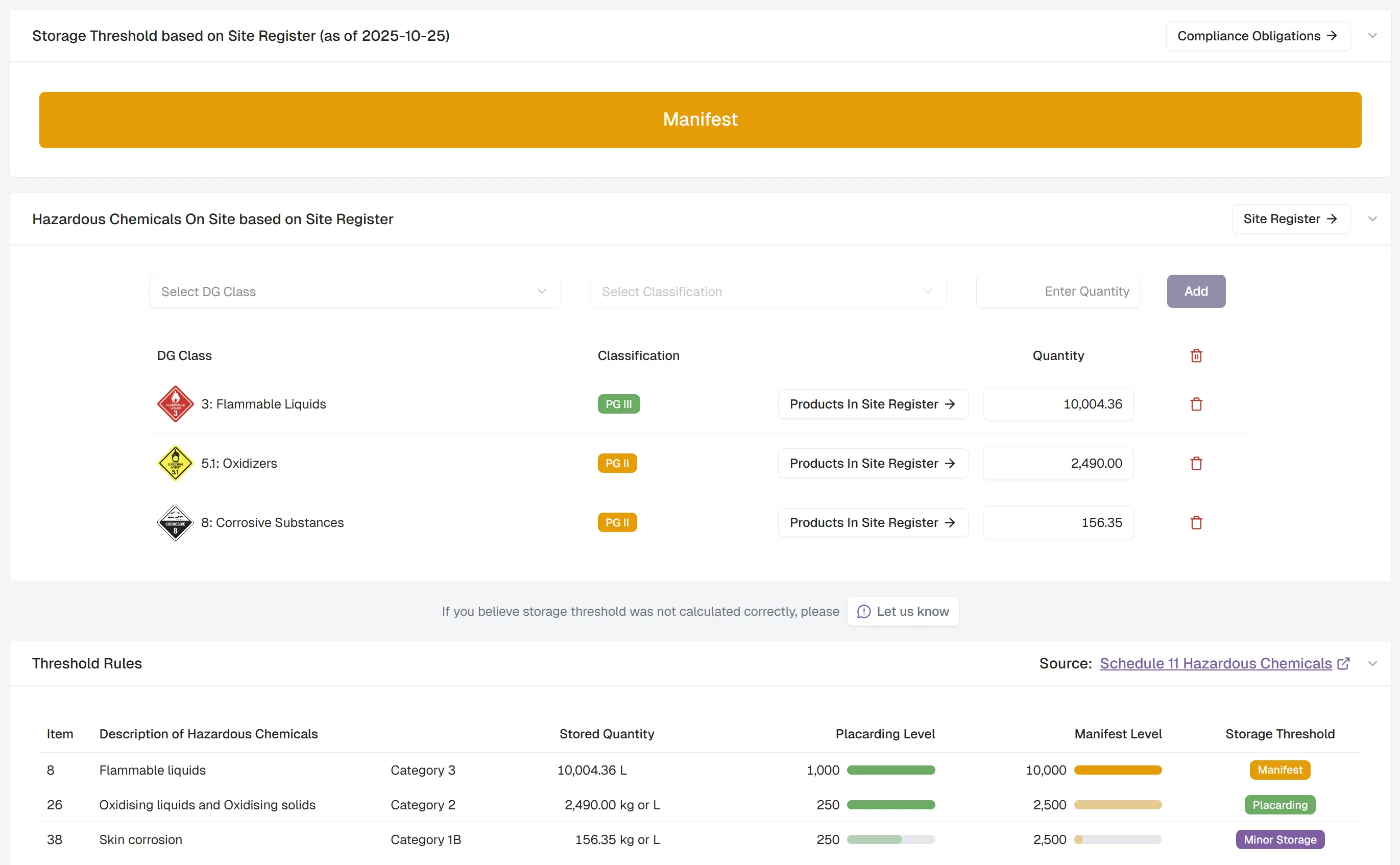
How to Calculate Your Dangerous Goods Thresholds
Calculating your thresholds starts with knowing what you have and how it's classified. Here's a simplified step-by-step approach:
1. Identify and list all dangerous goods and hazardous chemicals on site.
Include everything from paints, fuels and aerosols to cleaning agents, acids and gases. Capture all substances used, handled or stored, even in small quantities.
2. Check each item's Safety Data Sheet (SDS).
The SDS identifies whether a substance is a dangerous good or hazardous chemical and provides key classification data such as the UN number, dangerous goods class, packing group and hazard statements. This information determines how each substance must be managed.
3. Group your chemicals by classification and jurisdiction.
Based on your location, substances must be aggregated according to the relevant framework—either the nine classes of dangerous goods or the GHS classification system.
- Aggregate totals at the class or hazard category level.
- If you operate multiple sites across different states or territories, each site must be assessed separately under its own jurisdiction's regulations.
4. Convert all quantities into consistent units.
To ensure accuracy, express all quantities in litres or kilograms, depending on whether the substance is a liquid, solid or gas.
5. Refer to the applicable threshold schedule.
Each jurisdiction publishes storage thresholds in either the Work Health and Safety Regulations or the Dangerous Goods Regulations (usually set out in a schedule rather than a table). These define the minor storage, placarding and manifest quantities — and in Victoria, also fire protection quantities.
6. Account for special cases and mixed classes.
Each jurisdiction outlines specific rules for complex scenarios, such as when different classes are stored together or when the same substance appears in multiple packing groups.
7. Review and update regularly.
Inventory changes, new materials and revised SDSs can all affect your thresholds. Regular reviews ensure your compliance obligations remain accurate and current.
Doing this accurately across dozens, hundreds or even thousands of chemicals quickly becomes time-consuming and complex. Yet, it's the foundation of an effective dangerous goods compliance program.
One Country, Many Rules
Another area that often catches people out is jurisdiction. Australia doesn't have one single set of dangerous goods or hazardous chemical storage and handling laws. Each state and territory has its own regulations, codes of practice and enforcement approach.
For example, a warehouse in Victoria will face different storage threshold limits, notification requirements and compliance obligations compared to one in New South Wales or Western Australia.
That's why understanding which jurisdiction you operate in and applying the correct set of rules is fundamental to compliance. A business operating nationally, storing and handling dangerous goods across multiple jurisdictions, must comply with each state's regulations, which adds complexity to maintaining compliance and ensuring ongoing health and safety.
READ MORE: NSW WHS regulation 2025
Running Blind vs. Running Smart
Managing dangerous goods without knowing your thresholds or jurisdiction is like trying to drive in the dark without headlights – you're moving forward, but you can't see the risks ahead.
Compliance isn't about buying more spill kits or fire extinguishers. It starts with clarity: knowing what you have, how much of it and where it sits against the rules that apply to you.
Once those foundations are in place, everything else, from storage design to risk assessments and emergency planning, can be built with confidence and control. That's the difference between running blind and running smart.

How DGXprt Helps
DGXprt was created to remove the uncertainty from dangerous goods compliance. Built by qualified industry-backed dangerous goods experts and an experienced software team specialising in regulatory and compliance technology, it combines deep subject matter expertise with proven software capability.
At its core, DGXprt automatically interprets dangerous goods storage thresholds and state-based rules for your specific site and inventory. The platform turns complex legislation into clear, actionable insights.
Key features include:
- Automatic storage threshold calculations: Instantly calculate your site's storage thresholds based on state-based regulations.
- Jurisdictional intelligence: DGXprt recognises your state or territory and applies the correct regulatory framework automatically.
- SDS integration: Easily upload your Safety Data Sheets. The system extracts key data and applies it directly to your compliance calculations.
- Inventory risk overview: Visual dashboards show where you're compliant, borderline or exceeding limits.
- Collaboration and user management: WHS managers and site operational managers can securely access and update data in one shared environment, maintaining clear visibility of dangerous goods compliance.
DGXprt simplifies the entire process, so instead of manually cross-checking SDSs, spreadsheets and state legislation, you can clearly see what's compliant, what's not, and what needs attention.
It's compliance made practical, proactive and precise.
No spreadsheets. No guesswork. No running blind.
Read More:
- The Hidden Hazards of Cosmetics Stored at Scale
- End-to-End SDS Management
- DGXprt vs Spreadsheets
- NSW WHS regulation 2025
Frequently Asked Questions
Frequently asked questions
Common questions about dangerous goods compliance software.