An SDS Library Is Not a Dangerous Goods Compliance System
Imagine a new chemical arrives at your site tomorrow.
Someone uploads its Safety Data Sheet, or SDS. The document is stored and available to your team.
But what happens next?
- Does your software check how much of the product is being stored?
- Does it combine that quantity with other dangerous goods already on site?
- Does it tell you whether the change has triggered placarding, manifest or notification requirements?
- Does it apply the correct rules for the Australian state where the site operates?
Many systems can store an SDS. Far fewer can use the information inside it, together with your site inventory, to tell you what your business needs to do. That distinction matters because there are three broad types of software used to manage dangerous goods and hazardous chemicals:
Chemical Management Systems
Broad EHS platforms
Purpose-built dangerous goods compliance platforms
Each category has a different primary purpose. Understanding that difference is the best place to start before comparing features, prices or vendors.
What this article covers
This article explains:
- The three main types of dangerous goods and hazardous chemicals software
- What each category is designed to do
- Where each category is strongest
- Why SDS management alone does not automate dangerous goods compliance
- How different platforms can work together
- What Australian businesses should ask before choosing software
What is dangerous goods compliance software for storage & handling?
Dangerous goods compliance software helps organisations manage the products, quantities, obligations and documentation associated with dangerous goods and hazardous chemicals. Depending on the platform, it may help an organisation:
- Store and manage SDSs
- Maintain a chemical or dangerous goods inventory
- Check whether SDSs are current and complete
- Calculate dangerous goods storage thresholds
- Identify placarding and manifest requirements
- Apply different rules across Australian states
- Generate registers and manifests
- Assess segregation and compatibility
- Monitor Major Hazard Facility thresholds
- Support risk assessments and compliance actions
Not every platform provides all of these capabilities. Some systems focus on detailed chemical information. Others manage broad workplace safety processes. Purpose-built dangerous goods platforms focus on applying dangerous goods rules to the products and quantities held at a particular site.
Why is an SDS library not enough?
An SDS is an essential source of information. It can tell you:
- What the product is
- What hazards it presents
- How it is classified
- How it should be handled and stored
- What personal protective equipment may be required
- What to do in an emergency
But an SDS does not tell you how much of the product is stored at your site. It also does not tell you whether your total inventory has triggered additional legal requirements. To answer that, the SDS information must be connected to:
- The products held at the site
- The quantities stored
- Their dangerous goods classifications
- Other dangerous goods that must be assessed with them
- The regulatory requirements for that state or territory
An SDS library tells you about the chemical. A dangerous goods compliance system should also help tell you what storing that chemical means for your site.
The three types of software to manage dangerous goods and hazardous chemicals
Chemical Management Systems
A Chemical Management System, often called a CMS, is primarily designed to help organisations understand and manage chemical information. These systems may provide: large SDS libraries; chemical properties; hazard classifications; toxicology information; exposure information; international regulatory content; chemical risk assessment tools; and product and substance approval workflows.
Their main strength is the depth of information they hold about chemicals.
Who is a Chemical Management System best for?
A CMS may be a strong choice for organisations involved in:
- Chemical procurement
- Research and formulation
- Product stewardship
- Restricted substance management
- Supply chain compliance
- Product safety
- International chemical regulation
These organisations may need detailed information about a chemical, its composition, properties and potential impacts.
What may still need to be done manually?
A CMS may not automatically apply the prescriptive dangerous goods requirements for each Australian site. For example, it may not automatically:
- Calculate whether site quantities have triggered placarding
- Determine whether a manifest is required
- Apply different threshold rules in different states
- Generate a regulator-ready manifest
- Assess proximity to Major Hazard Facility thresholds
- Explain site obligations in plain English
The system may contain the necessary chemical data, but someone may still need to interpret the regulations and apply them to the site. That does not make a CMS the wrong system. It means its primary purpose is chemical intelligence rather than site-level dangerous goods obligation management.
Broad EHS platforms
A broad Environment, Health and Safety platform manages many workplace safety and environmental processes in one system. It may include modules for: incidents and investigations; audits and inspections; risk assessments; corrective actions; training and competency; permits; environmental reporting; management of change; contractor safety; and chemical registers.
Their main strength is consolidation. A large organisation may use one EHS platform to manage consistent workflows, reporting and governance across multiple safety and environmental programs.
Who is a broad EHS platform best for?
An EHS platform may be suitable for organisations that want to manage areas such as:
- Workplace incidents
- Safety inspections
- Corporate risk registers
- Corrective actions
- Training compliance
- Environmental performance
- EHS reporting
A chemical or dangerous goods process can sit within that broader system.
What may still need expert input?
Broad EHS platforms generally provide workflows and structures for recording and managing information. However, the quality of the result still depends on the knowledge of the people using or configuring the system. For example, a chemical register may record products and quantities, but the platform may not automatically:
- Apply Australian dangerous goods threshold rules
- Combine quantities correctly where aggregation is required
- Determine which obligations have been triggered
- Generate a compliant manifest
- Apply jurisdiction-specific dangerous goods requirements
The platform can support the process, but someone may still need to interpret the rules. Again, this is not a weakness where the organisation's main goal is broad EHS management. It is simply a different purpose.
Purpose-built dangerous goods compliance platforms
A purpose-built dangerous goods platform is designed specifically to help organisations understand and manage dangerous goods obligations. It connects information from SDSs with the products and quantities stored at each site. For Australian organisations, a purpose-built platform may then apply the relevant state rules to:
- Calculate storage thresholds
- Identify placarding requirements
- Identify manifest requirements
- Determine notification obligations
- Generate registers and manifests
- Assess segregation and compatibility
- Monitor Major Hazard Facility thresholds
- Explain obligations in plain English
What is this chemical?
What does storing this product, in this quantity, at this site require us to do?
Who is a purpose-built DG platform best for?
A purpose-built platform may suit:
- Organisations without a dangerous goods expert at every site
- Operations managers who need a clear view of site obligations
- Safety teams managing multiple sites
- Businesses operating across different Australian states
- DG professionals who want reliable data for risk-based decisions
- Organisations still relying on spreadsheets and manual calculations
Its main strength is the compliance logic built into the software.
The user should not need to build every threshold calculation or interpret every regulatory schedule from scratch.
A simple comparison of the three software categories
| Software category | Primary focus | Main question it answers |
|---|---|---|
| Chemical Management System | Chemical data and properties | What is this chemical and what hazards does it present? |
| Broad EHS platform | Safety processes, workflows and reporting | How do we manage our wider EHS activities? |
| Purpose-built DG compliance platform | Site-level dangerous goods obligations | What do our products and quantities require us to do at this site? |
All three questions matter. The mistake is buying a system designed to answer one question and assuming it will automatically answer all three.
Can the three types of software work together?
Yes.
For many organisations, the answer is not necessarily choosing one system and removing the others. The platforms can perform different roles.
Chemical Management System
May provide detailed chemical and SDS information.
Broad EHS platform
May manage incidents, audits, risk registers, training and corrective actions.
Purpose-built DG platform
May calculate thresholds, identify obligations and generate compliance documentation.
Where systems can exchange information, each platform can perform the work it was designed to do. The goal is to avoid gaps between:
- Chemical information
- Site inventory
- Safety processes
- Dangerous goods obligations
What should dangerous goods compliance software do?
Before selecting a platform, ask what happens after an SDS and product are added. A dangerous goods compliance platform should help answer the following questions.
Does it validate the SDS or only store it?
A stored SDS may still be outdated, incomplete or unsuitable for Australian requirements. The system should help identify problems with the source data before that information is used elsewhere.
Does it connect the SDS to a live site inventory?
Compliance depends on what is actually held at each site. The platform should connect product information to site quantities and storage locations.
Does it calculate thresholds automatically?
The system should continually assess whether the quantities stored have triggered additional requirements. The user should not have to rebuild calculations in a spreadsheet each time the inventory changes.
Does it apply the correct rules for each state?
Dangerous goods and hazardous chemical requirements vary across Australia. The software should recognise the jurisdiction in which each site operates and apply the relevant rules.
Does it explain what the result means?
A calculation alone is not enough. The platform should translate the outcome into clear actions, such as whether placards, a manifest, regulator notification or other controls are required.
The complete DGXprt Buyer's Guide expands this into 14 capabilities buyers should assess when comparing dangerous goods compliance software.
Does dangerous goods software replace expert judgement?
No. Some parts of dangerous goods compliance are specific and can be automated. For example:
- Threshold calculations
- Prescribed placarding triggers
- Manifest requirements
- Required register content
- Notification quantities
Other decisions depend on the context of the site. These may include:
- Risk controls
- Storage arrangements
- Emergency planning
- Exposure risks
- Operational activities
- Site layout
- Suitability of existing controls
Software should automate the rules that can be reliably calculated. It should guide and document the areas that still require human judgement. This allows dangerous goods professionals and safety teams to spend more time on the decisions where their knowledge adds the most value.
How DGXprt approaches dangerous goods compliance
DGXprt is a purpose-built dangerous goods and hazardous chemicals compliance platform for Australian organisations.
It connects:
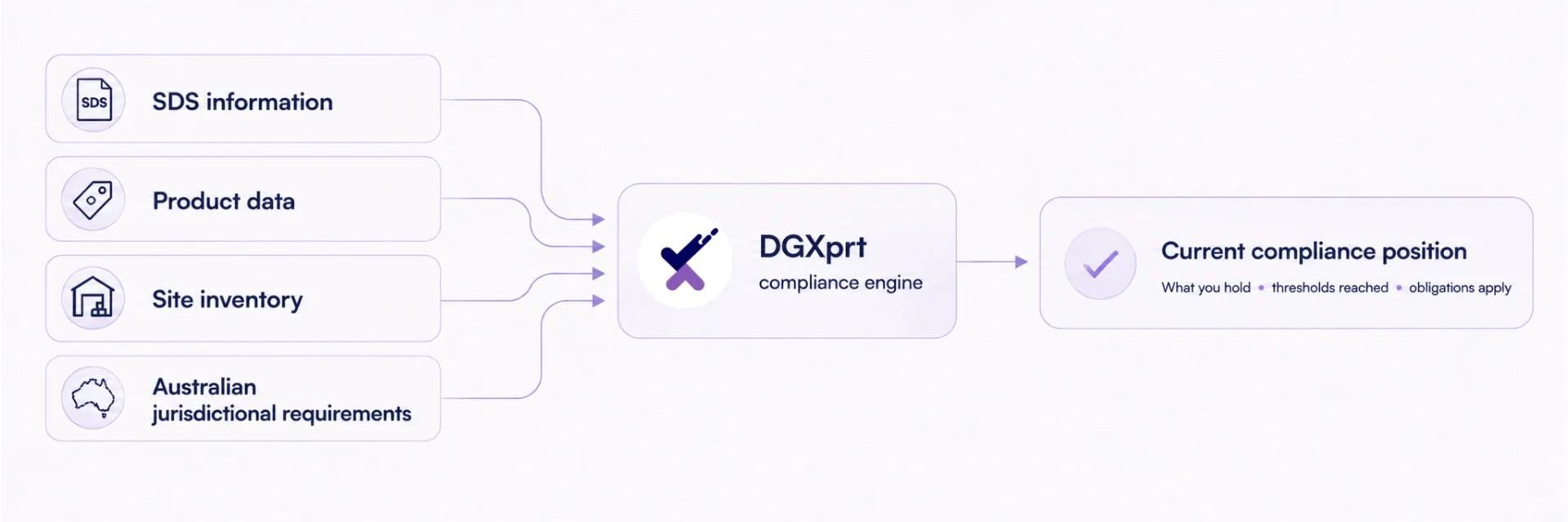
This allows organisations to understand what they hold, which thresholds they have reached and what obligations apply. DGXprt is designed to automate the parts of dangerous goods compliance that can be reliably determined, while making it clear where verification, site context or professional judgement is still required. The result is a compliance system that remains connected to the current site inventory, rather than a spreadsheet or document that becomes outdated as soon as something changes.
Choose the category before comparing features
The first question in a software evaluation should not be:
Which platform has the longest feature list?
It should be:
What problem was this platform built to solve?
Chemical Management System
May be the right choice where deep chemical intelligence is the priority.
Broad EHS platform
May be the right choice where the organisation needs to consolidate many workplace safety processes.
Purpose-built DG platform
May be needed where the organisation must understand what its dangerous goods inventory means for each site.
All three may store SDSs.
What matters is what happens next.
Download the Dangerous Goods Compliance Software Buyer's Guide
The DGXprt Buyer's Guide provides a practical framework for choosing dangerous goods compliance software.
It includes:
- A detailed comparison of the three software categories
- The difference between prescriptive and risk-based compliance
- A dangerous goods compliance maturity model
- 14 software capabilities to assess
- Questions to ask vendors
- Guidance for building the internal business case
- A decision framework for choosing the right approach
Download the practical guide to choosing dangerous goods compliance software.
Download the Buyer's Guide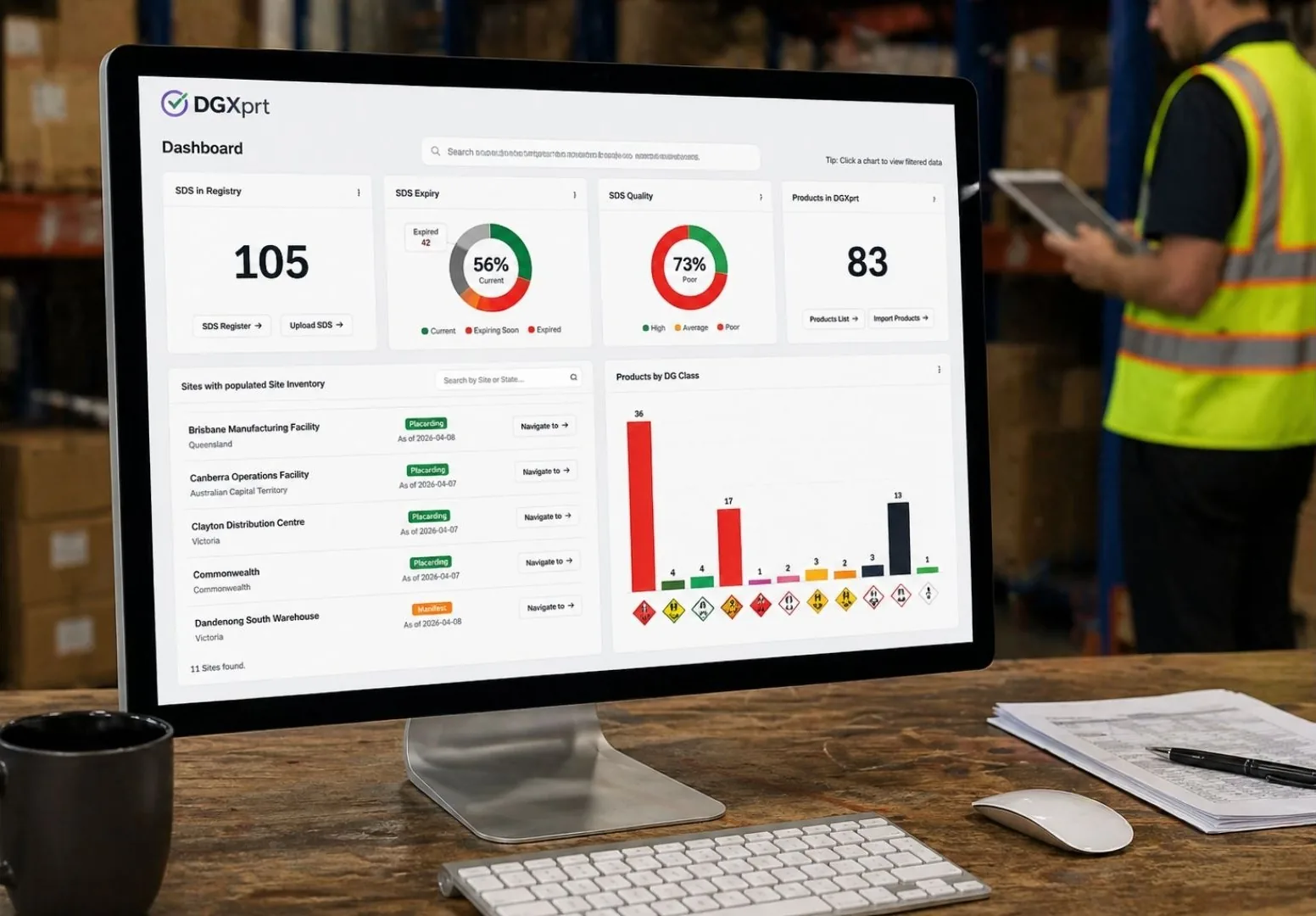
Frequently asked questions
Common questions about dangerous goods compliance software.