Are Your Safety Data Sheets Actually Compliant?
What SDS validation means for Australian businesses — and why getting it wrong affects your entire compliance program
Most businesses assume their Safety Data Sheets are fine. They came from the supplier. They're on file. That's enough.
It isn't.
In our experience validating SDSs across Australian workplaces, over 40% are found non-compliant on initial assessment. Not because businesses are negligent — but because SDS compliance is more specific than most people realise, and the requirements have changed significantly in recent years.
What SDS compliance actually requires in Australia
An SDS isn't compliant just because it exists. Under the WHS Regulations and the Safe Work Australia Code of Practice for Preparation of Safety Data Sheets, every SDS must meet specific requirements:
Currency — Reviewed and updated at least every five years. The review date must be stated in Section 16 of the SDS. An SDS prepared in 2018 and never updated is non-compliant regardless of what it contains.
GHS 7 alignment — From 1 January 2023, all SDSs in Australian workplaces must comply with GHS 7. If your SDS was prepared under GHS 3 or an earlier version and hasn't been updated, it is non-compliant. This catches a significant number of businesses who received supplier SDSs before 2023 and assumed they were still valid.
English language — All SDSs used in Australian workplaces must be written in English. An SDS provided only in another language does not meet the requirement, regardless of how accurate or complete it is.
Australian-specific requirements — An overseas SDS is not automatically compliant. It must be reviewed to meet Australian classification criteria, contain Australian contact details (name, address, and business telephone number of the manufacturer or importer), and include an Australian emergency telephone number that is available outside business hours — not a generic international hotline. The Code of Practice is explicit on this: the emergency number must be Australian and reachable after hours. The SDS must also use Australian legal units of measurement.
All 16 sections present and complete — The SDS must contain all 16 sections prescribed under Schedule 7 of the WHS Regulations. Missing or incomplete sections make the SDS non-compliant regardless of the information that is there.
Accurate classification — The hazard classification must correctly reflect the substance's properties under the GHS. Vague language ("may be dangerous," "safe under most conditions of use") is explicitly non-compliant under the Code of Practice.
Why non-compliant SDSs create downstream risk
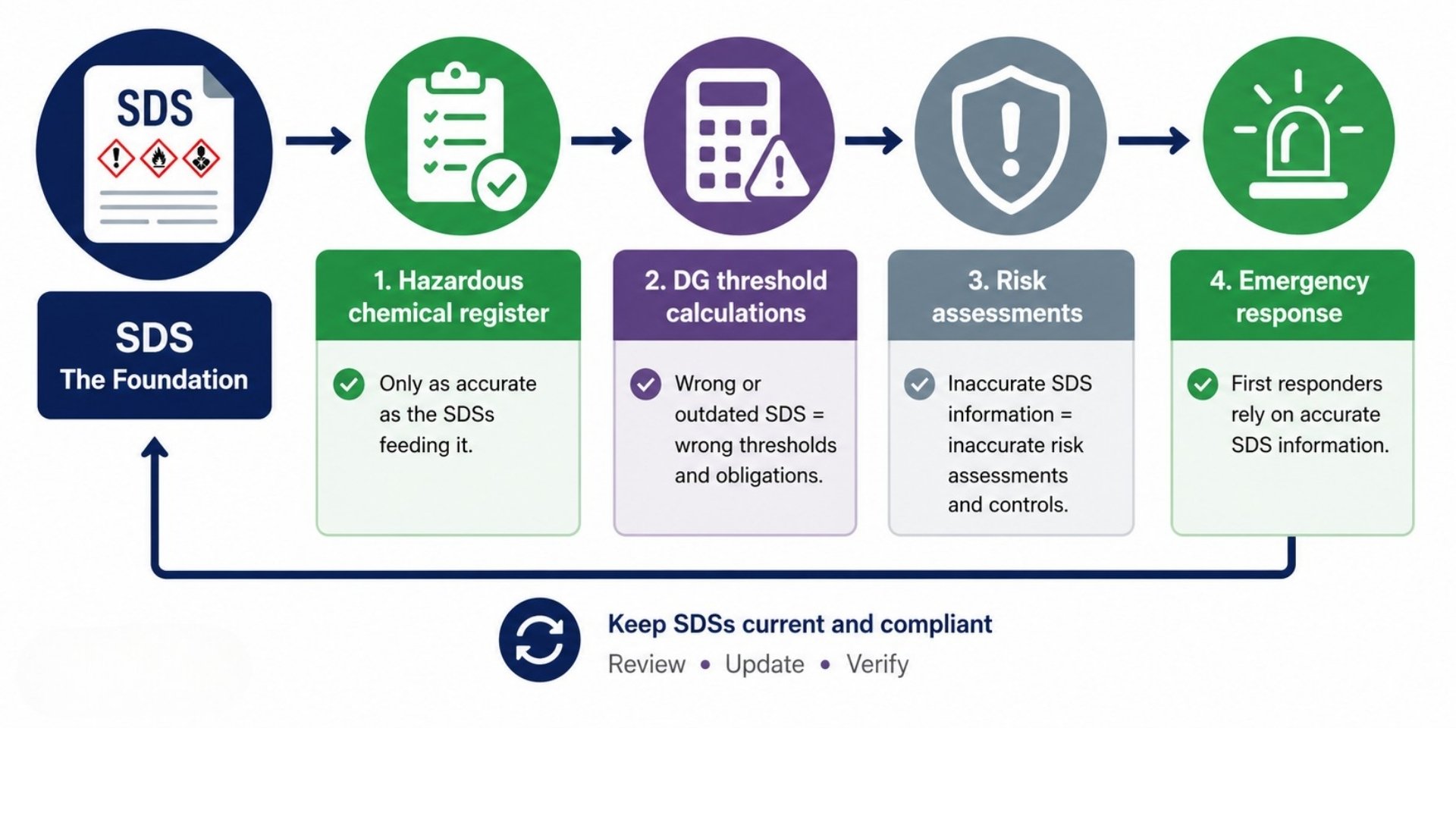
An SDS isn't just a document you keep on file. It's the foundation of your entire hazardous chemicals compliance program. If your SDSs are non-compliant, everything built on them is compromised:
Hazardous chemical register — Your register is only as accurate as the SDSs feeding it. Non-compliant or outdated SDSs mean incorrect classifications, wrong hazard information, and a register that won't stand up to a regulator visit.
Dangerous goods threshold calculations — DG classifications flow from GHS hazard classifications. If an SDS carries the wrong classification — or an outdated one — your threshold calculations may be wrong, and you may not know you've triggered placarding, manifest, or notification obligations.
Risk assessments — Risk assessments built on inaccurate SDS information are themselves inaccurate. Controls selected on the basis of wrong hazard data may not address the actual risk.
Emergency response — Emergency services rely on accurate SDS information. An outdated or incorrect SDS in a fire or chemical incident can directly affect how first responders approach the scene.
This is why SDS validation — not just SDS storage — is one of the 14 capabilities we consider essential in any dangerous goods compliance platform.
The four most common SDS compliance failures we see
1. Outdated SDSs not updated for GHS 7
Suppliers updated their SDSs to reflect GHS 7 but didn't automatically push updates to customers. Many businesses are still holding pre-2023 SDSs that are now non-compliant.
2. Overseas SDSs used without Australian review
A product imported from a US or European supplier comes with an SDS that meets US OSHA HazCom or EU CLP requirements — not Australian WHS Regulations. Without Australian-specific review, that SDS is non-compliant regardless of how comprehensive it appears. Missing an Australian emergency number is one of the most frequently missed requirements.
3. SDSs past their five-year review date
The five-year review requirement is one of the most commonly missed. An SDS prepared in 2019 and still in use today without review is non-compliant. The obligation applies to the workplace holding the SDS, not just the manufacturer.
4. Non-English SDSs
SDSs provided in a language other than English are non-compliant for Australian workplaces. This is a straightforward requirement but is regularly missed, particularly in businesses that import directly from non-English-speaking countries.
The manual reality
If you're thinking "we'll just check each SDS ourselves" — consider what that actually involves. A business with 50 products has 50 SDSs to audit, each requiring manual checks across six compliance dimensions. Add new products, supplier SDS updates, and the five-year rolling review cycle, and the ongoing maintenance burden becomes significant.
Most businesses with 100+ SDSs find it impossible to maintain compliance manually. An SDS that passes review today may be non-compliant in six months when a supplier quietly updates their formulation. There is no notification system. You won't know unless you check — and checking manually at scale doesn't happen in practice.
This is why SDS validation is a system problem, not a process problem. The question isn't whether your team understands what to look for. It's whether any team, doing this manually, can stay on top of it across a live inventory that changes continuously.
What to do about it
Audit your current SDS library
For each SDS, check: the review date in Section 16, whether it references GHS 7, whether it is written in English, whether it contains Australian contact details and an Australian after-hours emergency telephone number, and whether all 16 sections are present.
Chase non-compliant SDSs from suppliers
You have the right to request a compliant, current SDS from your supplier. Document your request and their response. If a supplier cannot or will not provide a compliant SDS, that is itself a compliance and risk issue.
If you're the first importer, consider SDS re-authoring
If your business imports a product and no compliant Australian SDS exists from the manufacturer, the obligation to prepare one falls on you as the importer. This is more common than businesses realise — particularly for products sourced from Asia or smaller international suppliers who don't have Australian-market SDSs.
Rather than attempting to prepare one in-house, importers can engage a specialist to re-author the SDS to Australian WHS requirements. DGXprt offers SDS re-authoring as part of our SDSVerify service — we source, verify, and where necessary re-author SDSs so your library is compliant from the ground up.
Implement a system that validates SDSs at the point of ingestion
Manual auditing of an SDS library doesn't scale and doesn't catch issues as new SDSs arrive. A purpose-built dangerous goods compliance platform should validate every SDS against WHS requirements automatically — flagging non-compliant documents before they compromise your downstream compliance.
How DGXprt handles SDS validation
DGXprt validates every SDS against Australian WHS compliance requirements at the point of ingestion — not just stores it. Each SDS is scored for compliance: currency, GHS 7 alignment, English language, Australian-specific requirements, section completeness. Non-compliant SDSs are flagged immediately, before they can feed incorrect data into your threshold calculations, register, or risk assessments.
For businesses that need to source, verify, or re-author SDSs, our SDSVerify service handles the process end-to-end — including re-authoring to Australian WHS requirements for first importers who don't have compliant SDSs from their suppliers.
Storing documents isn't compliance. Validating them is.
→ Book a 60-day pilot — see your SDS compliance position in under 8 hours
Start your pilotFrequently asked questions
Common questions about dangerous goods compliance software.