What is a chemical risk assessment?
A chemical risk assessment identifies how hazardous chemicals at a workplace could cause harm, how likely and serious that harm is, and what controls are needed. A product risk assessment applies this to one specific product at one specific site, across fire, exposure, spills and storage.
Is a chemical risk assessment required in Australia?
Not always, but a risk-based approach is. The WHS Regulations don't make a risk assessment mandatory for hazardous chemicals. Part 3.1 (regulations 32 to 38) does require you to identify hazards, eliminate or minimise risks so far as is reasonably practicable using the hierarchy of controls, maintain those controls and review them. The Code of Practice notes that a risk assessment is, "in many circumstances… the best way" to do this.
Whatever method you use, it must be holistic. Part 7.1 of the Regulations covers reactions, fire, stability, spills, damage and emergencies, not just exposure.
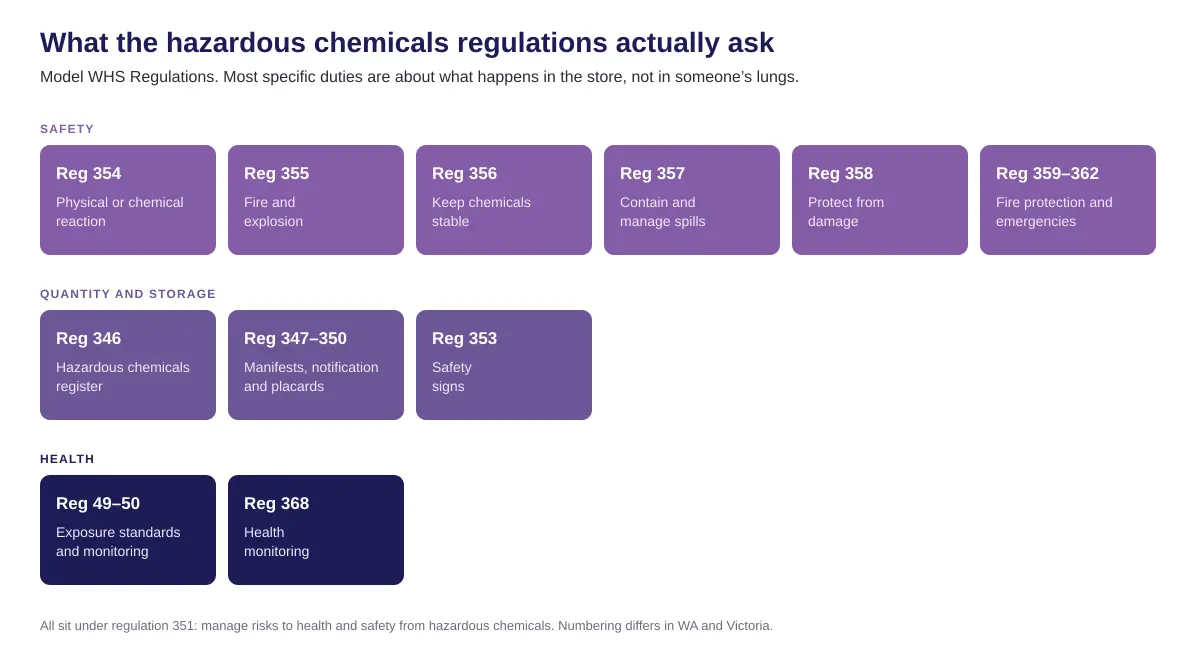
What does the Code of Practice expect?
- Start with the label and SDS. A basic assessment reviews them and assesses the risks of using the product.
- Scale effort to risk. Generic assessments suit genuinely identical work, but not very high-risk chemicals such as carcinogens. Significant health risk or uncertain exposure needs a detailed assessment.
- Consult the people doing the work. "Observe and consult with workers to find out how the job is actually done."
- Consider the whole picture. Who could be exposed, how the product is used and stored, what it could react with, and whether existing controls work.
What should a chemical risk assessment cover?
A complete chemical risk assessment covers four areas, underpinned by emergency readiness.
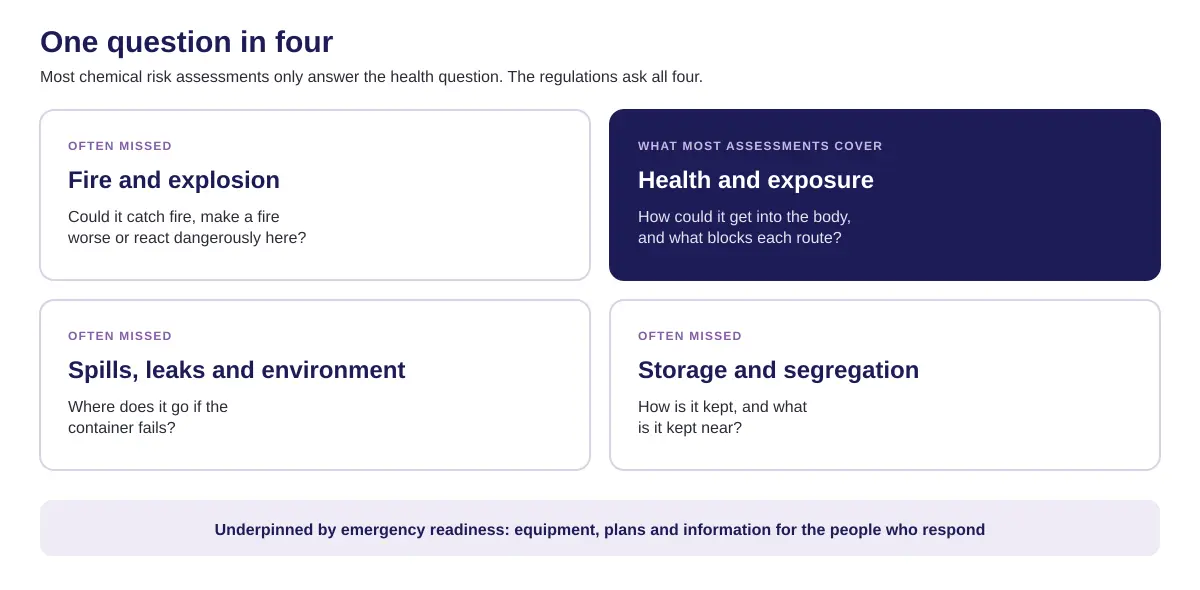
| Area | Ask | SDS sections | Key regulations |
|---|---|---|---|
| Fire and explosion | Could it catch fire, make a fire worse or react here? Flash point, vapour build-up, ignition sources, static, hazardous areas. | 5, 9, 10 | 354, 355, 359 |
| Health and exposure | How could it enter the body, and what blocks each route? Inhalation, skin and eyes, ingestion, long-term effects, exposure limits, health monitoring. | 2, 4, 8, 11 | 49, 50, 368 |
| Spills and environment | Where does it go if the container fails? Bunding, drains, stormwater, vapour release, clean-up safety. | 6, 12, 13 | 357 |
| Storage and segregation | How is it kept, and what is it kept near? Incompatible neighbours, stability, damage, quantities against placard and manifest thresholds, security, signs. | 7, 10, 14 | 346 to 350, 353, 356, 358 |
Fire and explosion
Could it catch fire, make a fire worse or react here? Flash point, vapour build-up, ignition sources, static, hazardous areas.
- SDS sections
- 5, 9, 10
- Key regulations
- 354, 355, 359
Health and exposure
How could it enter the body, and what blocks each route? Inhalation, skin and eyes, ingestion, long-term effects, exposure limits, health monitoring.
- SDS sections
- 2, 4, 8, 11
- Key regulations
- 49, 50, 368
Spills and environment
Where does it go if the container fails? Bunding, drains, stormwater, vapour release, clean-up safety.
- SDS sections
- 6, 12, 13
- Key regulations
- 357
Storage and segregation
How is it kept, and what is it kept near? Incompatible neighbours, stability, damage, quantities against placard and manifest thresholds, security, signs.
- SDS sections
- 7, 10, 14
- Key regulations
- 346 to 350, 353, 356, 358
Emergency readiness means the right equipment, plans and information are in place for the people who respond (regulations 359 to 362).
How do you do a chemical risk assessment, step by step?
- 1
List the products and get current SDSs. Start from your hazardous chemicals register, and check every Safety Data Sheet is the current version from the supplier.
- 2
Identify every hazard, health and physical. Use the GHS classification in Section 2 of the SDS, plus the physical properties, stability and reactivity in Sections 9 and 10, and the dangerous goods class where one applies.
- 3
Assess the risk where the product is stored and used. Consider who could be exposed, how it is used, how much is held, what it is stored near, and how likely and serious harm could be. Observe the work and consult the workers and health and safety representatives involved.
- 4
Control the risk using the hierarchy of controls. Work from the top down, and combine controls where one alone isn’t enough.
- 5
Record, communicate and train. Document the assessment, share it with the people who work with the product, and make sure training, signage and emergency information match it.
- 6
Review it. Review when controls aren’t working, before a change at the workplace, when new information comes up (such as an updated SDS or a changed exposure limit), or when workers or a health and safety representative ask for it.
How do you apply the hierarchy of controls to hazardous chemicals?
The WHS Regulations require controls to be chosen in order of effectiveness. For hazardous chemicals:
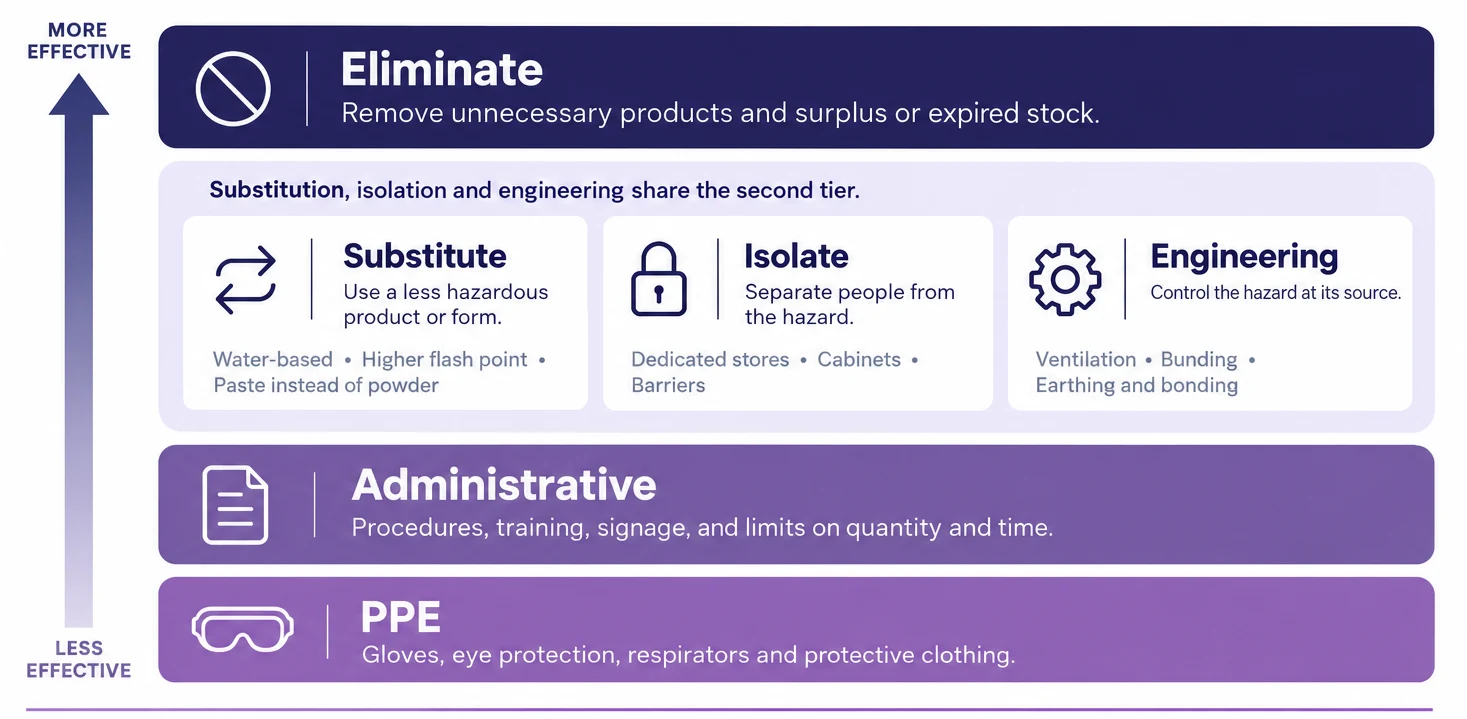
- Eliminate. Do you need the product at all? Remove surplus, expired or unused stock.
- Substitute. Use a less hazardous product or form, such as a water-based product, one with a higher flash point, or a paste instead of a powder.
- Isolate. Separate the product from people and from incompatible products, using dedicated stores, cabinets, segregation distances or barriers.
- Engineering controls. Ventilation and extraction, bunding and spill containment, earthing and bonding to prevent static, and equipment rated for hazardous areas.
- Administrative controls. Safe work procedures, training, signage, and limits on quantities and time.
- Personal protective equipment. The last line of defence, used when higher-order controls can't eliminate or adequately minimise the risk.
Substitution, isolation and engineering controls sit together in the second tier, and most sites combine controls. The test: an assessment that starts and ends with gloves and goggles hasn't applied the hierarchy.
Which SDS sections should a chemical risk assessment use?
More than Section 8. Section 8 covers exposure controls, but the safety information sits across the SDS: firefighting (5), accidental release (6), handling and storage (7), physical and chemical properties (9), stability and reactivity (10), ecological information (12) and transport (14).
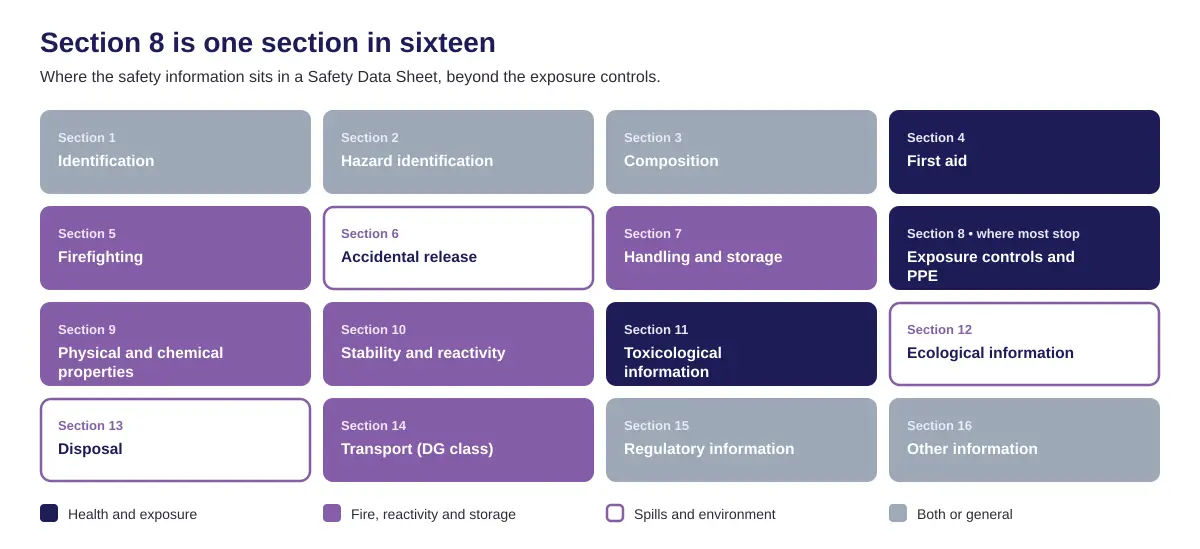
SDSs are a starting point. Always confirm the information against how the product is actually stored and handled on your site.
What should a chemical risk assessment template include?
- Product name, SDS version and date, GHS classification and dangerous goods class
- Site and storage location, quantity held, and the task or activity assessed
- Who could be exposed: workers, contractors, visitors and the public
- Hazards across all four areas, with existing controls and whether they work
- Risk rating before and after controls, using likelihood and consequence
- Additional controls chosen using the hierarchy, with owners and due dates
- Who was consulted, sign-off, and the next review date
Is your chemical risk assessment complete?
8 of 8: complete. 5 to 7: close, with gaps. 0 to 4: mostly an exposure assessment, answering one question in four.
0 of 8
Mostly an exposure assessment. It's answering one question in four.
See how DGXprt Product Risk Assessments work through all four areasDo the rules differ in Western Australia and Victoria?
The legislation and regulation numbers differ, but every jurisdiction expects hazards to be identified and risks controlled across health, fire, spills and storage. The four areas apply everywhere.
| Jurisdiction | Hazardous chemicals | Dangerous goods storage |
|---|---|---|
| NSW, Qld, SA, Tas, ACT, NT, Commonwealth | WHS Act and Regulations: Part 3.1 risk management and Part 7.1 hazardous chemicals. | In the same WHS Regulations: manifests, placards, notification and emergency plans. |
| Western Australia | Work Health and Safety Act 2020 and WHS (General) Regulations 2022, closely aligned with the model laws. | Dangerous Goods Safety Act 2004 and the Dangerous Goods Safety (Storage and Handling of Non-explosives) Regulations 2007. Sites above manifest quantities need a dangerous goods site licence, manifest, site plan and emergency plan, and WorkSafe WA expects a hazard identification and risk assessment for each dangerous good and installation, reviewed at least every five years. |
| Victoria | Occupational Health and Safety Act 2004 and OHS Regulations 2017 (hazardous substances): register, SDSs, hierarchy of control, exposure standards and health monitoring. | Dangerous Goods Act 1985 and Dangerous Goods (Storage and Handling) Regulations 2022: identify hazards, control risk using the hierarchy, stability and interaction of goods, spill control, manifests, notification to WorkSafe and emergency plans. |
Workplace Exposure Limits apply in all jurisdictions from 1 December 2026, with Victoria adopting them through its own regulations.
See how DGXprt Product Risk Assessments work through all four areas.
Why most assessments miss three of the four areas
Sources
- Model WHS Regulations, Parts 3.1 and 7.1
- Safe Work Australia, Model Code of Practice: Managing risks of hazardous chemicals in the workplace
- WorkSafe WA, Requirements for dangerous goods storage and handling licences
- WorkSafe WA, WES to WEL transition
- WorkSafe Victoria, Hazardous substances: safety basics
- WorkSafe Victoria, Workplace exposure standards and limits
- Dangerous Goods (Storage and Handling) Regulations 2022 (Vic)
- Safe Work Australia, Changes to Workplace Exposure Limits (June 2025)