Most of the hazardous chemicals regulations aren’t about exposure. So why are most chemical risk assessments?
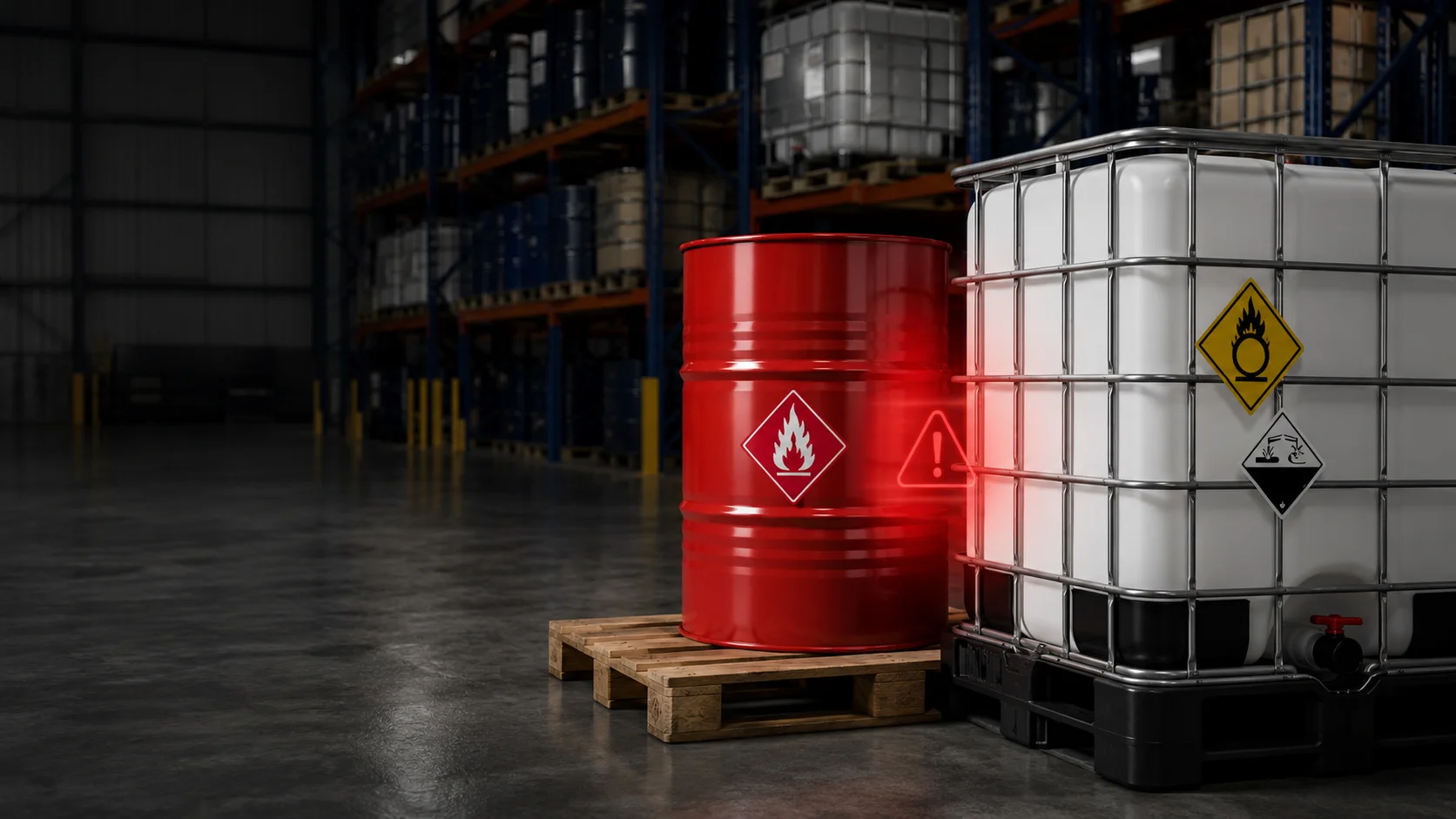
In August 2026, a Victorian company was fined $40,000. Inspectors had found four 205-litre drums of Class 3 flammable liquid sitting beside intermediate bulk containers of a Class 8 corrosive, after the company had already been issued an improvement notice about it.
Picture the chemical risk assessment for either of those products. It almost certainly listed gloves, eye protection and ventilation. It probably referenced the exposure standard. It may even have been signed off and filed.
What it almost certainly didn’t ask was the question that led to the fine: what is this product stored next to?
Why do most chemical risk assessments focus only on health exposure?
Because many of the tools and methods behind them come from occupational hygiene. They ask the questions an industrial hygienist would: routes of entry, dose, duration, exposure standards and PPE. Silica, occupational cancer and the new Workplace Exposure Limits keep the spotlight there too, and rightly so.
The result is a blind spot. Fire, reactions between incompatible products, spills reaching stormwater and damaged containers get treated as someone else’s problem: facilities, the dangerous goods coordinator, or the fire brigade.
What do the WHS Regulations actually ask?
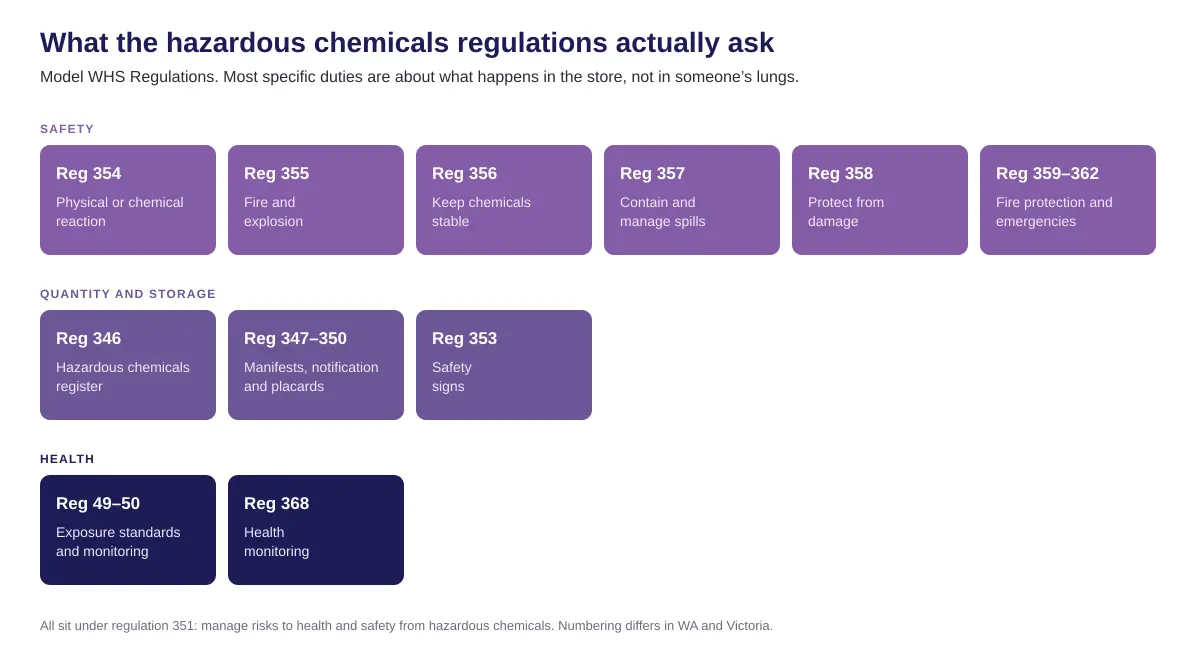
The model WHS Regulations require risks to health and safety from hazardous chemicals to be managed. A formal risk assessment isn’t mandatory, but a risk-based approach is, and the specific duties show what it has to cover:
- Safety: identify reaction risks (reg 354), control fire and explosion (355), keep chemicals stable (356), contain spills (357), protect from damage (358), and have fire protection and emergency arrangements (359 to 362).
- Quantity and storage: the register (346), manifests and placards (347 to 350), and safety signs (353).
- Health: exposure standards and monitoring (49 and 50) and health monitoring (368).
Count them. Most of the specific duties are about what happens in the store, not in someone’s lungs. Western Australia and Victoria legislate some of this differently, particularly dangerous goods storage, but the same risks are covered.
What happens when storage risks are missed?
2018
West Footscray
An unregistered warehouse packed with illegally stored chemicals burned for more than a week. More than 140 firefighters responded, and dead fish and eels washed up along Stony Creek.
140+ firefighters
2019
Campbellfield
Around 300,000 litres of chemicals caught fire. Two workers suffered severe burns and 11 schools and kindergartens closed because of toxic smoke. The operator was fined $2.9 million, which went unpaid after the company collapsed.
$2.9 million fine
2026
Victoria
Class 3 drums beside Class 8 IBCs, Victoria, August 2026
$40,000 fine
Neither was an exposure problem. Both were storage, quantity and segregation failures. (All three examples are Victorian, where similar duties sit under the state’s own OHS and dangerous goods regulations.)
Does health exposure still matter?
Absolutely. In 2024, 188 workers died from traumatic injuries at work, while a 2019 AIOH Foundation estimate puts deaths from occupational disease at around 4,900 a year. And from 1 December 2026, new Workplace Exposure Limits replace the current standards, so many assessments need reopening anyway. The point isn’t to assess health less. It’s that health is one question in four.
“An exposure limit is a ceiling, not a target. And it says nothing about fire.”
Four myths worth retiring
“Section 8 of the SDS is the assessment.”
Section 8 covers exposure controls. The safety risks live in Sections 7, 9 and 10.
“Below the exposure limit means we’re compliant.”
The duty is to minimise risk so far as is reasonably practicable, and the limit says nothing about fire.
“PPE is the control.”
PPE is the last line of defence in the hierarchy of controls. Elimination, substitution, isolation and engineering come first.
“The register covers it.”
A register is a list with SDSs attached. It isn’t a risk assessment.
So what does good look like?
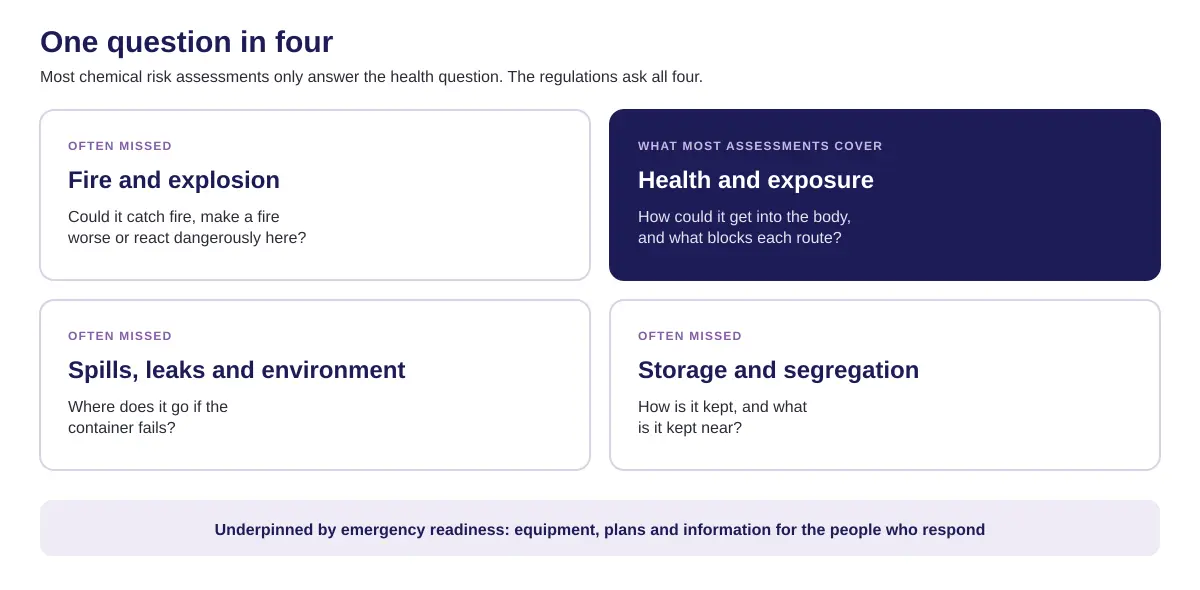
A complete chemical risk assessment works through four areas at the specific site: fire and explosion, health and exposure, spills and the environment, and storage and segregation. It applies the hierarchy of controls, and it’s done with the people who actually store and handle the product.
Our free guide, What good looks like: chemical risk assessments in Australia, sets it out in three pages: the four areas, six practical steps, the hierarchy of controls for hazardous chemicals, the SDS sections to use, template fields, and an eight-question self-check.
Because a chemical risk assessment that only asks about exposure is answering one question in four.
Sources
- WorkSafe Victoria, $40,000 in fines (August 2026)
- IGEM Victoria, Report into the West Footscray Industrial Fire
- Campbellfield factory fire, 2019
- Safe Work Australia, Key WHS Statistics Australia 2025
- AIOH Foundation (2019 estimate based on UK rates)
- Safe Work Australia, Workplace Exposure Limits changes (June 2025)
- Model WHS Regulations