For organisations storing large quantities of hazardous chemicals, few compliance questions are more important than understanding whether a site may be approaching, meeting or exceeding Major Hazard Facility threshold quantities.
It is also one of the harder questions to work through manually. It requires checking Schedule chemicals, reviewing named chemicals and hazard categories, converting quantities to tonnes, applying concentration and density data, and aggregating threshold ratios across the site.
With 2026.5, DGXprt introduces a guided Major Hazard Facility threshold assessment that uses the SDS, product and Site Inventory data already available in DGXprt to help organisations understand their threshold position more clearly and consistently.
New in 2026.5
Major Hazard Facility Threshold Assessment
DGXprt now includes a guided MHF threshold assessment workflow designed to make a complex regulatory process easier to review, document and explain.
The assessment helps users work through three key steps.
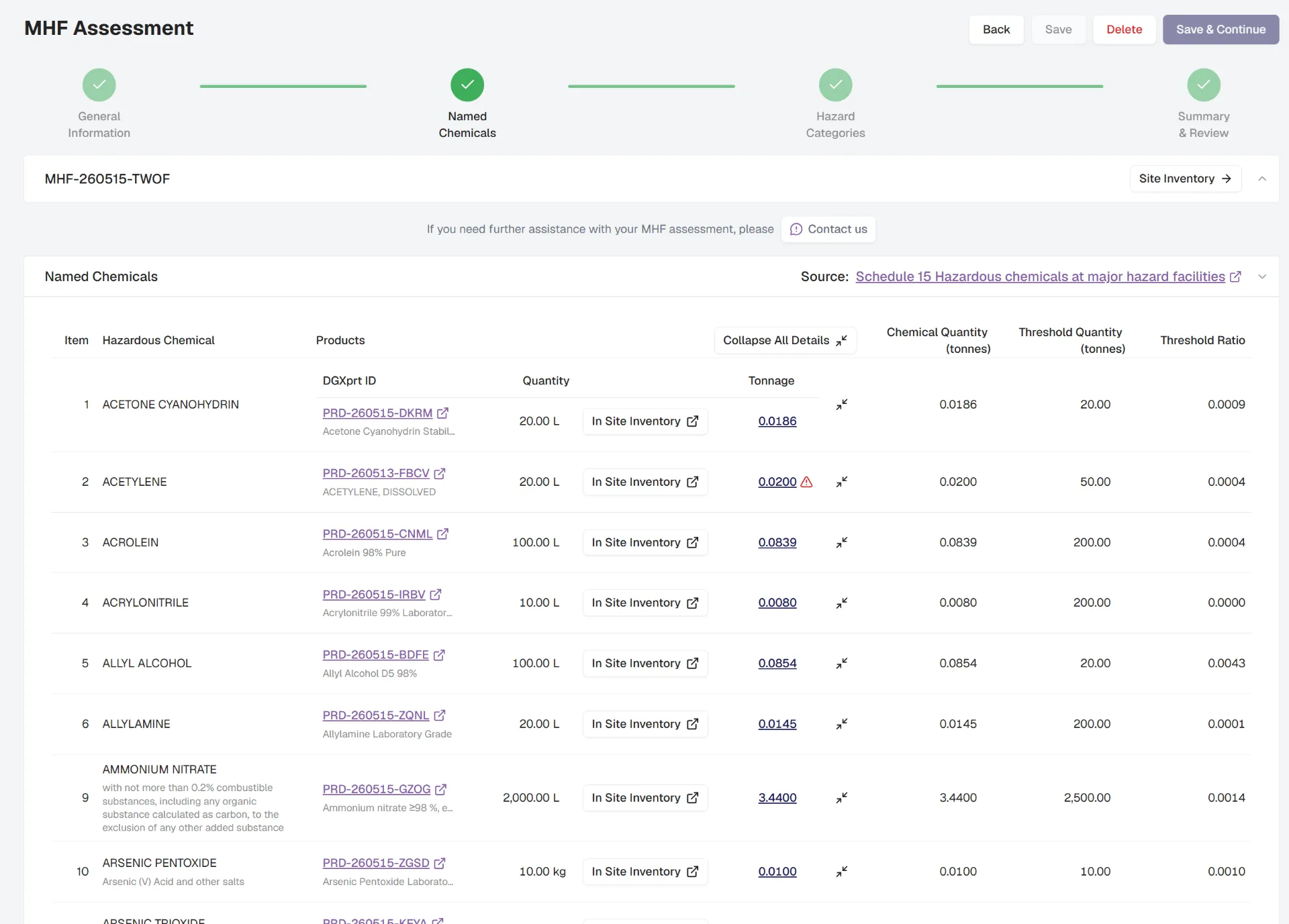
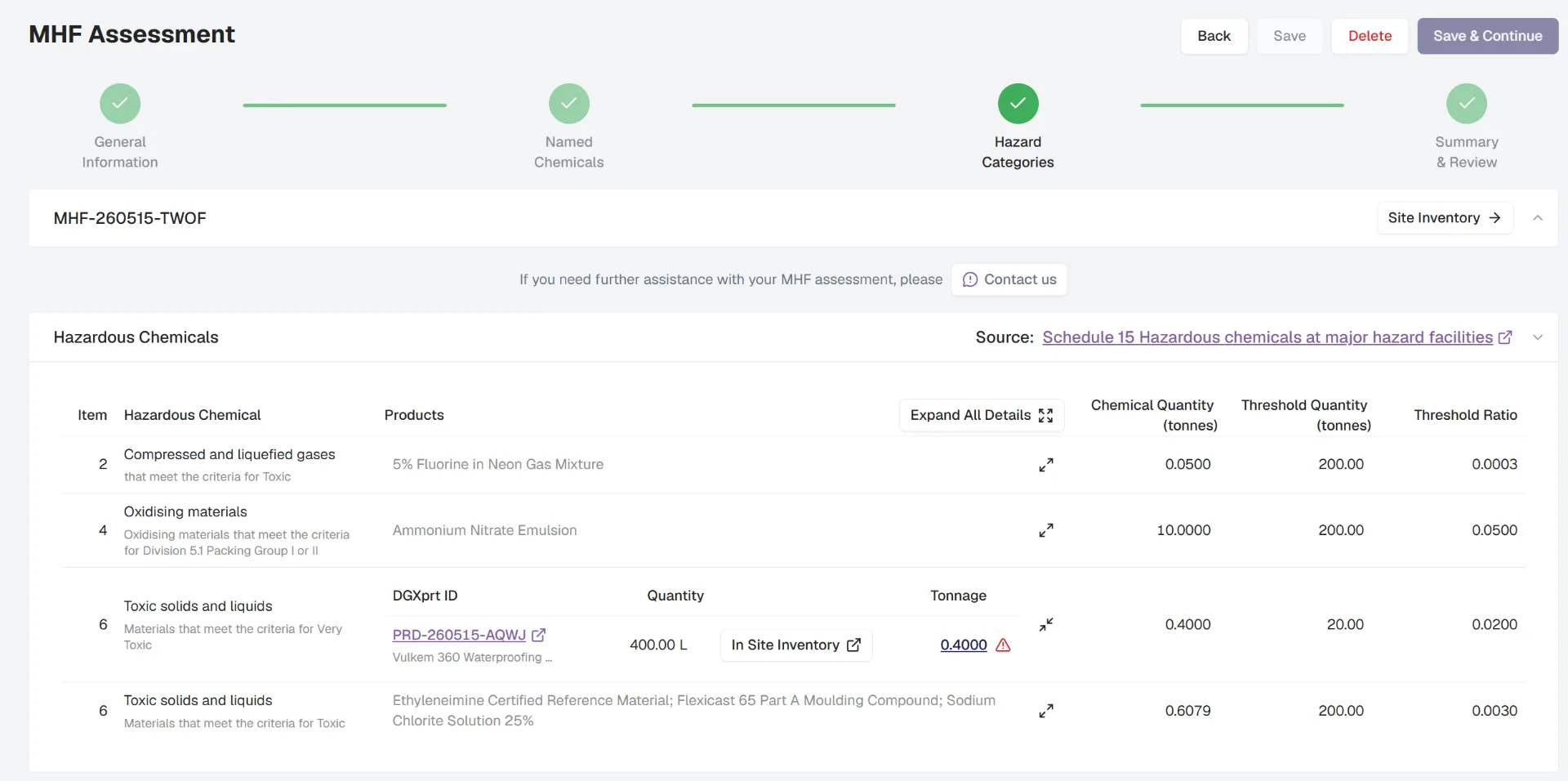
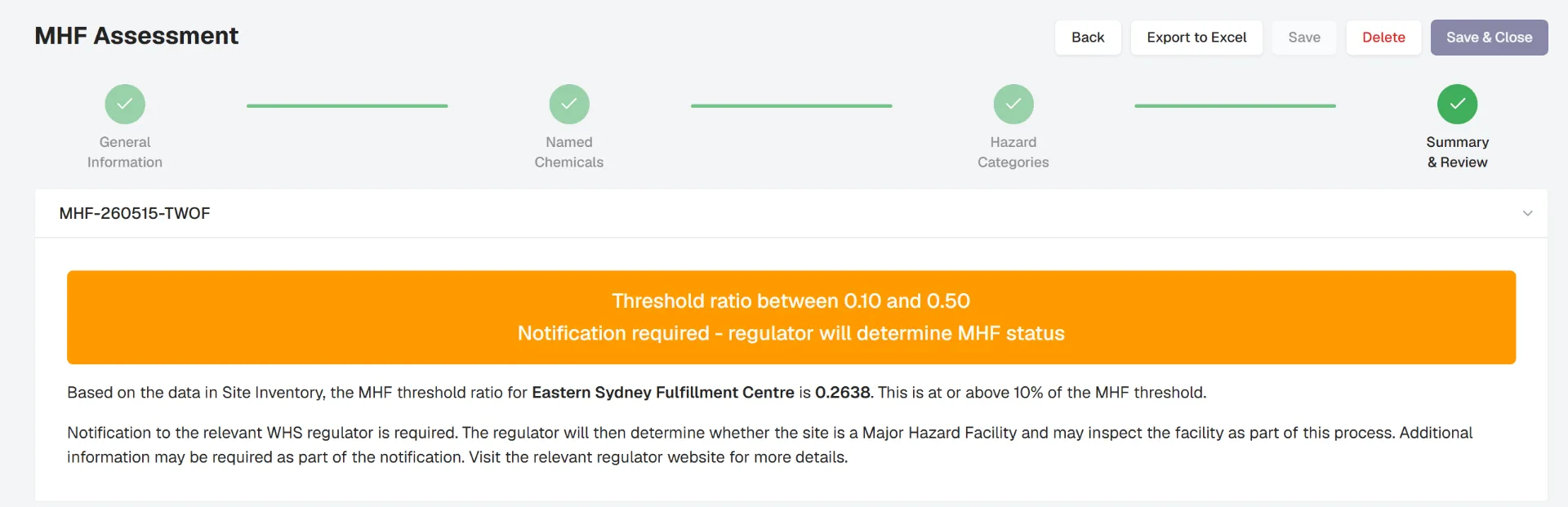
1. Named Chemicals
- 1Named Chemicals. DGXprt identifies products that may contain named chemicals listed in the relevant MHF schedule. Where a named chemical is present as an ingredient in a mixture, only the named ingredient quantity is counted, based on the concentration recorded in the SDS.
- 2Hazard Categories. DGXprt then reviews remaining chemicals against the relevant hazard categories, using available data such as DG class, packing group, toxicity and GHS classifications.
- 3Summary and Review. The final step brings the assessment together, showing the site’s aggregated threshold ratio, applicable outcome band, warnings and review notes. Users can save the assessment as a point-in-time record and download the detail to Excel for record-keeping, offline review or further expert assessment.
The result is a clearer, more auditable way to assess MHF threshold position using the data already managed in DGXprt.
MHF Assessment is available in this release for jurisdictions operating under the harmonised WHS framework: NSW, QLD, NT, SA, Tasmania, ACT, Commonwealth and WA. Support for Victoria, which operate under different MHF schedules, is planned for our June release.
Support for Sites Outside Australia
DGXprt now supports sites located outside Australian jurisdictions.
For organisations managing sites across multiple countries, this means non-Australian sites can now be included in DGXprt for product management, SDS management, Site Inventory and Hazardous Chemicals Registers.
Because DGXprt’s threshold and obligations coverage is currently focused on Australian jurisdictions, threshold calculations and compliance obligations are not shown for sites marked as outside Australia. This keeps the experience clearer while still allowing organisations to manage broader product, SDS and inventory information in one platform.
Outside-Australia sites appear on the dashboard alongside Australian sites, giving organisations a more complete view of their chemical portfolio.
Obligations AI Assistant for NSW and Victoria
DGXprt is also introducing the first release of the Obligations AI Assistant, available initially for NSW and Victoria sites.
The AI Assistant sits alongside DGXprt’s existing plain-English obligations and helps users ask follow-up questions about what those obligations mean in practice.
This first release is deliberately focused on NSW and Victoria, allowing us to refine the experience around the jurisdictions, regulations and Codes of Practice customers are already using most actively.
The AI Assistant is designed to support clarification and learning. It does not replace the obligations list, provide legal advice or generate prescriptive compliance actions. The plain-English obligations remain the comprehensive list of requirements identified for the site. Where further clarification or human expertise is needed, users can contact the DGXprt team directly from the assistant.
Additional jurisdictions will be added over time.
Smarter Imports, Clearer Results and Easier Access
2026.5 also includes a set of practical improvements designed to make DGXprt easier to use day to day. These improvements focus on helping users get data into the system more easily, understand results more clearly, and share product and SDS information with the people who need it.
Smarter SDS Quality Scoring
- The SDS Quality Score has been refined to provide clearer feedback on emergency contact information. DGXprt now flags SDSs that list 000 or the Poisons Information Centre as the emergency contact number. These may be useful emergency services, but they do not satisfy the requirement for an Australian business telephone number from which chemical-specific information can be obtained in an emergency.
Public Product List by Site
- Organisations with large product volumes can now provide workers, contractors and other relevant parties with a searchable product list for each site.
- The list can be accessed via a public link, without requiring a DGXprt login. This gives users a faster way to find a specific product and its SDS than searching through a PDF register.
- The Public Product List by Site complements the existing ability to share DG and Hazardous Chemicals Register PDFs, giving organisations another practical way to make chemical information easier to access.
What’s Coming Next
DGXprt is continuing to build towards a single platform where dangerous goods and hazardous chemicals compliance is easier to understand, maintain and act on.
One of the next focus areas is segregation support. Our goal is not to create another technical report that only an expert can decipher. We are working towards practical segregation guidance that helps teams understand what needs to be separated, why it matters, and what actions may be needed at a site level.
This continues the direction of DGXprt: turning complex dangerous goods compliance into clearer, more practical workflows for the people who need to manage it.
If you have questions about any of these features or want to understand how they apply to your sites, contact us at info@dgxprt.com or speak to your account manager.
Continue reading
DGXprt 2026.4 — National Dangerous Goods Compliance Coverage
National dangerous goods compliance coverage across every Australian jurisdiction, smarter SDS intelligence and expanded external access.
Read moreBuyer’s guideAre You Accidentally Non-Compliant? A Buyer’s Guide to DG Compliance Software
Most Australian businesses storing dangerous goods are non-compliant and don’t know it. Understand the three types of compliance software and what to look for.
Read more