Most organisations storing dangerous goods are not entirely sure what can and cannot be stored together. That is not negligence. It is a knowledge problem.
The rules exist, but they are written for specialists. Applying them correctly means working through class combinations, subsidiary hazards, conditional codes and physical properties that all affect the outcome. For most safety teams, that requires either a dangerous goods consultant, access to a technical standard written for expert interpretation, or both. In practice, many organisations apply a rough approximation, rely on whoever set the storage up originally, or simply do not check.
The consequences of getting it wrong range from fires and chemical reactions to vapour releases and packaging failures from incompatible materials stored in proximity. Improper segregation is one of the most commonly identified gaps in dangerous goods compliance audits across Australian industry.
With 2026.7, DGXprt introduces a Segregation Module that applies the rules to the products actually held at your site and surfaces the results in plain language. No standard to interpret. No table to cross-reference by hand. A reliable starting point before complex cases are escalated for expert review.
This release also extends Major Hazard Facility coverage to Victoria, adds full support for C1 combustible liquids, and includes a set of practical usability improvements.
New in 2026.7
Segregation Module
The module works directly against your live inventory data and provides three tools, each serving a different purpose.
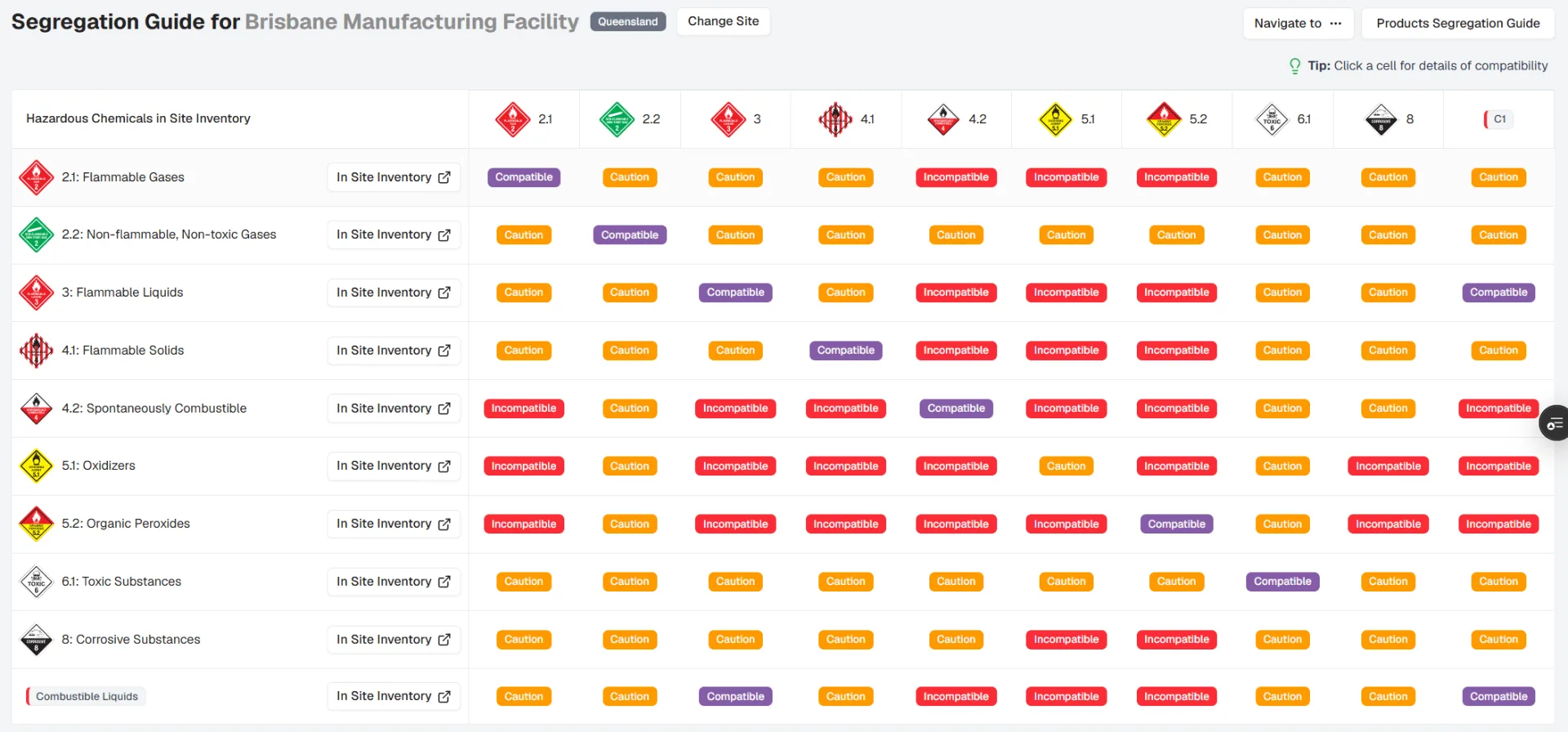
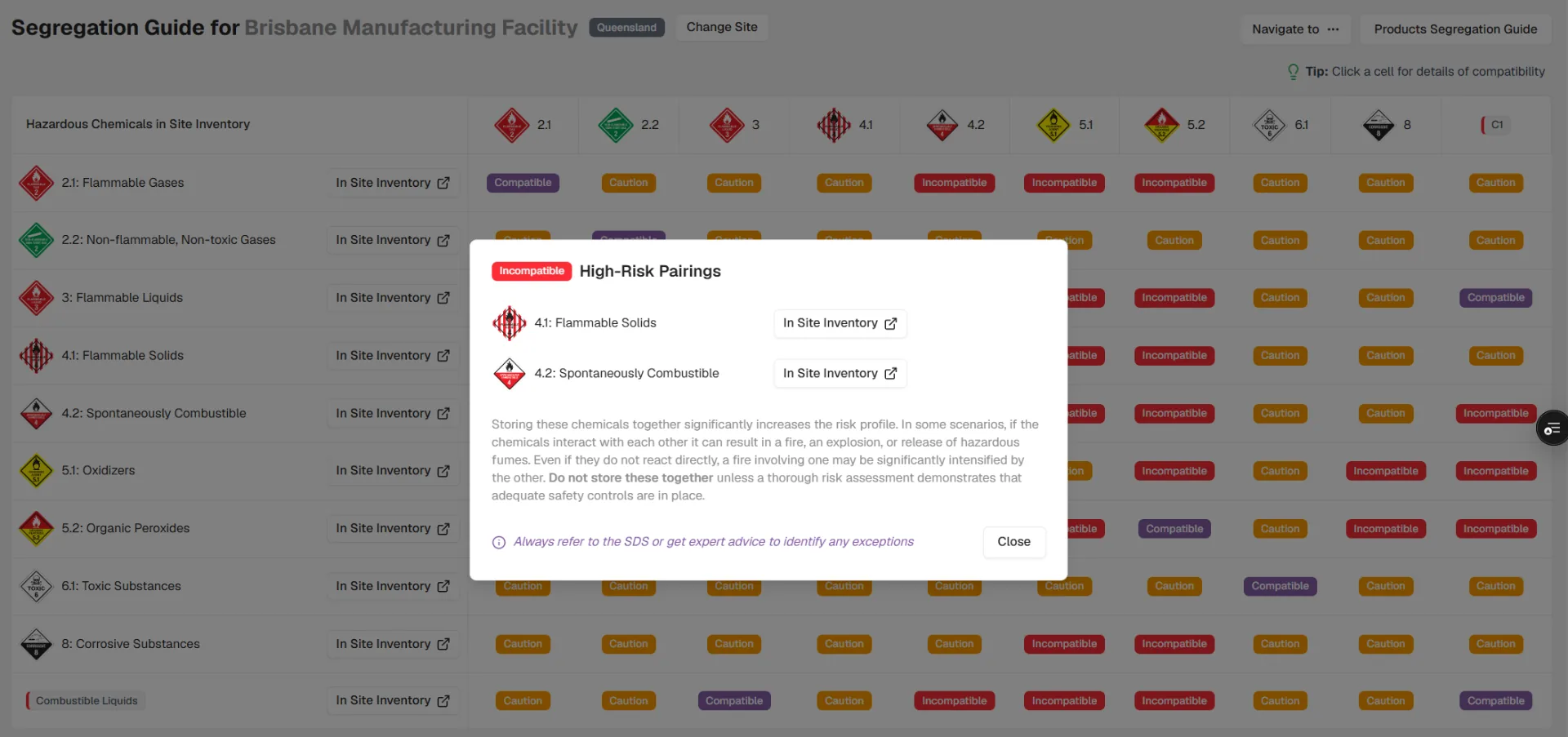
- 1Site Segregation Guide. A class-level overview of how the DG classes at your site interact with each other, giving an immediate whole-of-site read without needing to check products individually.
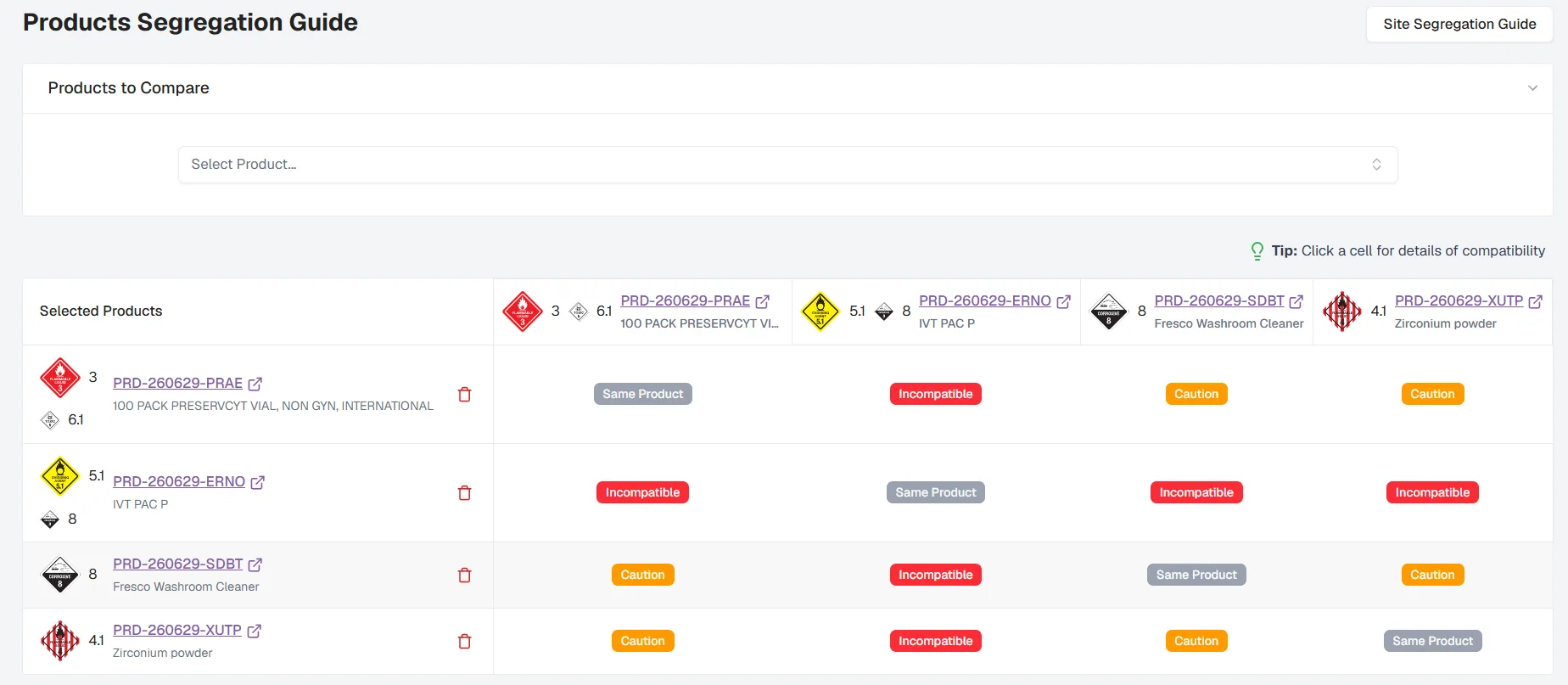
- 2Product Segregation Guide. A flexible tool for comparing any combination of products across your inventory, returning a full matrix of results with subsidiary hazards and conditional rules applied at the product level.
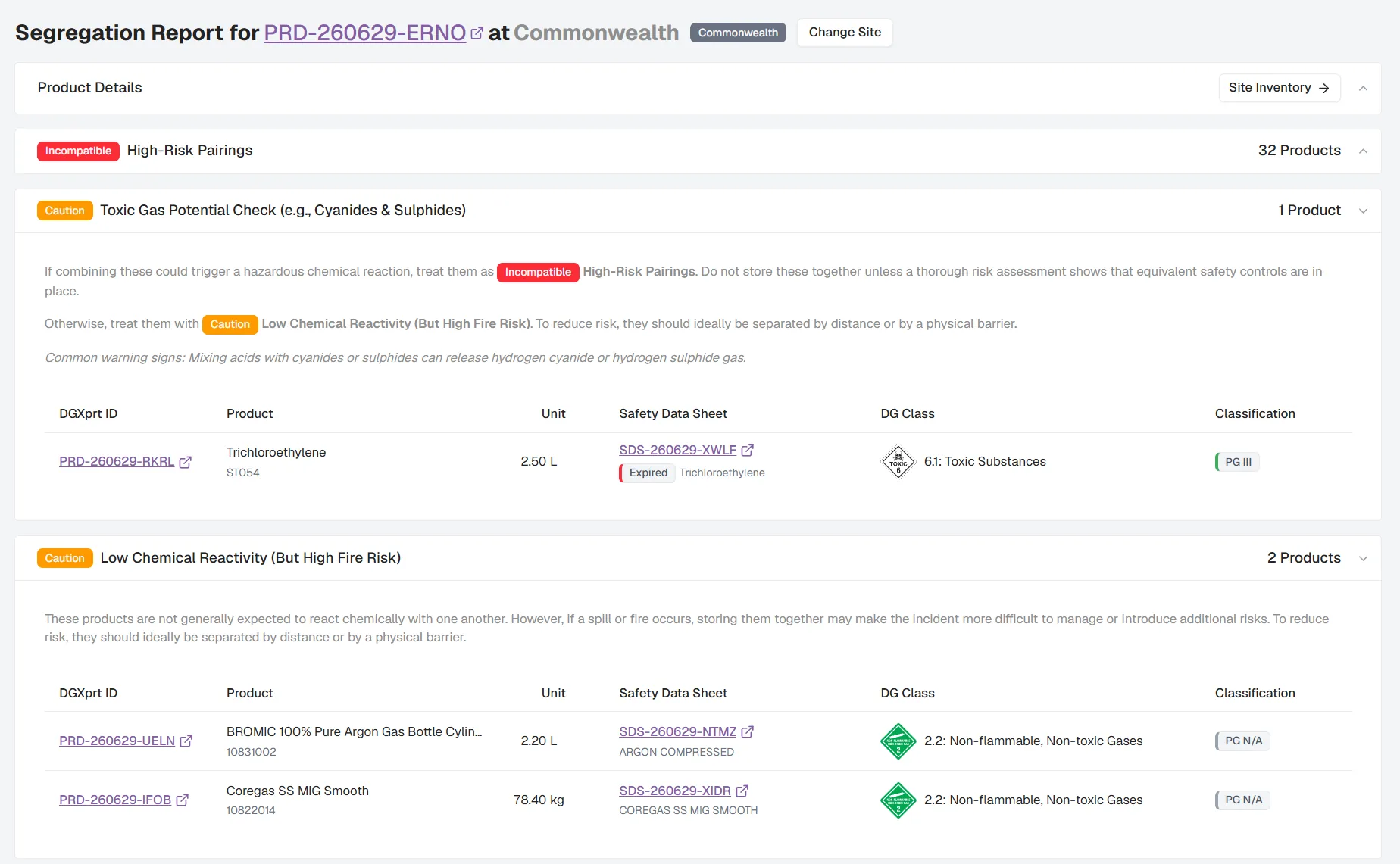
- 3Product Segregation Report. A full compatibility report for a single product against every other product at the same site, grouped by result so teams can immediately see what requires attention.
Results are shown in plain language, so teams do not need to interpret the underlying codes themselves. Where a result depends on information DGXprt does not hold, it is flagged for manual review rather than resolved by assumption.
This helps site managers, safety teams and compliance leads identify potential storage issues earlier, review proposed storage changes faster, and understand where expert advice may be needed.
Segregation guidance built to be genuinely usable by non-experts, not another technical report.
C1 Combustible Liquid Support
DGXprt now identifies and accounts for C1 combustible liquids across the platform.
C1 combustibles are not classified as dangerous goods for transport, but they add to the fire load of a storage area and are captured by storage regulations under AS 1940. DGXprt now detects them automatically from SDS data and carries that classification through the Threshold Calculator, DG Register, Manifest, and the Segregation Module, so combustible liquids are accounted for wherever they matter, not just where they happen to be classified.
For WA and Victorian sites, DGXprt also guides users through the storage context for C1 combustible liquids, including whether they are stored in isolation or with other dangerous goods. This matters because the applicable thresholds can change depending on how the C1s are stored, so DGXprt asks the right question before applying the result.
Major Hazard Facility Assessment: Now Available for Victoria
Following on from 2026.5, the guided MHF threshold assessment now supports Victorian sites, completing coverage across every Australian state and territory.
Victoria regulates Major Hazard Facilities under its own Occupational Health and Safety Regulations, separate from the harmonised WHS framework used elsewhere in Australia. DGXprt's MHF Assessment now applies the correct schedule and thresholds automatically based on a site's jurisdiction, so Victorian organisations get the same guided, auditable assessment already available to the rest of the country.
What's Coming Next
DGXprt is continuing to build toward a single platform where dangerous goods and hazardous chemicals compliance is easier to understand, maintain and act on.
Having extended segregation guidance and MHF coverage this release, we're turning our attention to making the obligations and AI assistance experience even more useful across more jurisdictions and continuing to refine the day-to-day workflows our customers use most.
If you are unsure whether your dangerous goods are stored together correctly, or want to understand how segregation, C1 combustible liquids or MHF thresholds apply to your sites, contact us at info@dgxprt.com.
Continue reading
DGXprt 2026.5 — Major Hazard Facility Threshold Assessment, Made Simpler
A guided MHF threshold assessment, support for sites outside Australia, and the first release of the Obligations AI Assistant for NSW and Victoria.
Read moreBuyer’s guideAre You Accidentally Non-Compliant? A Buyer’s Guide to DG Compliance Software
Most Australian businesses storing dangerous goods are non-compliant and don’t know it. Understand the three types of compliance software and what to look for.
Read more