Sometimes you do not need another document. You need help with one burning question.
No one has time to stop what they are doing, work through pages of dangerous goods regulations and Codes of Practice, or wait for a dangerous goods expert to become available.
And not everyone responsible for dangerous goods compliance is a dangerous goods expert. But sometimes a question cannot wait:
- Who do I notify when removing an underground fuel tank?
- What is the manifest notification timeframe?
- What training do workers need to handle dangerous goods?
- What fee applies to a major hazard facility notification?
With 2026.8, DGXprt makes it easier to get practical guidance when you need it, while also giving organisations more control over how dangerous goods compliance is managed across complex sites.
This release brings Australia-wide coverage for the Obligations AI Assistant, introduces parent and sub-site support, adds smarter Class 8 corrosive segregation guidance, and includes a range of practical improvements across manifests, inventory and product management.
NEW in 2026.8
Australia-wide obligations guidance
Ask the question you need answered
The Obligations AI Assistant is now available across every Australian state and territory, together with Commonwealth requirements.
Compliance Obligations for Sydney Distribution Centre
- Because you are now over manifest quantities of Schedule 11 hazardous chemicals, you must give written notice to the Regulator (SafeWork NSW) that these quantities are, or are going to be, used, handled or stored at your workplace.
- Timing: you must notify whichever is earlier of:
- immediately after you know you will first exceed manifest quantity, or
- at least 14 days before that first use/handling/storage above manifest quantity.
- If there is later a significant change in the risk (e.g. major increase in quantities, new high-risk areas), you must again give written notice on the same timing basis: immediately after you know of the change, or at least 14 days before it happens, whichever is earlier.
- When notifying, you must include your business details and attach your manifest (and pay the applicable fee). If you ever cease holding manifest quantities and don't expect to resume, you must also notify the Regulator as soon as practicable.
- Work Health and Safety Regulation 2025, Chapter 7, Part 7.1, Division 3, clause 347–348
- SafeWork NSW: Hazardous chemicals notifications
The answer does not have to wait for the expert in the room.
The Assistant gives site managers, safety teams and compliance leads a faster way to explore the obligations relevant to their site, ask the question in front of them and get plain-English guidance grounded in the requirements for that jurisdiction.
It works alongside DGXprt's Compliance Obligations, helping users move from knowing a requirement applies to understanding what it means in practice. Users can continue the conversation with follow-up questions or request clarification from a DGXprt compliance expert when needed.
Less searching. Less waiting. More understanding when it matters.
Complex sites
See every area. Understand the whole-site position.
Large and complex sites need more than one flat compliance view. Dangerous goods may be spread across buildings, warehouses, laboratories or operational areas, while the organisation still needs to understand the combined position across the entire site.
DGXprt now supports parent and sub-site structures, giving organisations the detail they need at an operational level and the consolidated view they need for compliance.
Detailed where the goods are held. Rolled up where the obligations apply.
Smarter segregation
Spot Class 8 acid and base risks automatically
DGXprt already assesses how the dangerous goods in your live site inventory interact, from a site-level overview through to detailed product-to-product guidance.
Class 8 corrosives cannot be understood by class alone. Acid and base pairings can create a serious incompatibility, even when both products carry the same dangerous goods class. The DGXprt Product Segregation Guide now identifies acid and base pairings automatically using pH information extracted from each product's SDS, bringing product-level intelligence directly into the segregation decision.
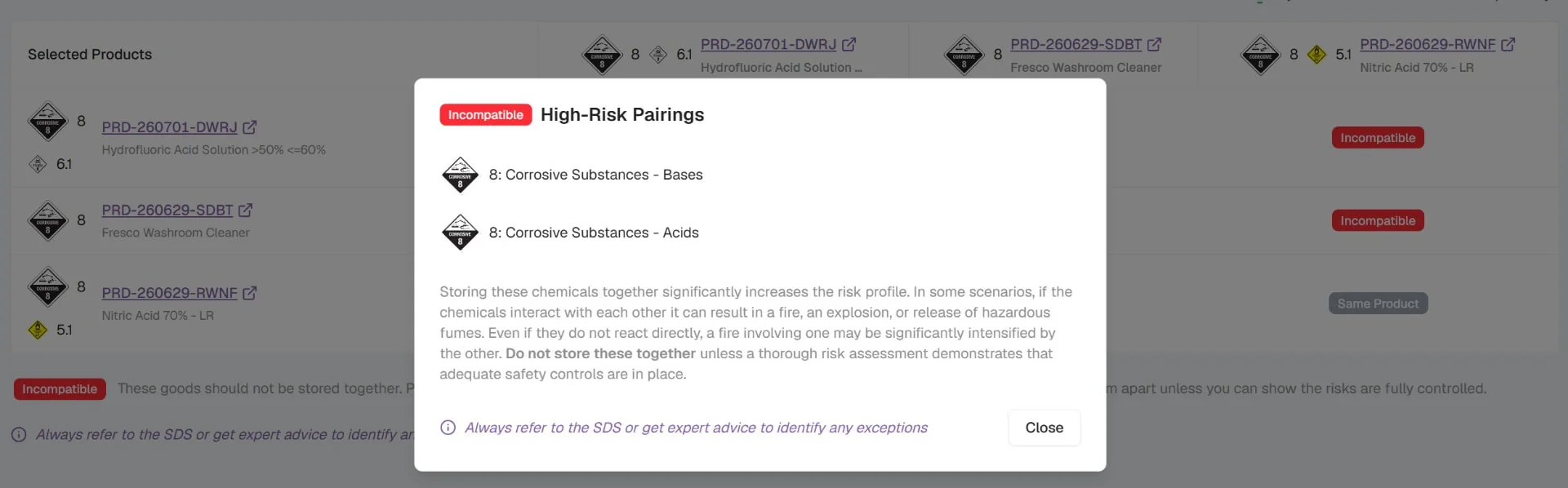
Not another static chart. Guidance based on the products actually on site.
See what was introduced in the DGXprt 2026.7 Segregation Module release.
Built with customers
Removing the friction around everyday compliance work
DGXprt 2026.8 also includes practical improvements shaped by customer and partner feedback across manifests, inventory and product management. Each one is designed to make routine compliance work faster, clearer and easier to maintain.
The bigger picture
Dangerous goods compliance should not depend on having an expert beside you
Expert judgement will always matter. But understanding a requirement, finding the right information and recognising a potential risk should not be harder than it needs to be. DGXprt is building a different way to manage dangerous goods compliance: one that turns complex regulations, site data and product information into guidance people can understand and act on.
Because sometimes the question is urgent. And the person asking it needs an answer now.
See how DGXprt can help your organisation understand its obligations, manage complex sites and identify potential incompatibilities earlier. Contact us at info@dgxprt.com.
Continue reading
DGXprt 2026.7 — Less Guesswork. More Confidence. Storage Segregation Guidance Arrives
A new Segregation Module that applies dangerous goods segregation rules to your live inventory in plain language, plus MHF coverage for Victoria and C1 combustible liquid support.
Read moreBuyer’s guideAre You Accidentally Non-Compliant? A Buyer’s Guide to DG Compliance Software
Most Australian businesses storing dangerous goods are non-compliant and don’t know it. Understand the three types of compliance software and what to look for.
Read more