Dangerous Goods Compliance in the ACT: Thresholds, Obligations and What Your Business Needs to Know
A Fyshwick building services company wins a government fit-out contract.
For the next few months, the team needs to hold paints, solvents, adhesives, sealants and cleaning chemicals on site while the work is completed. The products are familiar. The quantities seem manageable. The storage is temporary.
So the project manager assumes the compliance obligations are lighter.
They are not.
In the ACT, temporary storage is still storage. The first hazardous chemical on site triggers obligations under the Work Health and Safety Regulation 2011. There is no special exemption because chemicals are only being held for a project, a contract, a tenant fit-out or a short-term operational need.
That is where ACT businesses can get caught out.
A contractor storing materials for a project, a 3PL taking in a client’s stock, a facilities manager with a tenant who handles chemicals, or a maintenance team holding extra product for a shutdown may all be creating hazardous chemical obligations without treating the change as a compliance event.
The immediate questions are practical.
Is there a current SDS for every product? Has the hazardous chemicals register been updated? Are the products correctly labelled? Are incompatible chemicals separated? Are spill containment and emergency arrangements suitable for what is actually on site? Have quantities moved the site into placarding or manifest requirements?
For ACT businesses, the practical question is not just:
“How long will these chemicals be here?”
It is:
“What obligations apply from the moment they arrive?”
Disclaimer: This page provides a general overview of dangerous goods compliance obligations in the ACT. It is not a complete or definitive statement of the law and should not be relied upon as legal or compliance advice. Obligations vary by substance, quantity, site configuration and the specific regulations in force at the time. Always consult the relevant legislation directly or seek qualified professional advice for your circumstances.
ACT framework in context
The ACT adopted the model WHS laws and uses the Work Health and Safety Regulation 2011 — the same instrument as the NT, though the ACT’s regulator is WorkSafe ACT rather than NT WorkSafe. The same Schedule 11 threshold quantities apply as in QLD, NSW, Tasmania and the NT. Multi-site operators will find the ACT obligations consistent with other model WHS jurisdictions in structure, though the ACT/Commonwealth overlap question is worth considering separately if your business contracts to Commonwealth agencies or operates on Commonwealth-controlled premises.
Obligations That Apply at Every Quantity Level
The following obligations apply to any ACT workplace using, handling or storing hazardous chemicals, regardless of quantity. There is no minimum volume below which these requirements do not apply. The first chemical on site triggers them.
Safety Data Sheets
A current SDS must be obtained on first supply of any hazardous chemical and after any amendment. It must be made readily accessible to workers and emergency responders — ‘readily accessible’ means available when needed, not stored in a management-only location. SDS must comply with the WHS Regulations and Schedule 7. You cannot alter an SDS unless you are the manufacturer or importer. Translations may be attached but must clearly state they are not part of the original document.
DGXprt stores, versions and validates your SDS library — flagging expired or non-compliant SDS before they become a compliance gap. Accessible to workers and emergency responders at any time, from any device.
dgxprt.com/solutions/sds-management →Hazardous Chemicals Register
An up-to-date register of every hazardous chemical at the workplace must be maintained, together with its current SDS (reg 346). The register must be accessible to workers and anyone else likely to be affected. It must reflect your current inventory — chemicals that are no longer on site should be removed, and new chemicals must be added before use.
DGXprt generates your compliant hazardous chemicals register automatically from your SDS library. When your library is current, your register is current — no manual reconciliation required.
dgxprt.com/solutions/sds-register →Labelling and Risk Management
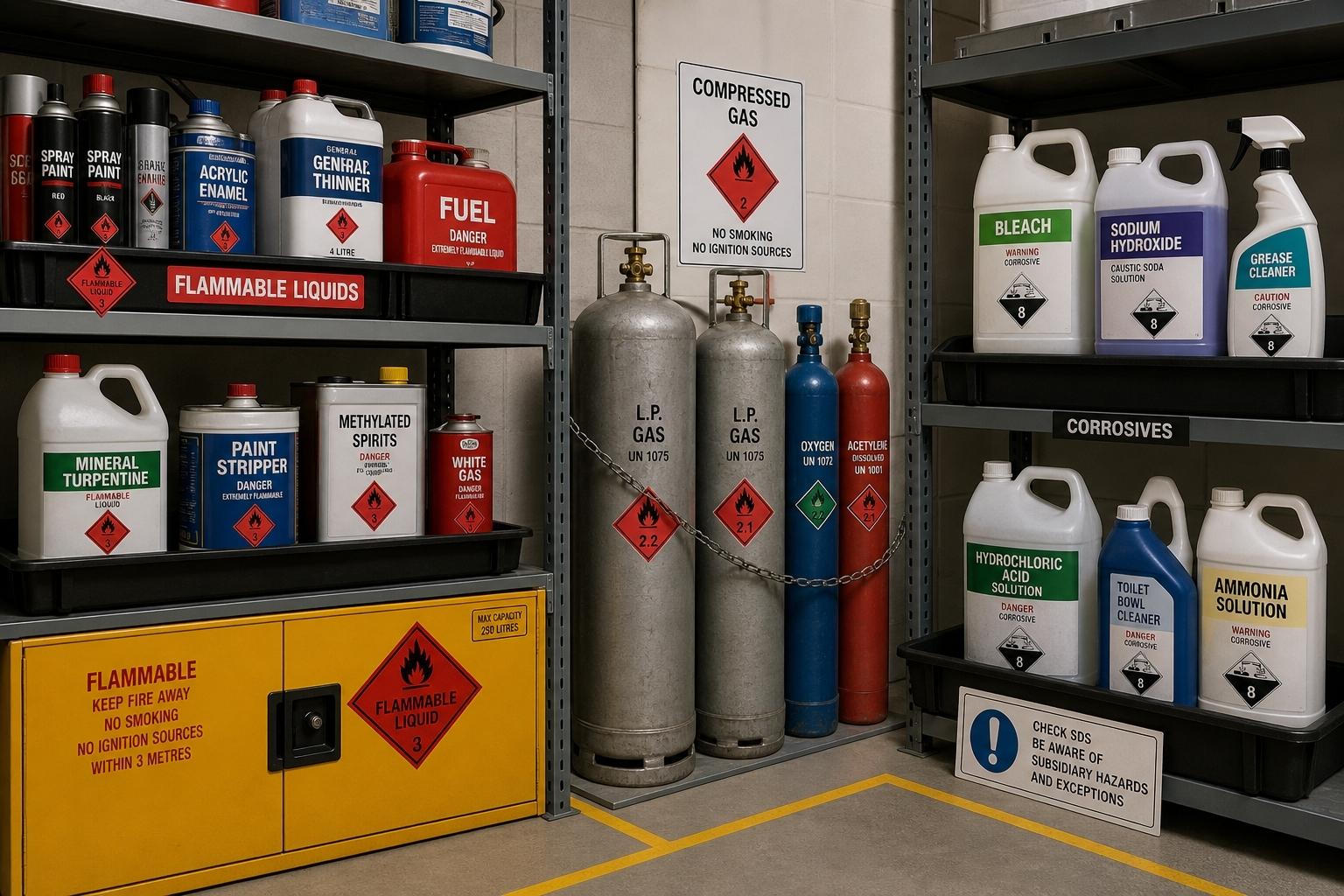
All hazardous chemicals must be correctly labelled, including chemicals that have been decanted or transferred into a different container, and labels must remain legible in use. Chemicals in pipework must be identified. Where a safety sign is needed to control an identified risk, it must be displayed near the hazard and be clearly visible.
Risk management obligations require you to identify hazards, assess and control risks (including incompatible chemical combinations and ignition sources in hazardous areas), and review controls at least every five years or sooner when circumstances change. Chemicals must not create new hazards through instability or contaminate food, packaging or personal-use products.
Training and Supervision
Workers who use, handle, store or maintain hazardous chemical systems must receive information, instruction and supervision sufficient to protect them from the associated risks (regs 363(2), 379). Supervision must be proportionate to the nature of the risk. Training alone is not sufficient if there is no system to maintain currency — knowing what to do at induction does not help if the SDS cannot be located when it is needed.
Fire Protection, Emergency Equipment and Emergency Plan
Firefighting equipment must be appropriate for the types and quantities of chemicals on site, compatible with emergency services equipment, and properly installed, tested and maintained, with dated records kept. If equipment becomes unserviceable, alternative risk controls must be put in place while repairs are made. Emergency equipment — spill kits, PPE, first aid — must always be available. Every workplace must have an emergency plan suited to its hazards, size, layout and workforce.
Spill Containment and Impact Protection
Systems must be in place to contain spills and leaks (including effluent), prevent incompatible chemicals mixing, and enable clean-up and disposal (reg 357). Containers, pipework and attachments must be protected from impact and excessive loads (reg 358). These are infrastructure obligations, not just procedural requirements.
Storage and Handling Systems
Any engineered system used to store or move hazardous chemicals — from fixed tanks to racking to decanting stations — must be used only for its intended purpose and kept in proper working order (reg 363). Operators and maintainers must be trained on the system. Bulk containers, defined as containers with a capacity greater than 500L (liquids) or 500kg (solids), must have stable foundations and be secured to prevent movement or damage (reg 364).
When a storage or handling system is decommissioned, it must be made free of hazardous chemicals, or correctly labelled if that is not practicable. Underground systems must be removed where practicable, or made safe. If a tank used for flammable gases or liquids is abandoned — two years of non-use or a stated intention not to reuse it — WorkSafe ACT must be notified (reg 367). This obligation is easy to overlook when infrastructure is upgraded or inherited from a previous tenant.
Health Monitoring and Carcinogens
Where workers are at significant risk from Schedule 14 chemicals, health monitoring obligations apply (regs 368–378). Records must be retained for at least 30 years. Adverse findings must be reported to WorkSafe ACT. Prohibited or restricted carcinogens and restricted hazardous chemicals cannot be used, handled or stored without regulator authorisation (regs 380–388).
The Three Threshold Tiers
On top of the base obligations, the ACT WHS Regulation 2011 creates three quantity thresholds that escalate your requirements as the amount you store increases. All three tiers share the base obligations above — each tier adds to the one below, not replaces it.
DGXprt determines your current threshold tier from your chemical inventory and quantities, and shows exactly which obligations apply to your ACT site — with regulation references, updated as your inventory changes.
dgxprt.com/solutions/thresholds-obligations →Tier 1 — Minor Storage
Below the Schedule 11 placard quantities, your site is at minor storage level. All base obligations apply in full. You do not yet need outer warning placards, area placards, a manifest, or notification to WorkSafe ACT. The compliance floor — SDS, register, labelling, risk management, training, emergency plan — applies regardless of tier.
Tier 2 — Placard Quantities
Once your quantities exceed the Schedule 11 placard thresholds, placarding obligations apply. Outer warning placards must be displayed at all workplace entrances, complying with Schedule 13. Placards must also be displayed for specific storage areas and bulk containers exceeding the placard thresholds, with exceptions for certain transport IBCs and underground retail tanks.
Placards exist for a specific operational reason: to give ACT Fire & Rescue and other emergency services the information they need — what is on site, in what quantities, how to respond — before they enter your premises. An unlabelled or under-labelled site creates real operational risk for emergency responders and signals non-compliance to any inspector.
Tier 3 — Manifest Quantities
At manifest quantities, a formal documentation and notification regime applies. A manifest must be prepared and maintained in the Schedule 12 format, updated whenever the types or quantities of chemicals change, and kept in a location agreed with emergency services and accessible to them at all times.
You must notify WorkSafe ACT in writing before first exceeding manifest thresholds, before any significant changes at that level, and again if quantities subsequently fall below manifest levels. WorkSafe ACT may request further information.
ACT Fire & Rescue at manifest quantities
At manifest quantities, a copy of your site emergency plan must be provided to ACT Fire & Rescue. The ACT obligations page notes the specific submission contact: ACTF-RRisk-Planning@act.gov.au. The emergency plan must be revised if ACT Fire & Rescue makes written recommendations. Keeping this plan current — and ensuring ACT Fire & Rescue holds the most recent version after any significant site change — is part of the ongoing compliance obligation, not just the initial setup.
DGXprt generates your Schedule 12-compliant manifest from your chemical inventory. When quantities or types change, your manifest updates — ready to agree with emergency services and keep current.
dgxprt.com/solutions/manifest →A Note on ACT and Commonwealth WHS Obligations
The ACT is home to a concentration of federal government agencies, defence facilities, diplomatic premises and contractors that exists nowhere else in Australia. For some businesses operating in the territory, this creates a genuine question about which WHS framework — ACT or Commonwealth — actually applies.
When do Commonwealth WHS obligations apply?
The Commonwealth WHS Act and Regulations apply to Commonwealth entities and to contractors working on Commonwealth-controlled workplaces (including many government buildings, defence sites, and national institutions in the ACT). If your business operates on or supplies services to Commonwealth-controlled premises, your WHS obligations — including those for hazardous chemicals — may be governed by the Commonwealth framework rather than (or in addition to) the ACT framework. The Commonwealth uses the same model WHS Regulations structure and Schedule 11 thresholds, so the obligations are substantively similar, but the regulator is the Australian Government’s Work Health and Safety Regulator (WHSRGA) rather than WorkSafe ACT. If you are uncertain which framework applies to your specific operations, seek advice from a WHS professional or confirm directly with the relevant regulator.
For businesses operating entirely in the private sector in the ACT — in industrial areas like Fyshwick, Hume or Mitchell — the ACT WHS Regulation 2011 is the applicable instrument and WorkSafe ACT is your regulator. The Commonwealth overlap is relevant primarily for businesses with government contracts or operations on government-controlled sites.
Managing ACT Compliance
The ACT’s model WHS framework is structurally consistent with other jurisdictions, which makes it more tractable than WA’s dual-framework structure or SA’s licensing layer. The compliance challenge for ACT businesses is the same one that applies everywhere: keeping the SDS library current, keeping the register aligned with the actual chemical inventory, and ensuring the manifest — if required — reflects what is actually on site.
These are not one-off setup tasks. A compliant register at the start of the year is not a compliant register twelve months later if chemicals have changed and the register has not. A manifest agreed with emergency services when it was first prepared does not stay agreed if the site changes materially and the document is not updated. DGXprt connects these documents to your live inventory so they stay accurate without manual effort.
Know your ACT DG compliance position
DGXprt automates threshold calculations against the ACT WHS framework, keeps your SDS library and hazardous chemicals register aligned, and generates Schedule 12-compliant manifests as inventory changes.
Frequently asked questions
Common questions about dangerous goods compliance software.