And why most businesses don't know the answer — until a regulator tells them
Most businesses know they have chemicals on site. Far fewer know which of those chemicals are classified as dangerous goods — and fewer still know what compliance obligations that classification triggers.
That gap is where regulatory risk lives. A business can be storing Class 3 flammable liquids, Class 2.1 flammable gas, and Class 8 corrosives — all of which trigger specific storage, placarding, manifest, and notification obligations — without realising any of it applies to them.
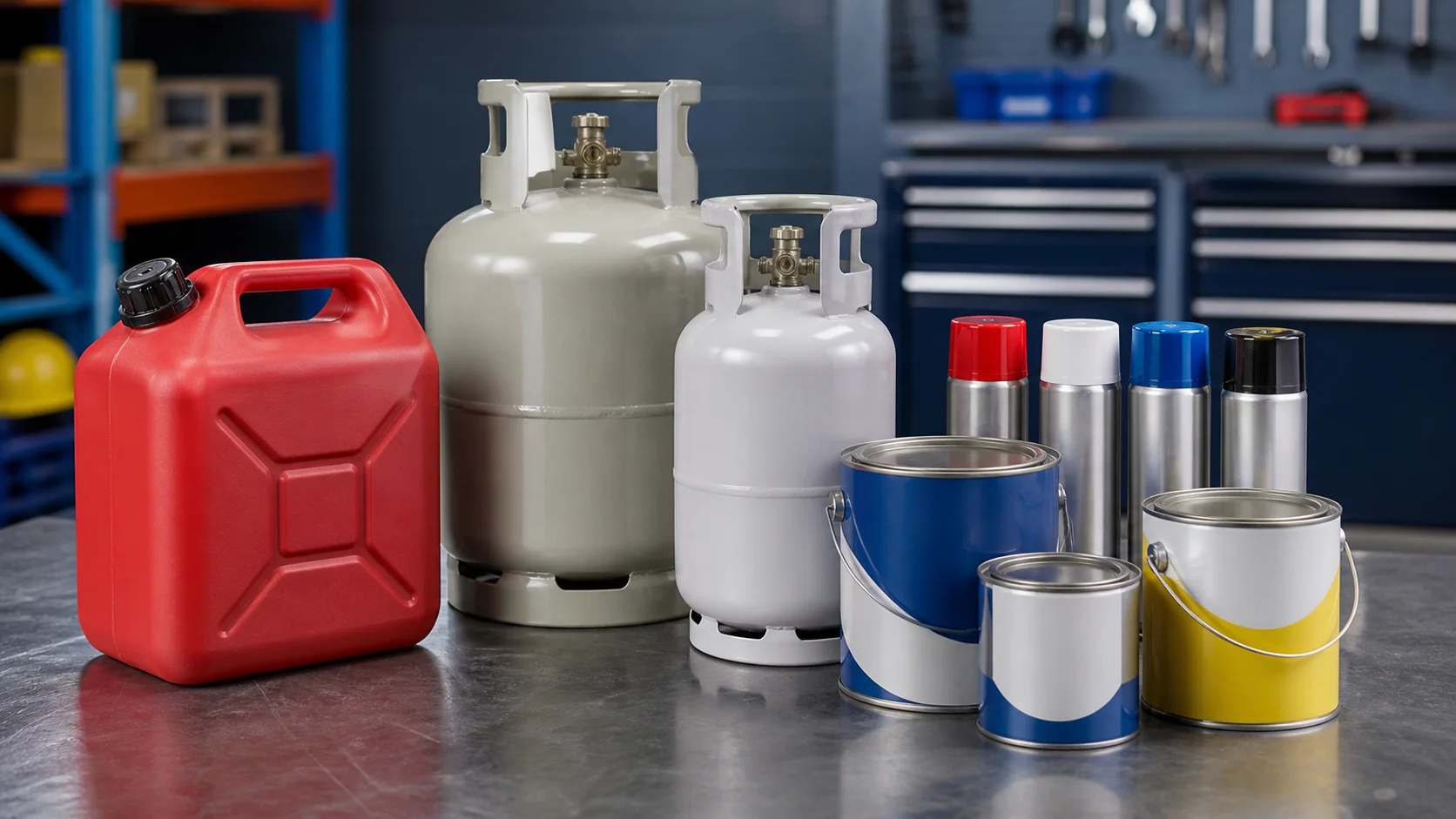
The products that catch businesses out are rarely industrial chemicals labelled with hazard diamonds. They're everyday products: fuel, LPG, spray paint, cleaning solvents, aerosols. Products that don't look like dangerous goods but legally are.
What are dangerous goods under Australian law?
Dangerous goods are substances or articles listed in the Australian Dangerous Goods (ADG) Code that have explosive, flammable, toxic, infectious, or corrosive properties. The ADG Code classifies dangerous goods into nine classes based on their primary hazard.
A substance doesn't need to be listed by name to be classified as dangerous goods. If it meets the classification criteria for any of the nine classes — based on its physical and chemical properties — it is classified as dangerous goods whether or not it appears in the DG list by name. This is an important distinction that many businesses miss: the classification follows the substance, not the label.
| Class | Type | Common workplace examples |
|---|---|---|
| 1 | Explosives | Detonators, fireworks, ammunition |
| 2.1 | Flammable gases | LPG, acetylene, hydrogen |
| 2.2 | Non-flammable gases | Compressed air, CO₂, nitrogen |
| 2.3 | Toxic gases | Chlorine, ammonia |
| 3 | Flammable liquids | Fuel, petrol, solvents, paints, alcohols |
| 4.1 | Flammable solids | Matches, metal powders |
| 4.2 | Spontaneously combustible | Activated carbon, white phosphorus |
| 4.3 | Dangerous when wet | Sodium, calcium carbide |
| 5.1 | Oxidising substances | Hydrogen peroxide, pool chemicals |
| 5.2 | Organic peroxides | Resins, hardeners |
| 6.1 | Toxic substances | Pesticides, methanol |
| 8 | Corrosives | Battery acid, caustic soda, cleaning agents |
| 9 | Miscellaneous | Dry ice, lithium batteries, environmentally hazardous substances |
Class 7 (radioactive materials) is covered separately under different legislation and is not included in the standard ADG Code workplace compliance framework.
Everyday products that are classified dangerous goods
The most common compliance blind spot isn't industrial chemicals — it's the products businesses use every day without realising they carry DG classification and trigger compliance obligations.
Fuel
Class 3 flammable liquid. One of the most commonly stored dangerous goods in Australian workplaces — in fuel tanks, drums, and bowsers. The quantity stored determines which obligations are triggered: placarding, manifest, bunding, notification to the regulator. Many businesses storing fuel have no idea they're above threshold quantities.
LPG
Class 2.1 flammable gas. Used for forklifts, heating, cooking, and industrial processes. LPG cylinders on site aggregate toward threshold quantities that trigger placarding and manifest obligations. The number of cylinders — including partly used ones — counts toward your total.
Aerosols
Class 2.1 (if flammable) or Class 2.2. Spray paints, lubricants, cleaning products, insecticides. Most aerosols in Australian workplaces are classified as flammable. A storeroom full of maintenance aerosols can contribute meaningfully to threshold calculations, particularly in smaller sites.
Paints and solvents
Class 3 flammable liquids. Thinners, acetone, methylated spirits, industrial cleaning solvents. Packing group matters here: Packing Group I (high danger), II (medium), or III (low) determines the threshold quantities that apply. Many businesses assume paint isn't dangerous goods because it's available in hardware stores.
The compliance trap: quantity aggregation. It's not whether a single product triggers a threshold — it's whether the combined quantity of all products in the same DG class or division on your site crosses the threshold. A business with small amounts of many Class 3 products may be above their manifest quantity without realising it.
Dangerous goods vs hazardous chemicals — what's the difference?
This is one of the most common points of confusion in Australian workplace compliance.
Hazardous chemicals are classified under the GHS based on health and physicochemical hazards — they include substances that can harm people through exposure (toxicity, carcinogenicity, skin and eye irritation, flammability). This is the HC register and SDS framework under the WHS Regulations.
Dangerous goods are classified under the ADG Code based on their hazard during storage and transport — primarily their potential to cause fire, explosion, or environmental harm. This is the DG threshold, placarding, manifest, and notification framework.
A substance can be both a hazardous chemical and dangerous goods. Fuel is a hazardous chemical (health effects from exposure) and dangerous goods (flammable liquid, Class 3). The compliance obligations are different and both apply.
Managing both correctly requires understanding where the frameworks overlap and where they don't. Most businesses manage neither systematically.
What triggers compliance obligations?
Classification alone doesn't determine your obligations. What matters is the quantity of dangerous goods stored on your site — and how that quantity compares to the threshold quantities set by your state's WHS Regulations.
Any quantity
Applies to every hazardous chemical on site, regardless of volume.
- SDS registerEvery hazardous chemical on site requires an SDS available to workers.
- HC registerA register of all hazardous chemicals must be maintained and kept current.
Threshold reached (Schedule 11)
Triggered once aggregate quantities by DG class and packing group cross state-specific thresholds.
- PlacardingPlacards must be displayed at entry points and storage areas.
- ManifestA site manifest must be prepared, maintained, and made available to emergency services.
- Regulator notificationYour state regulator must be notified and a copy of the manifest lodged.
MHF threshold (Schedule 15)
Significantly more complex obligations apply when quantities approach Major Hazard Facility levels.
- Major Hazard FacilityA comprehensive safety case, MHF licensing, and ongoing regulator engagement is required.
Threshold quantities vary by state. The Schedule 11 thresholds in your state's WHS Regulations are specific to each DG class and packing group. A quantity that triggers a manifest obligation in NSW may not trigger one in WA. Victoria has additional obligations under its fire protection framework that don't exist in other jurisdictions. Getting this right requires state-specific knowledge, not a generic national calculation.
How hard is it to work out what you have?
Harder than most businesses expect — and that's not an exaggeration.
Step one is identifying every hazardous chemical on site — not just the obvious ones in dedicated chemical storage, but the aerosols in the maintenance shed, the LPG cylinders near the loading dock, the fuel in the generator. Step two is classifying each one correctly under the ADG Code. Step three is calculating aggregate quantities by DG class and packing group. Step four is comparing those quantities against the correct state-specific thresholds. Step five is determining which obligations are triggered and what's required to meet them.
And then your inventory changes. A new product arrives. A supplier changes their formulation. Quantities increase seasonally. The process starts again.
This is why businesses get it wrong — not because they're careless, but because this is genuinely complex work that most teams aren't resourced to do continuously.
A purpose-built dangerous goods compliance platform doesn't just tell you what you have. It classifies it, calculates your threshold position by state, identifies the obligations that apply, and updates automatically as your inventory changes.
How DGXprt helps
DGXprt starts with your inventory and your SDSs. The platform identifies and classifies all dangerous goods on your site, calculates your threshold position against state-specific Schedule 11 quantities, and translates that into plain-English obligations — what you need to do, linked to the specific regulation that requires it.
You don't need to know the ADG Code. You don't need to manually cross-reference Schedule 11 for every state you operate in. You need to know where you stand and what's required. That's what DGXprt delivers.
Read more
Frequently asked questions
Common questions about dangerous goods compliance software.