Ask most safety managers whether their site needs a dangerous goods manifest and the honest answer is: they're not sure. They know they have a hazardous chemicals register. They're less certain about whether a manifest is also required — and if it is, what exactly it needs to contain.
This is not a minor compliance detail. A manifest is a legal document with strict content requirements, and the obligation to have one is triggered automatically once stored quantities cross a defined threshold. There is no grace period and no discretion. If you have crossed the threshold and do not have a compliant manifest, you are in breach.
Here is what you need to know.
Register and manifest: not the same document
The confusion between these two documents is the most common starting point for manifest compliance failures. They are different documents, required at different thresholds, for entirely different audiences.
Hazardous Chemicals Register
- Audience: workers and management
- Purpose: day-to-day chemical safety
- Content: all chemicals on site + current SDS
- When required: at every worksite storing any quantity
- Used during: normal operations
Dangerous Goods Manifest
- Audience: fire services and emergency responders
- Purpose: emergency response on arrival
- Content: DG classifications, quantities, storage locations, site plan, emergency contacts
- When required: only when manifest quantity thresholds are exceeded
- Used during: incidents and emergencies
Having a comprehensive register does not satisfy a manifest obligation. They serve different purposes and are assessed separately. Using a register in place of a manifest is one of the most frequently identified compliance failures during regulator inspections.
When is a manifest required?
A manifest is required once the quantity of hazardous chemicals at your workplace exceeds the manifest quantity threshold for the relevant chemical class or packing group. The thresholds are set out in the schedule of the regulation that applies in your state or territory. The obligation applies from the moment the threshold is crossed — not from the next scheduled compliance review.
The thresholds operate in tiers:
- Any quantity: hazardous chemicals register required
- Above placarding threshold: physical placards required at site entrances and storage areas
- Above manifest threshold: manifest required, regulator notified, fire authority consulted
The regulation that applies depends on your state
NSW: WHS Regulation 2025, Schedule 11. QLD, TAS, ACT: WHS Regulation 2011, Schedule 11. VIC: DG (Storage & Handling) Regulations 2022, Schedule 2 — Victoria sits outside the harmonised WHS model entirely, with its own unique threshold structure including a fire protection quantity trigger requiring formal engagement with FRV or CFA. SA: WHS Regulation 2012, Schedule 11 (hybrid). WA: DG Safety (Storage & Handling) Regs 2007, Schedule 1 (hybrid). NT: WHS (National Uniform Legislation) Regs 2011. Multi-site operators cannot apply a single national template.
Three calculation errors consistently cause organisations to miss their manifest obligations: failing to aggregate quantities across the whole site (the threshold applies to total site quantities, not individual storage areas); not accounting for mixed classes and subsidiary hazards; and assuming that chemicals temporarily held or in transit are exempt — in most cases they are not.
What must a manifest contain?
Schedule 12 of the WHS Regulations (or the equivalent instrument in your state) prescribes the required content. Every element exists for a specific emergency response reason — not as a formatting convention.
- General information and emergency contacts. Business name, site address, and after-hours telephone numbers for at least two people who can be contacted if an incident occurs.
- Packaged chemical storage areas. Proper shipping name, UN number, DG class, subsidiary risk, packing group, type of storage area, average quantity and largest quantity for each storage area.
- Bulk storage and containers. Chemicals stored in tanks, IBCs or open stockpiles, including design capacity, tank diameter and actual quantity present.
- Manufacturing areas. If chemicals are used in manufacturing on site, average and maximum quantities by area.
- Chemicals in transit. Sealed, unused goods on site for five days or fewer. Transit area identifiers, average and largest quantities.
- Identification of each chemical. Proper shipping name and UN number from the ADG Code. For combustible liquids, the product identifier. For unstable explosives or Type A goods, the name and "goods too dangerous to be transported".
- Site plan to scale. The most consistently deficient element. See below.
The site plan: the most commonly deficient element
The site plan is where most manifests fall short. In the experience of DG consultants and emergency services, an incomplete or unclear site plan is the single most common reason a manifest is judged unfit for purpose.
A compliant site plan must be drawn to scale (1:100, 1:200, or 1:500) and must clearly show:
- All chemical storage locations — packaged goods, bulk, tanks, IBCs, manufacturing areas and transit areas
- All entry and exit points, main access gates and emergency gates
- All fire hydrants, electrical mains isolations, and emergency infrastructure
- All drains, stormwater interception and environmental controls
- The location of the manifest itself on site
- Adjacent properties and their nature, street names and any nearby waterways
- True north indicator and a legend for all reference codes
Storage area identifiers on the plan must exactly match the identifiers in the manifest entries. A firefighter using the manifest during an incident needs to cross-reference them instantly, without ambiguity. The plan must also be physically durable and legible under emergency conditions — laminated, large enough to read quickly, and updated whenever site layout changes.
The manifest must be held in a HAZMAT emergency information box accessible at the site entrance — not on a computer, not in a filing cabinet, not locked in an office. It must be accessible to emergency services at any hour without assistance from site personnel.
Watch: Is Your Manifest Fit for Purpose?
David Irvine (DGXprt) and Renton Parker (Riskcon Engineering) cover when manifests are required, what must be in them, and what emergency services actually expect — with a live platform demonstration.
Keeping your manifest current
A manifest is a live document. Regulators treat an outdated manifest as non-compliant because it cannot serve its emergency response purpose. It must be updated as soon as practicable — best practice is within seven days — whenever any of the following occur:
- Chemical types or stored quantities change
- Containers are moved, transferred or removed from a storage area
- Site layout changes due to construction, renovation or weather damage
- After-hours contact details change
- PCBU, management or ownership details change
- An access point, drain or utility service is added or changed by council
At minimum, conduct a full manifest review every three months as part of your regular compliance audit cycle. Always update the "last amendment date", replace the physical copy held at the site entrance, and notify emergency services of any significant changes to site layout or DG storage configuration.
Continue reading

Dangerous Goods Manifests: Where Compliance Breaks Down
A detailed look at why manifests so frequently fail in practice — and the data problems that sit behind most compliance failures.
Read article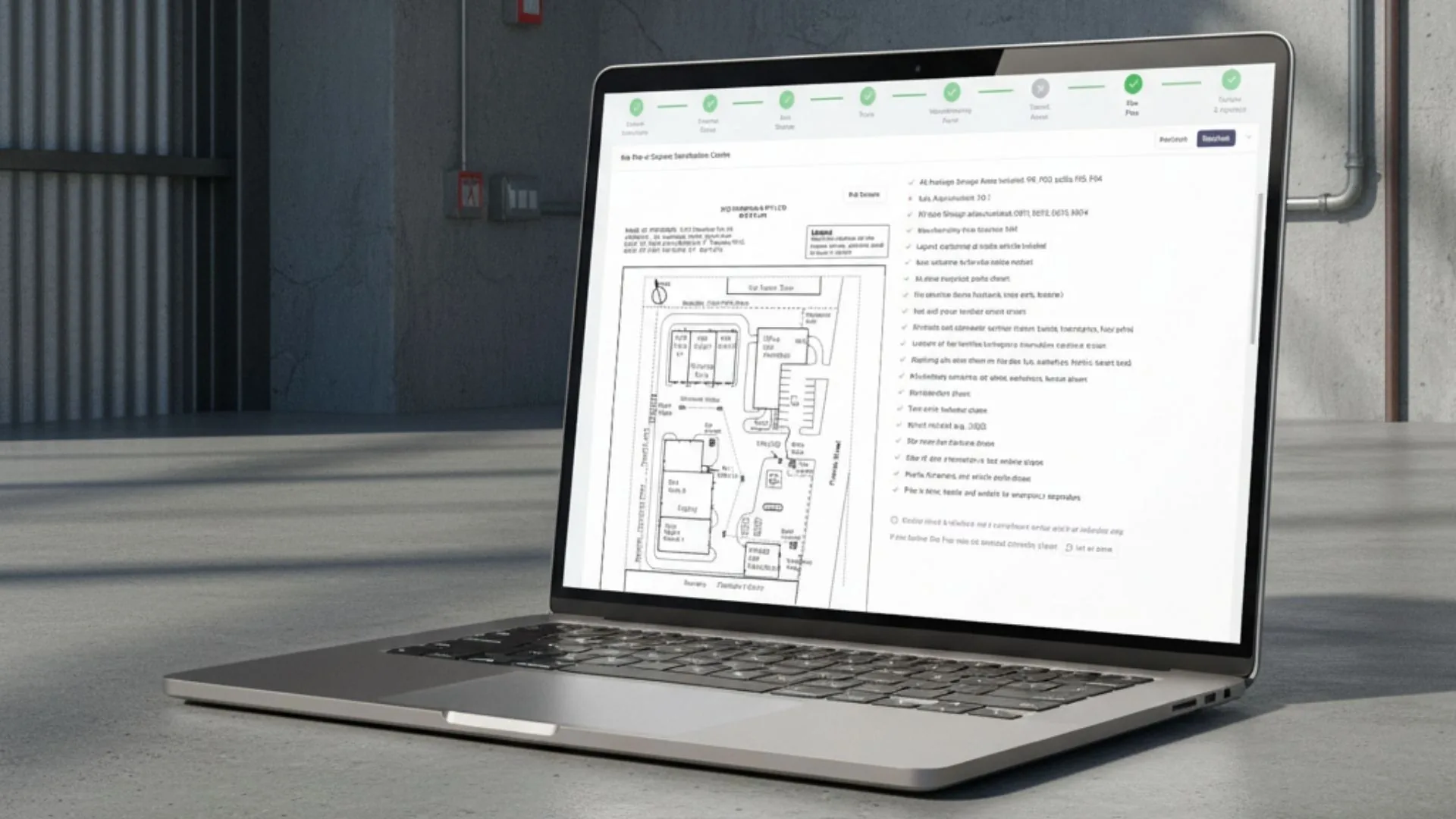
Feature Spotlight: Manifest Module
Platform-specific detail on how DGXprt automates compliant manifest creation directly from your site data.
Read articleFrequently asked questions
Common questions about dangerous goods compliance software.