Compliance sounds simple — until you try to do it properly. Here's what Australian businesses are dealing with, and why getting it right requires more than a spreadsheet and good intentions.
Dangerous Goods Are More Common Than You Think
Many businesses are surprised to discover they're affected. These aren't industrial facilities or chemical plants. If your workplace stores, uses, or handles everyday products like these, you likely have regulatory obligations — whether you know it or not.
Real example: A Queensland business recently received a $3,600 on-the-spot fine for a missing hazardous chemical register. The business didn't consider itself a chemical company. Neither might you — but the obligation still applies.
Two Registers Every Australian Workplace Must Maintain
These aren't optional — they apply to virtually any workplace that stores or uses chemicals. Many businesses have neither. Some have one but not the other. Even fewer have both kept current.
Safety Data Sheet (SDS) Register
A current Safety Data Sheet for every chemical stored or used at your workplace, maintained in an accessible register. Required under WHS Regulations across all states. Must be accessible to workers at any time — including after hours.
Common failure modes: SDS out of date · products changed but register not updated · stored in a folder no-one can find · SDS from the wrong supplier version
Chemical Inventory Register
A current list of all dangerous goods and hazardous chemicals at your site, including quantities. Required under state dangerous goods regulations and WHS legislation. Quantities must reflect what's on site — not what was there six months ago.
Common failure modes: Quantities outdated · new products added but register not updated · different people maintaining different lists · incorrect classifications
Both registers must be kept current. Having them once is not enough — an inspector can arrive tomorrow, and the question is whether they're accurate today.
The Regulatory Landscape: Fragmented, State-Specific, and Constantly Updated
Having registers is the floor — not the ceiling. Depending on what you store and how much of it, you may have additional obligations that most businesses don't even know exist. The below is just the most common — there are more prescriptive and complex ones.
- → Model WHS Act 2011
- → State WHS Regulations (each state)
- → State Dangerous Goods Acts
- → State Dangerous Goods Regulations
- → Storage & Handling of Dangerous Goods
- → Managing Risks of Hazardous Chemicals
- → Labelling of Workplace Hazardous Chemicals
- → Preparation of SDS
- → AS 1940 (flammable liquids)
- → AS 4452 (toxic substances)
- → AS 4326 (oxidising agents)
- → AS/NZS 1596 (LP Gas)
Australia has no single national dangerous goods framework. Each state and territory sets its own thresholds, notification requirements, and enforcement approach. A warehouse in Victoria faces different obligations than one in NSW or Queensland — even for the same chemicals in the same quantities.
Dangerous goods compliance is highly prescriptive — with far more obligations to understand, track, and meet than most teams expect. It rarely sits with one person as a full-time responsibility, which means things get missed, even with the best intentions.
Struggling to keep on top of your DG compliance? DGXprt + Managed Compliance handles the heavy lifting — so your team doesn't have to. See how it works →
Thresholds and Calculations: Where Obligations Escalate
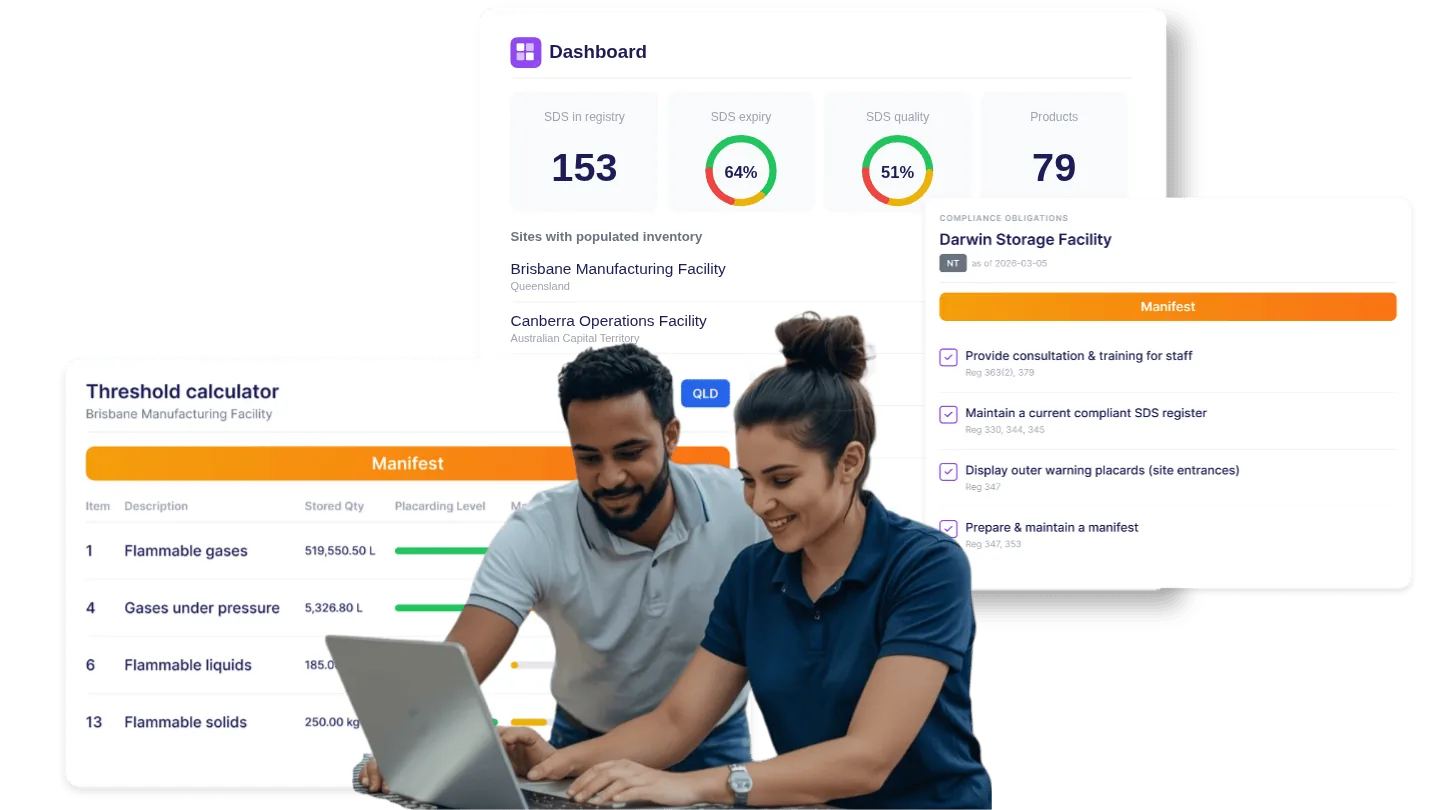
Once stored quantities cross a threshold, your base obligations increase — triggering additional requirements on top of what already applies. Calculating where you sit requires clean inventory data, current Safety Data Sheets, accurate classifications, and a working knowledge of your state's regulatory schedules.
What follows is a core summary only. The detail behind each obligation is significantly more involved.
Most businesses massively underestimate how time-consuming this is to get right. Getting it right once is hard enough. Keeping it current — as inventory changes, suppliers change, and regulations update — is a job in itself.
Don't Want to Figure This Out Alone?
DGXprt + Managed Compliance handles your registers, thresholds, and documentation — with expert oversight every month.
Frequently asked questions
Common questions about dangerous goods compliance software.