Every organisation that stores or handles hazardous chemicals and dangerous goods has a duty to manage the risks they present, and a risk assessment is how most show they have done it. The expectation is clear. Doing it well is the hard part.
The people completing assessments are usually site supervisors, warehouse leads and WHS generalists. Few are dangerous goods specialists or WHS professionals with deep hazardous chemicals knowledge, and fewer have time to spare. Yet most risk assessment tools assume that kind of specialist is doing the work. And the Safety Data Sheets those assessments rely on run to 16 technical sections that take time and expertise to interpret.
DGXprt 2026.9 introduces Product Risk Assessments, which close that gap with two layers of help: a guide to what to think about, and the SDS translated by AI into plain, practical language. It is the first step in taking DGXprt from a dangerous goods compliance tool to an active dangerous goods risk platform. The release also moves storage threshold calculations to assess directly against GHS classifications, the way the regulations are written.
NEW in 2026.9
Product Risk Assessments
Two layers of help, so anyone can assess well
Product Risk Assessments were developed with input from customers across logistics, retail and manufacturing, and one theme came up again and again: the people doing assessments are not specialists, yet the tools they are given assume they are.
Each assessment is created per product, per site, and built to guide even inexperienced users through a structured yet simple approach. Because DGXprt already holds each site's inventory and SDSs, every assessment starts from data already in the platform, not a blank form.
Layer 1: A guide to what to think about. The assessment works through four risk areas: fire and explosion, health and exposure, spills and the environment, and storage and segregation. Every area opens with plain-language guidance on what to consider at this site, from where vapours could build up to what else is stored nearby, and where in the SDS to look. It brings a dangerous goods and WHS specialist's way of thinking to the people doing the work.
Layer 2: The SDS, translated. DGXprt's AI reads the SDS and extracts the relevant hazards and controls, tailored to how the product is stored and handled on site. Dense technical content becomes practical language: what could cause harm, how it could happen here, and what needs to be in place, from the PPE to wear to what to do in a spill.
The assessor stays in control throughout. Everything extracted is labelled and editable, site-specific controls can be added, and a person scores the risk and signs off. The result is a well-made assessment, completed in less time. Specialist judgement still matters for high-risk products and complex sites, and Product Risk Assessments free specialists to focus there.
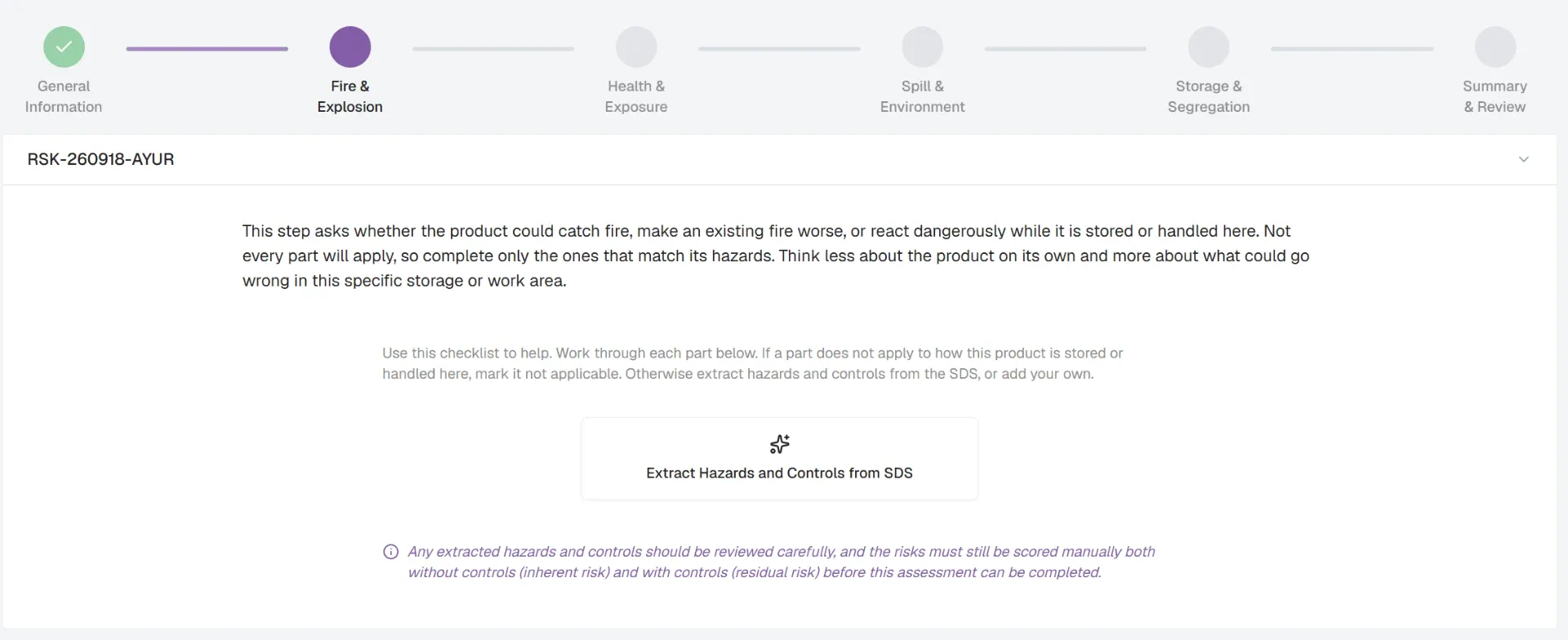
"Expert guidance and the SDS's detail, in words the team can act on."
Storage Threshold Calculator
Thresholds assessed directly against GHS, the way the regulations are written
In the harmonised WHS jurisdictions, Schedule 11 of the WHS Regulations sets placard and manifest quantities, and every one of its 43 items is defined by a GHS hazard class and category.
Unlike tools that start from the DG classes and map across to GHS, a step where some hazard detail can be lost, DGXprt now assesses thresholds the way the schedule is written. Every hazard a product carries counts, including subsidiary risks, and every figure traces back to a specific line on a Safety Data Sheet. For DGXprt customers, that means a threshold result they can explain to any regulator or auditor, and a clear view of the products driving it. Western Australia and Victoria continue to be assessed under their own frameworks.
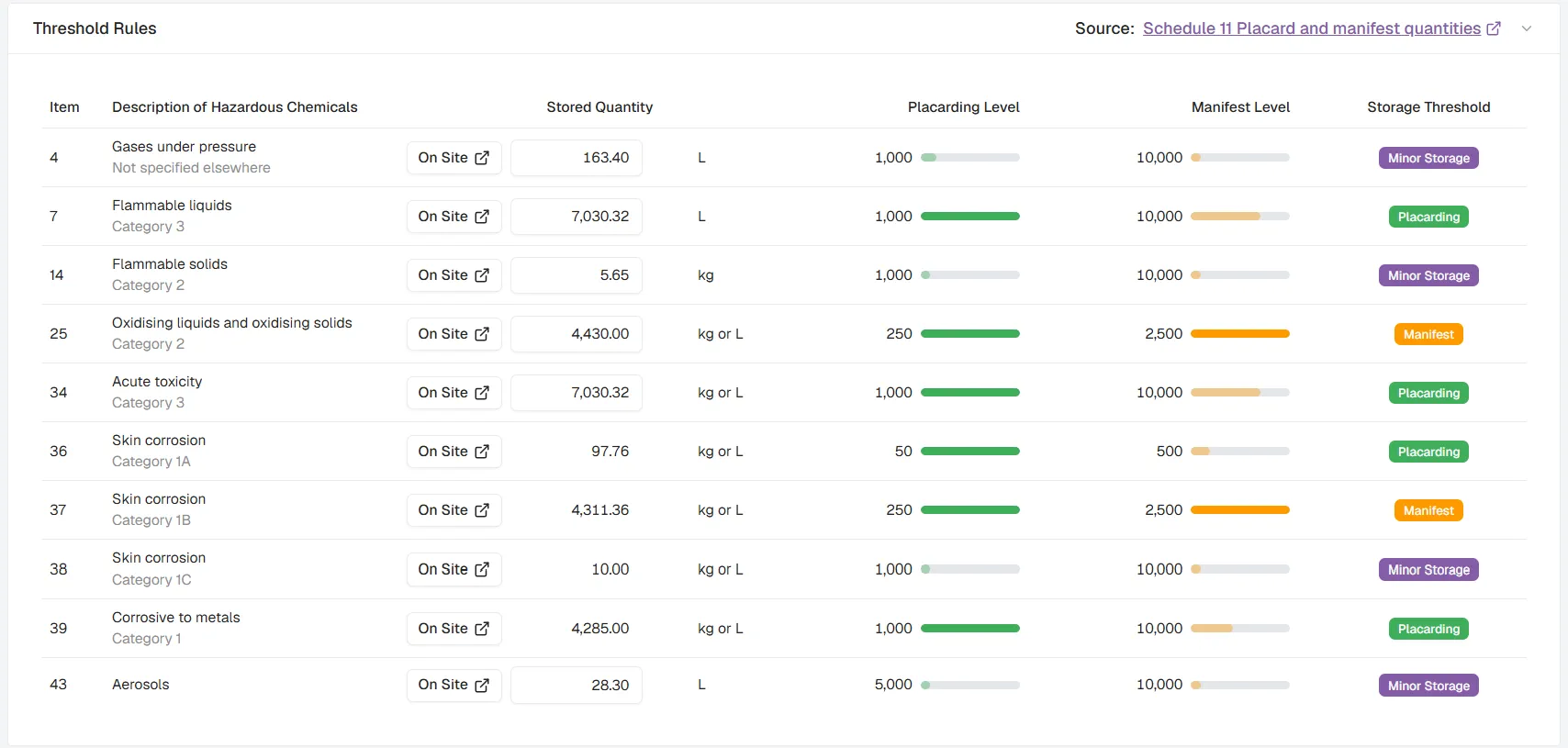
"Every number, traced back to the SDS line that drove it."
MHF Assessments
A complex assessment made fast and simple, now even more precise
Working out whether a site is approaching or crossing Major Hazard Facility thresholds has traditionally been specialist, spreadsheet-heavy work. DGXprt already makes it fast and simple, building the assessment directly from a site's live inventory and SDS data across Australian jurisdictions.
2026.9 goes further, giving assessors more ways to reach a scientifically backed result. SDSs are not always complete, current or specific to the material actually held, so assessors can now refine the composition, density and toxicity classification used in the calculation. DGXprt also now takes the route of exposure into account when determining toxicity. Every adjustment is recorded on screen with the original SDS value, the new value and the reason, and carried through to the exported assessment.
"A more accurate number, and the evidence behind it."
Also in this release
More control, less friction
- Site-level access. Users can be restricted to a single site, supporting clear site accountability across multi-site organisations.
- Everyday improvements across product management, manifests and the DG / Hazardous Chemicals Register, shaped by customer feedback.
The bigger picture
Deep in dangerous goods. Built on AI.
2026.9 marks the next stage for DGXprt. Compliance shows where an organisation stands against the rules. Risk management changes what happens on site. Risk assessments begin DGXprt's shift from a dangerous goods compliance tool to an active dangerous goods risk platform, used by the site and WHS teams who store and handle dangerous goods every day.
Broad EHS suites treat chemicals as one module among many. DGXprt goes deep in one specialist domain: dangerous goods and hazardous chemicals. Every module, from the register and thresholds to MHF and now risk assessments, builds on the same foundation of live site inventory and SDS data, so every release strengthens the whole platform.
DGXprt has been AI-native from day one, using AI where it adds most and rules where certainty matters. AI reads every SDS and extracts the data. DGXprt's deterministic rules engine applies the regulatory requirements, so results are consistent and traceable. AI Assistants grounded in the regulatory set help people understand their obligations. People stay in charge of every decision.
2026.9 follows the Segregation module in 2026.7 and the Australia-wide Obligations AI Assistant in 2026.8. DGXprt now supports more than 200 active sites and 12,000 SDSs across Australia.
"Most risk assessment tools are built for specialists, but the people doing the assessments usually aren't specialists, and they shouldn't have to be. Product Risk Assessments give them a specialist's way of thinking and the SDS in plain language. It's also a clear signal of where DGXprt is heading: from showing compliance to actively managing dangerous goods risk."
David Irvine, Co-Founder and CEO, DGXprt
To learn more about DGXprt, contact info@dgxprt.com.
Continue reading
DGXprt 2026.8: A burning DG compliance question. A clear answer, right now.
Australia-wide coverage for the Obligations AI Assistant, parent and sub-site support, and smarter Class 8 corrosive segregation guidance.
Read moreExplore DGXprtDangerous goods compliance software built for Australian requirements
See how DGXprt turns live site inventory and SDS data into clear, traceable compliance guidance.
Read more