Dangerous goods compliance in South Australia: two frameworks, thresholds and what your business needs to know
Most businesses do not think of themselves as dangerous goods sites.
They are schools, councils, manufacturers, warehouses, laboratories, workshops, retailers, healthcare facilities, farms, contractors or service businesses. They store the products they need to operate: fuels, gases, aerosols, corrosives, solvents, cleaning chemicals, pool chemicals, laboratory reagents or maintenance products.
But once dangerous goods or hazardous chemicals are stored on site, compliance obligations can be triggered quickly.
It is not only about having Safety Data Sheets. Quantities matter. Storage locations matter. Container types matter. So do placards, manifests, emergency planning, segregation, bunding, firefighting equipment and, in South Australia, licensing at higher quantities.
This is where SA can catch businesses out.
South Australia requires businesses to navigate two separate but connected regulatory frameworks. The WHS Regulations 2012 set the base obligations for hazardous chemicals and, in SA, also contain the placarding and manifest requirements. The Dangerous Substances (General) Regulations 2017 add a separate layer focused on physical storage standards, container specifications, separation, bunding and Licence to Keep requirements at higher quantities.
SafeWork SA is the primary regulator for both frameworks. At manifest quantities, the Metropolitan Fire Service or Country Fire Service may also become involved, depending on the site location.
For SA businesses, the key question is not simply: “Do we have dangerous goods?”
It is: “Which obligations apply to our site, under which framework, and at what quantity?”
Disclaimer: This page provides a general overview of dangerous goods compliance obligations in South Australia. It is not a complete or definitive statement of the law and should not be relied upon as legal or compliance advice. Obligations vary by substance, quantity, site configuration and the specific regulations in force at the time. Always consult the relevant legislation directly or seek qualified professional advice for your circumstances.
South Australia's two regulatory frameworks
Framework 1: Work Health and Safety Regulations 2012 (SA)
Applies to hazardous chemicals (GHS classification). Covers worker health protection, SDS, register, labelling, risk management, training — and in SA specifically, also placarding and manifests. Administered by SafeWork SA.
Framework 2: Dangerous Substances (General) Regulations 2017 (SA)
Applies to dangerous substances (ADG Code classification). Focuses on immediate physical hazards: fire, explosion, toxic release. Adds physical storage standards, Australian Standards compliance for containers, separation and bunding requirements, and, at higher quantities, a Licence to Keep. Also administered by SafeWork SA.
Key SA distinction: Unlike Western Australia, where placarding and manifests sit in the separate DG Safety Regulations, South Australia keeps these obligations within the WHS Regulations. This means the WHS framework does more heavy lifting in SA than in WA.
Framework 1: WHS Regulations — what applies at any quantity
The WHS Regulations 2012 (SA) set a base layer of obligations that apply to any SA business using, handling or storing hazardous chemicals, regardless of quantity. The first chemical on site triggers these requirements.
Safety Data Sheets
A current SDS must be obtained on first supply and after any amendment, made readily accessible to workers and emergency responders. SDS must comply with the WHS Regulations and Schedule 7. You cannot alter an SDS unless you are the manufacturer or importer. A translation may be attached but must clearly state it is not part of the original.
DGXprt stores, versions and validates your entire SDS library — flagging expired or non-compliant SDS before they become a gap. Accessible to workers and emergency responders at any time.
dgxprt.com/solutions/sds-management →Hazardous Chemicals Register
An up-to-date register of every hazardous chemical at the workplace, together with its current SDS, must be maintained and made accessible to workers and anyone else likely to be affected (reg 346). The register must reflect the current inventory.
DGXprt generates your compliant hazardous chemicals register automatically from your SDS library. No manual reconciliation required.
dgxprt.com/solutions/sds-register →Labelling, risk management and training
All hazardous chemicals must be correctly labelled, including decanted containers, with labels remaining legible in use and pipework identified. Risk controls must be identified, implemented and reviewed at least every five years or when circumstances change. Ignition sources must be controlled in hazardous areas. Workers must receive information, instruction and supervision proportionate to the risk they face.
Firefighting equipment must be appropriate for the types and quantities of chemicals on site and compatible with equipment used by the MFS or CFS (depending on your location). Equipment must be properly installed, tested and maintained with dated records kept. Emergency equipment must always be available. Every workplace must have an emergency plan.
Placarding (under WHS — SA-specific structure)
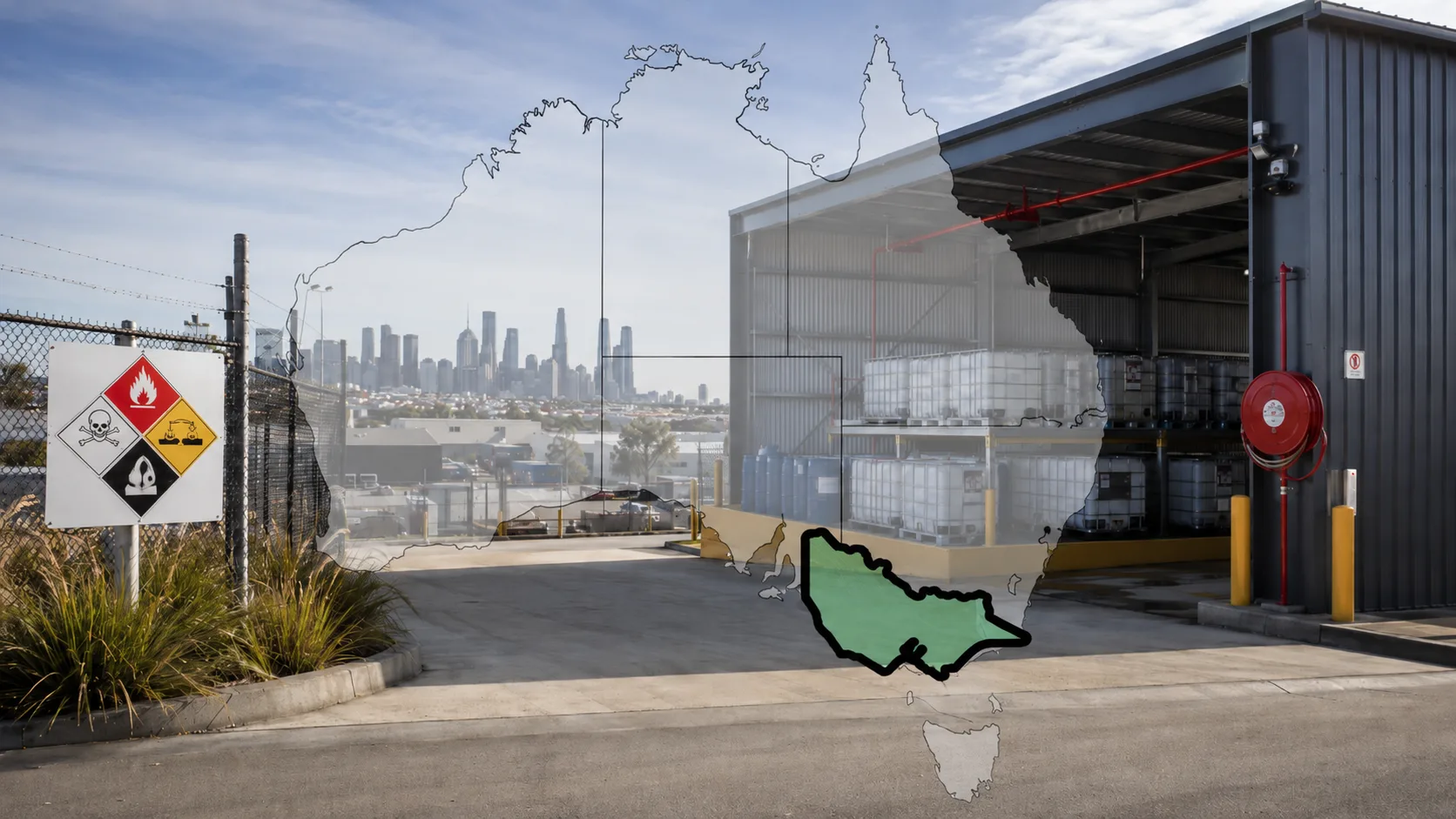
In South Australia, placarding obligations sit within the WHS Regulations, not the Dangerous Substances Regulations. Once quantities exceed the Schedule 11 placard thresholds, an outer warning placard must be prominently displayed at the workplace, complying with Schedule 13 (displaying 'HAZCHEM' in red letters on a white or silver background). Placards must also be displayed for specific storage areas and bulk containers exceeding placard thresholds.
This is a structural difference from WA. An SA business managing its WHS obligations is also managing its placarding obligations. There is no separate placard regime to track under a different regulator or instrument.
Manifest quantities (under WHS)
At manifest quantities, you must prepare and maintain a manifest in Schedule 12 format, notify SafeWork SA in writing before first exceeding manifest thresholds and before significant changes, and notify again if quantities fall below manifest levels. A copy of the emergency plan must be provided to the relevant fire service (MFS or CFS) and revised if they make written recommendations.
DGXprt generates your Schedule 12-compliant manifest from your chemical inventory. When quantities or types change, your manifest updates — ready to provide to SafeWork SA and the relevant fire service.
dgxprt.com/solutions/manifest →Framework 2: Dangerous Substances (General) Regulations 2017 — physical storage standards
The Dangerous Substances (General) Regulations 2017 apply to dangerous substances under the ADG Code and add a layer of physical storage and handling requirements on top of the WHS obligations. These are not alternatives to WHS compliance — they apply in addition.
DGXprt calculates which DS Regulations obligations apply alongside your WHS tier — based on your specific chemical inventory and quantities, with regulation references for both frameworks.
dgxprt.com/solutions/thresholds-obligations →SA requires Licence to Keep at higher quantities
Above the licensing threshold under the Dangerous Substances (General) Regulations 2017, a Licence to Keep is required to store dangerous substances at your site. This is a South Australia-specific licensing mechanism — it exists in addition to the WHS manifest notification regime. Operators approaching or exceeding licensing thresholds should confirm their current licence status with SafeWork SA. DGXprt's threshold calculator flags when quantities are approaching the licensing trigger.
Minor storage — non-licensed obligations
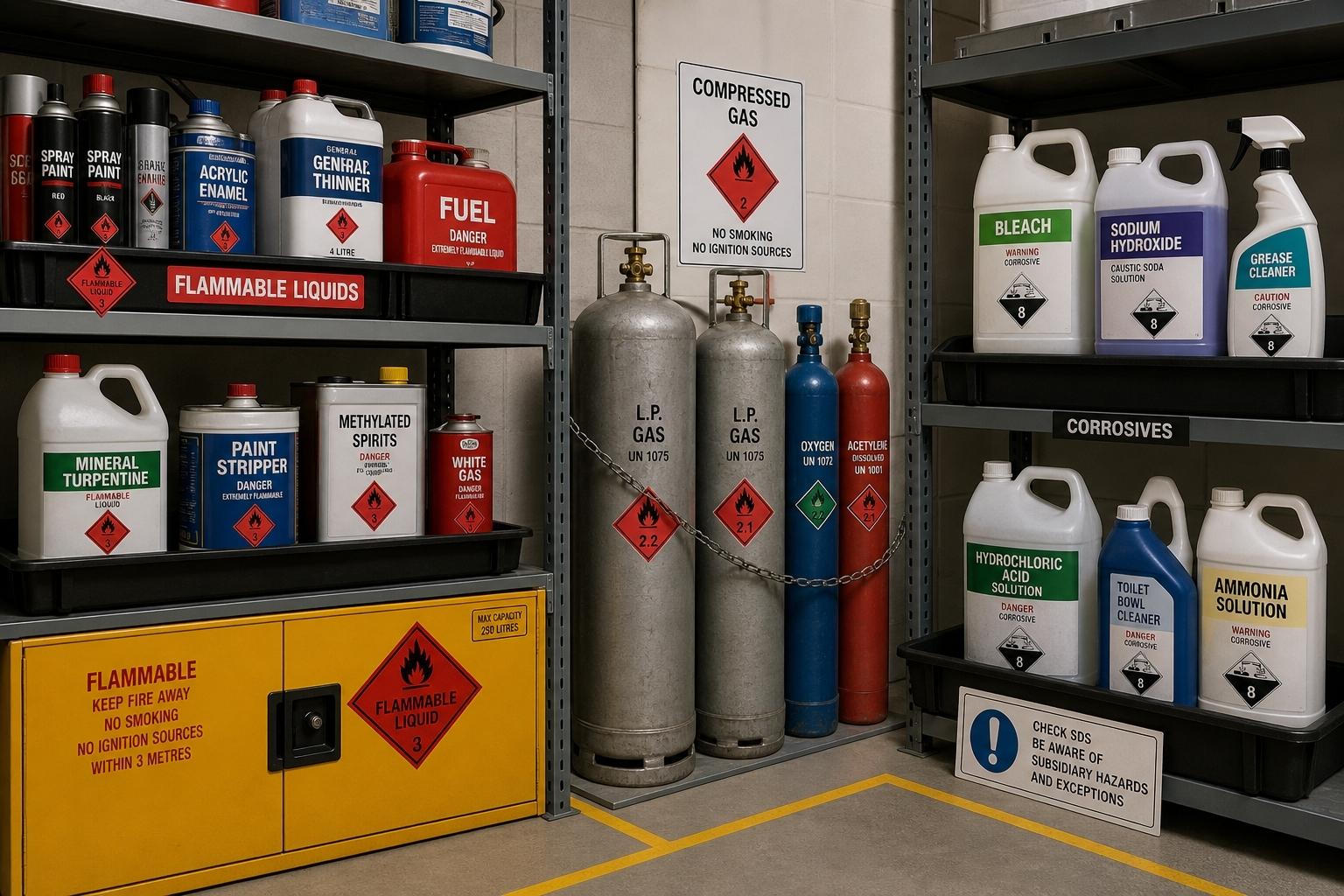
At quantities below the licensing threshold, businesses storing dangerous substances must meet a set of physical safety requirements under the DS Regulations. These are particularly focused on Class 6 (Toxic) and Class 8 (Corrosive) substances, and Class 2 (gases) and Class 3 (flammable liquids).
Toxic and Corrosive substances must be protected from the weather at all times, and storage areas must be locked or supervised by a responsible person to prevent unauthorised access. For quantities above 50 litres or kilograms of high-hazard (Packing Group I) Class 6 or Class 8 substances, a hazard warning sign of at least 250mm must be displayed at each entrance to the storage area.
Incompatible substances must be segregated — Class 6 and Class 8 substances that could react to cause fire, explosion or toxic gas release must be physically separated. Toxic and Corrosive substances must also be stored away from food, medical supplies and food packaging, as both liquid spills and airborne vapours can cause contamination.
Spill containment infrastructure must be in place to capture any leak or spill of liquid Toxic or Corrosive substances. Discharge to drains, stormwater channels or watercourses is prohibited. Leaking tanks, pipes or pumps must be taken out of service immediately until repaired.
Container standards are specific under the DS Regulations. Class 3 (flammable liquids) in containers under 20 litres must be in strong, completely closed containers. Containers of 20 litres or more must be approved steel drums meeting AS 2950:1986. LPG cylinders and tanks must comply with AS/NZS 1596:2014, AS 2030.1:2009, and AS 2030.5:2009 — and must bear a current test date stamp. These are not aspirational standards; they are regulatory requirements.
How the two frameworks interact in practice
For most SA businesses, the WHS Regulations cover the majority of day-to-day compliance obligations including placarding and manifests. The DS Regulations add the physical storage layer — container specifications, bunding, segregation, weather protection, access control — and the licensing requirement at higher quantities.
A SafeWork SA inspector visiting your site may look at both frameworks in a single visit. Non-compliance under the DS Regulations — an out-of-date cylinder, inadequate bunding, unlicensed storage above the threshold — is not a minor oversight. The Australian Standards referenced in the DS Regulations have specific technical requirements, and using non-compliant containers or cylinders is a regulatory breach regardless of how long the arrangement has been in place.
The clearest risk for SA businesses is not knowing which framework applies to a particular obligation, and assuming that WHS compliance alone is sufficient. For businesses with Class 3, Class 6 or Class 8 substances, the DS Regulations add meaningful requirements that sit alongside the WHS framework, not inside it.
Know your South Australian DG compliance position
DGXprt automates threshold calculations across both the WHS Regulations 2012 and the Dangerous Substances (General) Regulations 2017 — generating compliant manifests, flagging Licence to Keep triggers, and tracking your full obligation set as inventory changes.
Frequently asked questions
Common questions about dangerous goods compliance software.