Dangerous Goods Compliance in Western Australia: Two Frameworks, Thresholds and What Your Business Needs to Know
An operations manager at a Kewdale distribution centre takes a call from a freight client.
The client needs to leave a container of solvents on site for two months while their own warehouse is being refitted. The container is sealed. The goods are packaged. The request is temporary. There is space in the yard.
It feels like a simple operational decision.
So the site says yes.
A few weeks later, a DMIRS inspector visits on an unrelated matter and asks a different set of questions.
Where is the dangerous goods manifest? Is the site licensed for these quantities? Are the placards correct? Is the site plan current? Has the new stock changed the site’s dangerous goods threshold position?
The team checks the paperwork. The SDS are available. The stock has been recorded somewhere. But the manifest has not been updated, the placarding has not been reviewed, and no one checked whether the temporary container pushed the site into a licensing requirement.
In Western Australia, that is not just a paperwork gap.
If dangerous goods are stored above manifest quantities, the site must hold a current dangerous goods site licence before operating at those quantities. Operating above those quantities without a licence is unlicensed operation of a dangerous goods site.
WA is different from most other Australian states because dangerous goods compliance is split across two separate regulatory frameworks. The WHS Regulations cover hazardous chemical obligations such as SDS, registers, labelling, worker health protection, risk management and training. The Dangerous Goods Safety Regulations cover the physical hazard side, including placarding, dangerous goods site classification, manifests, site plans, Hazmat Box requirements and licensing.
For WA businesses, the practical question is not only:
“Can we store this?”
It is:
“Does storing this change our WHS obligations, our dangerous goods tier, or our licence position?”
Disclaimer: This page provides a general overview of dangerous goods compliance obligations in Western Australia. It is not a complete or definitive statement of the law and should not be relied upon as legal or compliance advice. Obligations vary by substance, quantity, site configuration and the specific regulations in force at the time. Always consult the relevant legislation directly or seek qualified professional advice for your circumstances.
Two Frameworks, Two Regulators
In Queensland, NSW, Tasmania, the ACT and the Commonwealth, hazardous chemical and dangerous goods obligations largely sit within a single instrument: the model WHS Regulations. In Western Australia they are split across two separate pieces of legislation, each administered by a different agency.
Framework 1: WHS (General) Regulations 2022
Applies to hazardous chemicals — substances classified under GHS. Focuses on protecting workers from health risks: toxicity, burns, respiratory harm, long-term illness. Administered by WorkSafe Western Australia.
Framework 2: Dangerous Goods Safety (Storage and Handling of Non-explosives) Regulations 2007
Applies to dangerous goods — substances classified under the ADG Code. Focuses on protecting public safety, property and the environment from immediate physical hazards: fires, explosions, major spills. Administered by DMIRS (Department of Mines, Industry Regulation and Safety).
Most substances your business handles are classified as both a hazardous chemical and a dangerous good. Full compliance in WA means meeting the requirements of both frameworks.
Framework 1: WHS Obligations That Apply at Any Quantity
The WHS Regulations set a base layer of obligations that apply to any WA business using, handling or storing hazardous chemicals — regardless of quantity. There are no threshold tiers under the WHS Regulations. The first chemical on site triggers these requirements.
Safety Data Sheets
You must obtain a current SDS on first supply of any hazardous chemical and after any amendment, and make it readily accessible to workers and emergency responders. ‘Readily accessible’ means available when needed — not locked away or accessible only to management. SDS provided by manufacturers and importers must comply with the WHS Regulations and Schedule 7. You cannot alter an SDS unless you are the manufacturer or importer.
DGXprt stores, versions and validates your SDS library — flagging expired or non-compliant SDS before they become a compliance gap. Your library is accessible to workers and emergency responders at any time.
dgxprt.com/solutions/sds-management →Hazardous Chemicals Register
You must maintain an up-to-date register of every hazardous chemical used, handled or stored at your workplace, together with its current SDS (reg 346). The register must be accessible to workers and anyone else likely to be affected. It is not a document you set up once — it must reflect your live inventory as chemicals arrive, are removed, or have amended SDS.
DGXprt generates your compliant hazardous chemicals register automatically from your SDS library. When your SDS library is current, your register is current.
dgxprt.com/solutions/sds-register →Labelling, Risk Management and Training
All hazardous chemicals must be correctly labelled — including chemicals decanted or transferred into a different container — and labels must remain legible while the chemical is in use. Pipework must also be identified.
Risk management obligations require you to identify hazards, assess and control risks, and review controls at least every five years or sooner when circumstances change — for example, after an SDS amendment, after a health monitoring report flags exposure, or if airborne monitoring exceeds exposure standards. Incompatible chemicals must be identified and segregated. Ignition sources must be controlled in hazardous areas. Chemicals must not become unstable or contaminate food or personal-use products.
Workers who use, handle or store hazardous chemicals must receive appropriate training and supervision. Training without a system to embed it in day-to-day operations provides limited protection — knowing what to do during induction does not help if the SDS cannot be found during an incident.
Fire Protection, Emergency Equipment and Emergency Plan
Firefighting equipment must be appropriate for the types and quantities of chemicals on site. In WA, the WHS Regulations explicitly require it to also be compatible with equipment used by the Fire and Emergency Services (FES) Department — this compatibility requirement is specific to WA and worth checking with FES if you are not certain.
Equipment must be properly installed, tested and maintained, with dated records kept. If equipment becomes unserviceable, alternative risk controls must be implemented immediately while repairs are arranged. Emergency equipment — spill kits, PPE, first aid — must always be available. Every workplace must have an emergency plan suited to its hazards, size, layout and workforce.
Health monitoring obligations apply where workers are at significant risk from Schedule 14 chemicals. Records must be retained for at least 30 years. Prohibited and restricted carcinogens cannot be used, handled or stored without regulator authorisation.
Framework 2: Dangerous Goods Safety Regulations — Physical Hazard Thresholds
The Dangerous Goods Safety (Storage and Handling of Non-explosives) Regulations 2007 use a tiered threshold system based on the quantities of dangerous goods you store. The thresholds are set out in Schedule 1 and vary by chemical class and packing group. As your quantities increase, each tier adds a new layer of obligations on top of the one below.
Your threshold tier is not a one-time assessment. Quantities change — a new chemical is introduced, storage increases to cover a busy period, a product line expands. Crossing into a new tier in WA can mean a licensing obligation, a bunding infrastructure requirement, or a Hazmat Box that must be in place before goods arrive.
DGXprt determines your current DG Safety tier from your chemical inventory and quantities — and shows exactly which WHS and DG Safety obligations apply to your site, with regulation references, updated as your inventory changes.
dgxprt.com/solutions/thresholds-obligations →Tier 1 — Small Quantity Dangerous Goods Location
If the dangerous goods you store do not exceed the Schedule 1 placarding quantities, your site is a Small Quantity Dangerous Goods Location (SQDGL). Obligations are lighter at this tier, but they are not zero.
At a SQDGL you must clean up and dispose of any spill or leak as soon as practicable, protect dangerous goods and storage systems from impact damage, prevent unauthorised access to stored goods, eliminate or control ignition sources in hazardous areas, and ensure incompatible goods cannot interact or contaminate each other. Anyone involved in storage or handling must receive induction and training that covers hazard properties, risk controls, systems of work and proper PPE use — and it must be provided in a language and manner appropriate to the person.
Tier 2 — Dangerous Goods Site (Placarding Quantities)
Once your quantities exceed the Schedule 1 placarding thresholds, your site becomes a “dangerous goods site” under Part 4 of the DG Safety Regulations. The step up from Tier 1 is material — both in terms of physical infrastructure requirements and the visibility your site must give to emergency responders.
Physical requirements that apply from this tier include bunded storage — a drain, sump, tank, compound or other built system capable of containing and recovering any spilled or leaked goods in each storage area (Class 2 gases are exempt). A spill kit alone is not sufficient. Goods must be segregated so incompatible substances cannot interact, and the site must have adequate fire control equipment compatible with FES equipment, tested and maintained to manufacturer specifications.
Placarding requirements kick in at this tier, and the placard type matters. WA’s DG Safety framework uses ADG Code HAZCHEM placards, not the GHS hazard pictograms used on SDS and WHS labels. These are different classification systems serving different purposes: GHS manages health risk information in the workplace; ADG Code HAZCHEM tells emergency responders at the gate what they are dealing with and how to respond.
HAZCHEM outer warning placards must be displayed at every entrance to the site (or at an FES Commissioner or Dangerous Goods Officer-approved alternative location). Class label placards are required at the entrance to any building, room or walled section where packaged goods exceed the placarding quantity. Every bulk container — defined as greater than 500L or 500kg — must carry the relevant placard or Emergency Information Panel, both on the container itself and at the entrance to its building. Bulk goods must also display the Hazchem Code from ADG Code Appendix C.
SDS must be accessible not only to workers but to FES Department officers. Site access and exits must be kept unobstructed and secure against unauthorised entry at all times. Training records must be retained for at least five years.
Tier 3 — Manifest Quantity Site (Licensing Required)
When dangerous goods quantities exceed the Schedule 1 manifest thresholds, the site enters the highest tier and a formal licensing regime applies under Part 4 Division 1 of the DG Safety Regulations. A current dangerous goods site licence must be held before operating at these quantities. The licence application requires a location plan, a written risk assessment, and the manifest and site plan. Annual fees apply.
Operating above manifest quantities without a licence is not a documentation gap — it is unlicensed operation of a dangerous goods site.
At manifest quantities, a written risk assessment of all dangerous goods at the site must be prepared and kept on record. It must be reviewed every five years, after any significant change to processes or systems, or after a reportable incident — and a revised risk assessment must accompany any incident report to the Chief Officer.
A written emergency plan must be maintained and kept readily available to workers. It must be reviewed every three years, after significant changes, or after a dangerous situation. If a dangerous situation at your site could extend to an adjacent property, you must proactively inform the neighbouring occupier of the risks and what actions to take — this neighbour notification obligation has no direct equivalent in most other Australian states.
The Hazmat Box
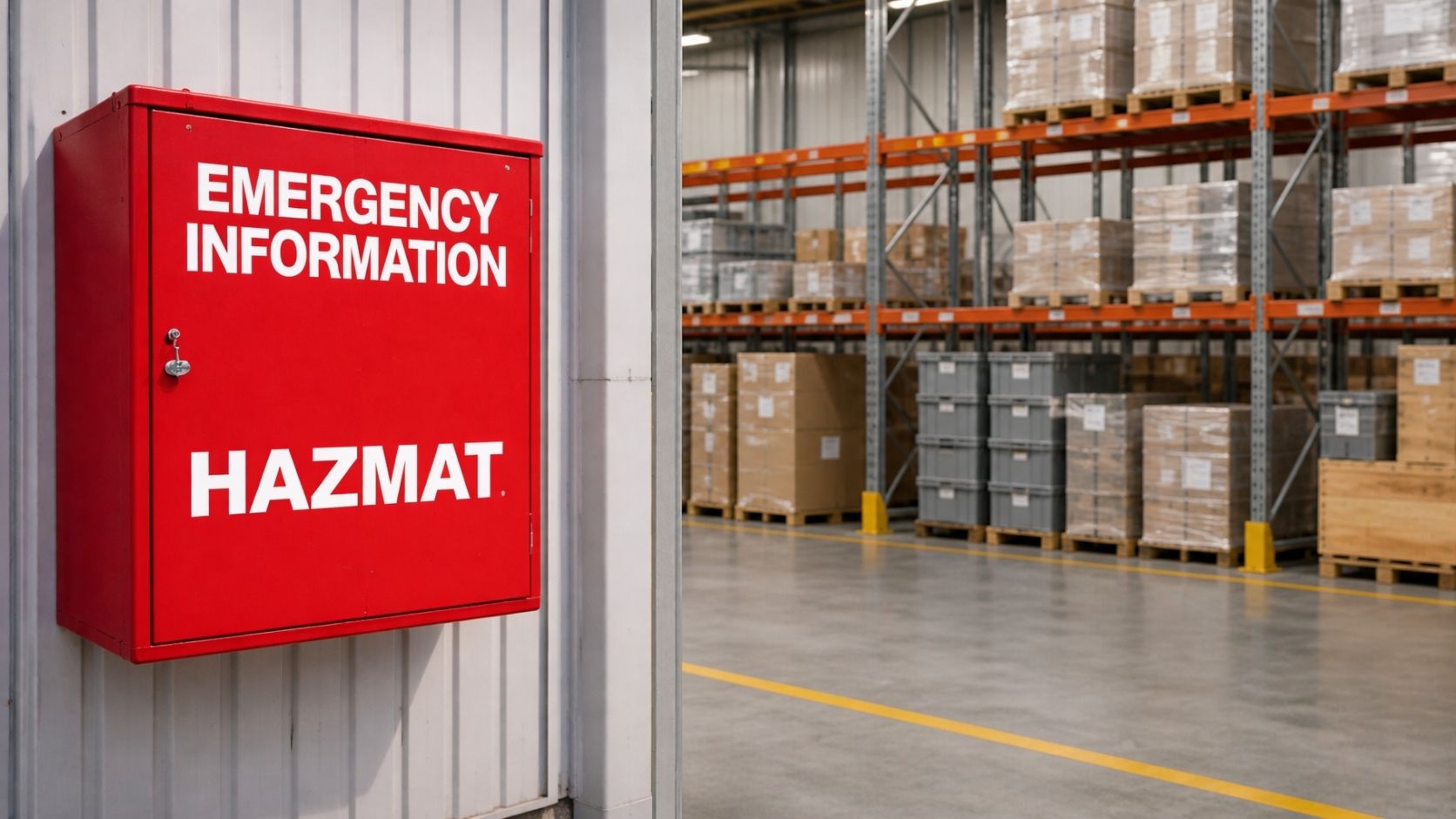
At manifest quantities, the manifest and site plan must be stored in a red Hazmat Box kept at the site entrance — physically accessible to Dangerous Goods Officers and FES officers on arrival, without needing to enter the site or locate a staff member. The manifest must follow the Schedule 3 Division 2 format (summary list of goods, bulk tank details, emergency contacts). The site plan must meet the Schedule 3 Division 3 requirements (boundaries, buildings, storage areas, drains, fire services). This is a WA-specific requirement with no equivalent in other states.
DGXprt generates a Schedule 3-compliant manifest and site plan from your chemical inventory — ready to print and place in the Hazmat Box. When quantities change, your manifest updates automatically.
dgxprt.com/solutions/manifest →Sites storing more than ten times the manifest quantity face one further obligation: an agreed FES Emergency Response Guide must be prepared for the site, with a current copy held at the nearest fire station. This is a WA-specific mechanism designed for very high-volume sites, with no equivalent in the QLD or NSW frameworks. The DMIRS Chief Officer must be notified of any reportable situation — a spill, leak, fire, explosion or unexpected release of energy. The site licence must also be amended before increasing quantities above the licensed limit or changing the types of goods stored.
How the Obligations Stack Up in Practice
The two frameworks and the DG Safety tiers are cumulative. A manifest quantity site is not just managing manifest obligations — it must simultaneously meet all WHS obligations, all SQDGL obligations, all placarding-tier obligations, and all manifest-tier obligations. Two regulators, both with inspection powers, both looking at different parts of the same site.
Example: fuel and chemical distribution in WA
A distribution site storing diesel, industrial solvents and compressed gases above manifest quantities must: hold a current WorkSafe-registered SDS for every chemical; maintain a live hazardous chemicals register under WHS; correctly label all containers including decanted quantities; display HAZCHEM outer warning placards at every site entrance; display class label placards and Emergency Information Panels on bulk containers; maintain bunded storage for liquids; hold a current dangerous goods site licence from DMIRS; maintain a written risk assessment reviewed every five years; maintain a written emergency plan reviewed every three years; keep a Schedule 3-compliant manifest and site plan in a red Hazmat Box at the entrance; ensure firefighting equipment is compatible with FES equipment; and notify adjacent occupiers if a dangerous situation could extend beyond the boundary. If quantities exceed ten times the manifest threshold, an agreed FES Emergency Response Guide is also required.
Managing WA Compliance in One Place
WA’s dual-framework structure means compliance tracking is more complex than in any other Australian state. The obligations that apply to your site depend on the specific chemicals you hold, their ADG classification, their GHS classification, the quantities you store, and which tier each chemical puts you in — and that picture changes as your inventory changes.
DGXprt is built to manage both frameworks from a single platform. Your SDS library drives your hazardous chemicals register under WHS. Your chemical inventory and quantities drive your DG Safety tier calculation under Schedule 1. Your compliance obligations view shows what applies to your site — by regulation reference, under both frameworks — and updates as your inventory changes. Your manifest and site plan are generated in Schedule 3 format, ready for the Hazmat Box.
Know your WA DG compliance position
DGXprt manages both WA frameworks in one place — SDS, registers, threshold tiers, licensing triggers, Schedule 3 manifest generation and Hazmat Box-ready site documentation.
Frequently asked questions
Common questions about dangerous goods compliance software.