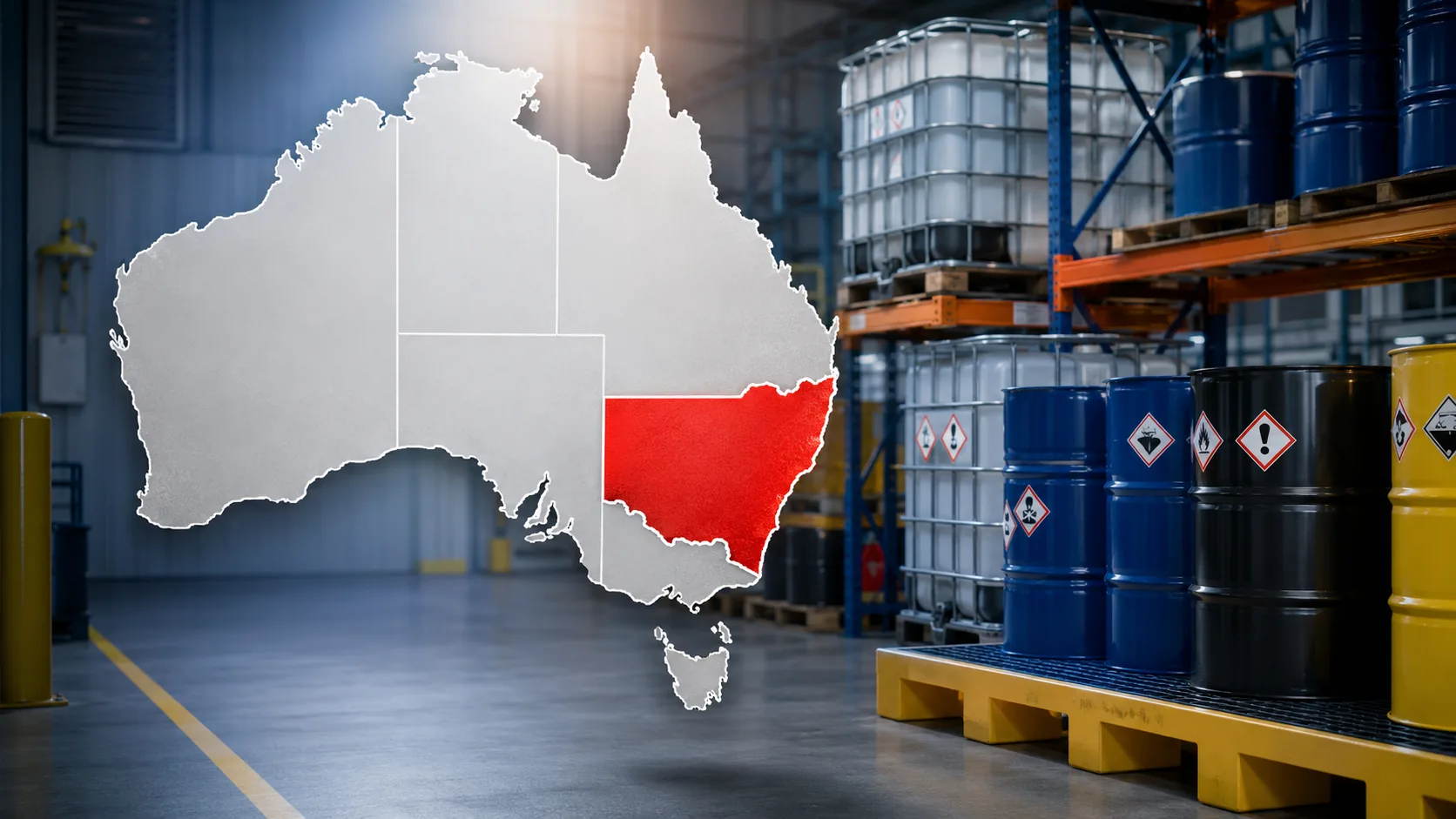
Last updated: October 2026. Covers NSW, QLD, VIC, WA, SA, TAS, ACT and NT.
In short:
- A hazardous chemical risk assessment determines what a chemical could do, who could be harmed, how likely and serious the risk is, and which controls reduce the risk as far as reasonably practicable.
- Every state except Victoria uses a version of the national model Code of Practice, so the process is similar across most of Australia.
- In NSW (from 1 July 2026) and Queensland (from 2018), you must comply with the Code of Practice or demonstrate an equal or higher standard.
- Victoria regulates chemicals separately as hazardous substances and dangerous goods. WA and SA also have separate laws for dangerous goods storage, and the NT has additional rules for LPG and fuel gas.
- Writing the assessment is not mandatory, but it is your best evidence that you met the standard.
If your business uses, stores or handles hazardous chemicals anywhere in Australia, a Code of Practice sets out how to do so safely. Each state and territory has its own version, and they run to more than 100 pages. This guide distils what matters for those who do the work: the store supervisor, the site manager and the safety lead who is not a chemist.
Most states adopt a version of Safe Work Australia's Model Code of Practice: Managing risks of hazardous chemicals in the workplace, so the core process in this guide applies nationally.
What differs is the legal weight of the Code of Practice and some additional dangerous goods rules, summarised by state below.
This guide focuses on one product at a time, in one place. That is how most real assessments start: a chemical arrives, and someone has to work out how to store and handle it safely.
What counts as a hazardous chemical?
A hazardous chemical is any substance, mixture or article that meets the criteria for at least one GHS hazard class under the WHS Regulations. In practice, most products with a GHS label or a hazard classification on their SDS are in scope.
There are a few minor exceptions. A product is not a hazardous chemical under the WHS Regulations if its only classifications are one or more of the following:
- acute toxicity Category 5 (oral, dermal or inhalation)
- skin irritation Category 3
- aspiration hazard Category 2
- flammable gas Category 2
- hazardous to the aquatic environment (acute or chronic)
- hazardous to the ozone layer
A product classified only as toxic to aquatic life can carry a GHS pictogram yet fall outside the WHS hazardous chemicals rules. It may still be a dangerous good, often Class 9, and environmental laws still apply.
This definition is the same across all states and territories that use the WHS laws. Victoria is different: a "hazardous substance" covers health hazards only, with similar low-level exclusions, while physical hazards such as flammability are dealt with as dangerous goods.
Most dangerous goods are hazardous chemicals. The exceptions are Class 7 (radioactive), Division 6.2 (infectious substances), and most Class 9 goods. Therefore, the Code of Practice applies to almost everything in a typical DG store. Transport is regulated separately under the ADG Code and each state's dangerous goods transport laws.
The Code of Practice splits hazards into two types, and many chemicals are both:
- Health hazards: harm to people through breathing it in, skin or eye contact, or swallowing it. Effects can be short-term (burns, nausea) or long-term (asthma, dermatitis, cancer).
- Physical hazards: immediate injury or damage, such as fire, explosion, corrosion or a violent reaction.
How do you assess hazardous chemical risks? The five steps
The Code of Practice follows the standard WHS risk management process. For a single product, it looks like this:
- Identify the hazards. Read the label and the SDS together. Work out what the chemical can do and how it could reach a person.
- Assess the risk, if you need to. Consider how serious the harm could be and how likely it is, given how the product is actually stored and used here.
- Eliminate the risk wherever reasonably practicable.
- Control what remains using the hierarchy of controls, starting with the most effective.
- Review the controls to make sure they keep working.
You must consult workers along the way. They know how the job is really done, including the shortcuts.
Do you need a risk assessment, and what kind?
Not always. If the hazard and its controls are well known and well established, the Code of Practice says you can put the controls in place. Writing the assessment down isn't mandatory, but a written record makes it much easier to review and show what you did.
Where you do need one, the Code of Practice describes three levels:
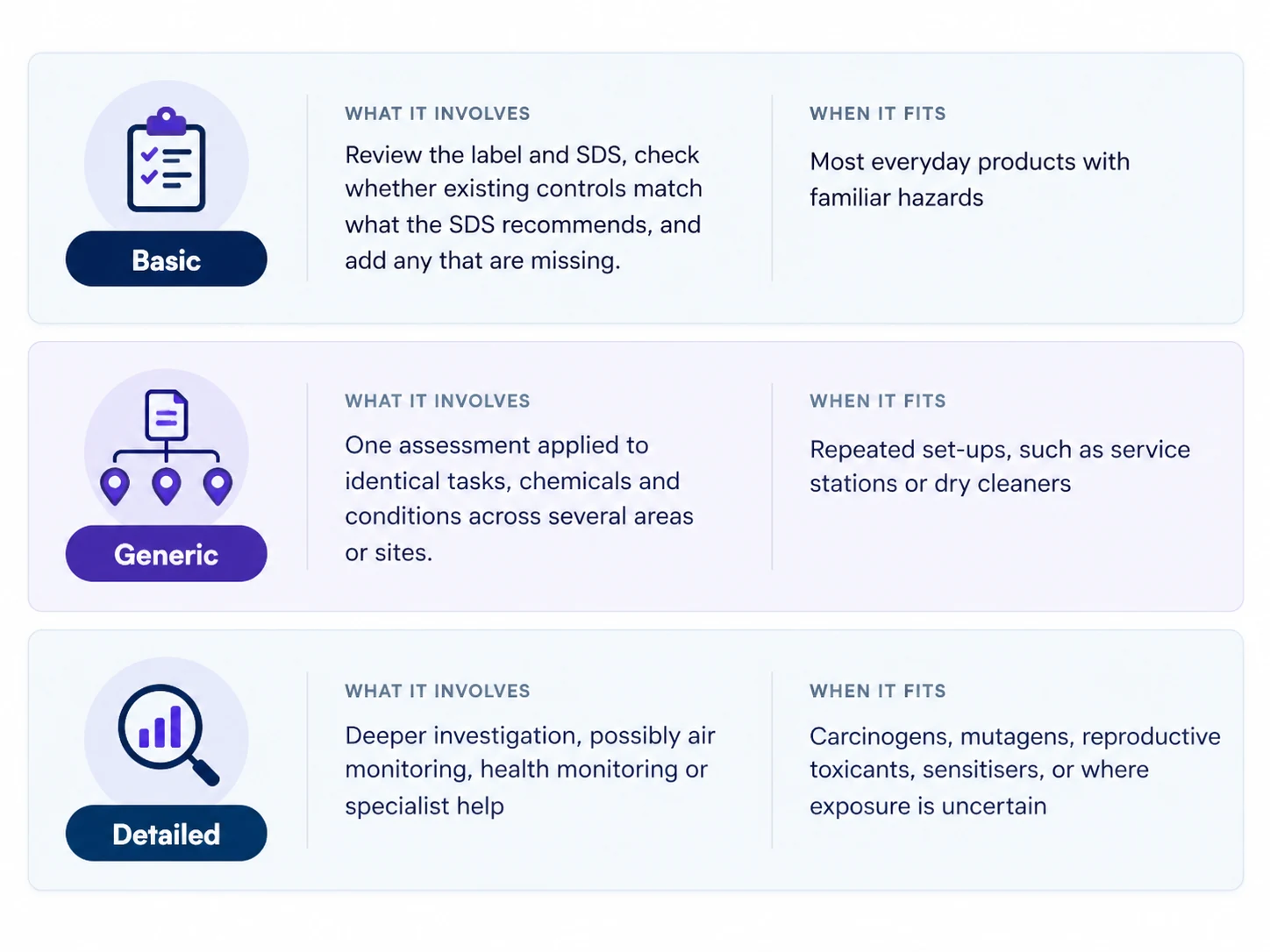
Swipe sideways to see the full table.
Generic assessments are not suitable for very high-risk chemicals such as carcinogens.
You also don't have to assess the whole workplace at once. The Code of Practice promotes breaking it down: by area, by groups of workers doing similar work, or by groups of similar chemicals used the same way.
Who can do a hazardous chemical risk assessment?
The Code of Practice says a single competent person, such as a supervisor, can carry out a simple assessment. What matters is that the person can:
- read and interpret the label and SDS
- understand how the work is actually done on site
- spot what could go wrong before it does
- talk to workers, suppliers and specialists
- pull it together into a clear conclusion and record it
More complex cases may need several people with different skills. Bring in outside help for things like designing air monitoring, interpreting test results, or designing ventilation and fire protection.
What information do you need from the SDS and label?
The SDS is your starting point. Get the current one from the Australian manufacturer or importer before the product is first used. You can also use an SDS from another source, such as an SDS database or the overseas manufacturer. However, you must still have the current SDS from the Australian manufacturer or importer.
When you read it, look for these six things:
| Look for | Why it matters |
|---|---|
| Hazard classification and statements | Tells you what kind of harm is possible, for example "fatal if inhaled" or "flammable liquid" |
| Routes of entry | Breathing, skin, eyes, swallowing. Some chemicals are only hazardous one way, so focus your controls there. |
| Warnings for at-risk workers | People who are sensitised, pregnant or have conditions such as asthma |
| Storage instructions and incompatibilities | What it must not be stored with, and whether it degrades over time |
| Physical properties | Solid, liquid or gas; flash point; vapour heavier or lighter than air; pH |
| Situations that create new hazards | For example, bleach releasing chlorine gas if mixed with an incompatible product. |
Read the label alongside the SDS. Labels on dangerous goods are often designed for transport and may not show every hazard.
A practical note: SDS quality varies. Older or thin SDSs can leave gaps, especially on incompatibilities. If something is missing, ask the supplier rather than assume it doesn't apply.
Section 8 of the SDS lists exposure standards, but always check them against Safe Work Australia's official list, as SDS values can be out of date. From 1 December 2026, workplace exposure standards are replaced by workplace exposure limits (WELs), so older SDSs may show values that no longer apply.
Who could be exposed, and what could go wrong?
Think wider than the person using the product. The Code of Practice specifically calls out cleaners, maintenance staff, contractors, visitors, supervisors, and anyone working alone. Cleaners and maintenance workers are often exposed to everyone else's chemicals as well as their own.
For health risks, ask:
- How is the task really done: decanting, spraying, mixing, heating?
- How much is used, how often, and for how long?
- What happens during non-routine work, such as breakdowns, cleaning or a one-off batch?
- Are the existing controls actually working? For example, is the extraction filter cleaned?
For physical risks, start with the fire triangle: fuel, oxygen and an ignition source. Then look for:
- Ignition sources, including ones that visit, such as delivery vehicles, cordless tools, phones and static during pouring
- Oxidisers near combustibles like wood, paper, solvents or fuels
- Incompatible chemicals that could react, generate heat or build pressure in a closed container
- Vapour behaviour: heavier-than-air vapours flow along the floor into neighbouring areas
- Corrosion of containers, shelving and fittings, leading to leaks
- Compressed gases, where leaks, pressure and asphyxiation are the main concerns
- What's nearby: neighbouring premises, schools or homes, and events like flooding or extreme heat
Don't rely on smell to detect a leak. Some people can't smell certain gases at all, and high concentrations can overwhelm the sense of smell.
Shared sites need coordination. If contractors, a landlord or other businesses work on the same site, you must consult, cooperate and coordinate with them. Typical cases include a 3PL warehouse storing a client's chemicals or a maintenance contractor doing hot work near your store.
How do you rate the risk?
Rate each hazard twice: once as things stand without controls, and again with your controls in place. The first rating, often referred to as the inherent risk rating, tells you how much attention it needs. The second, the residual risk, tells you whether you have done enough.
Most businesses rate likelihood and consequence on a matrix, commonly 5 by 5, which gives a level such as Low, Medium, High or Extreme. The Codes of Practice don't prescribe a particular matrix, so use the one in your organisation's risk framework and apply it consistently.
Three rules of thumb:
- Rate what is credible on this site, not the worst thing imaginable anywhere.
- The residual rating should be lower than the first. If it isn't, the controls aren't doing their job.
- If the residual risk is still High, add controls higher up the hierarchy, or escalate to someone who can approve stopping the task.
How do you choose the right controls?
Work down the hierarchy of controls, and only move to the next level when the one above isn't reasonably practicable. Administrative controls and PPE rely on people getting it right every time, so they are the weakest options when used on their own.
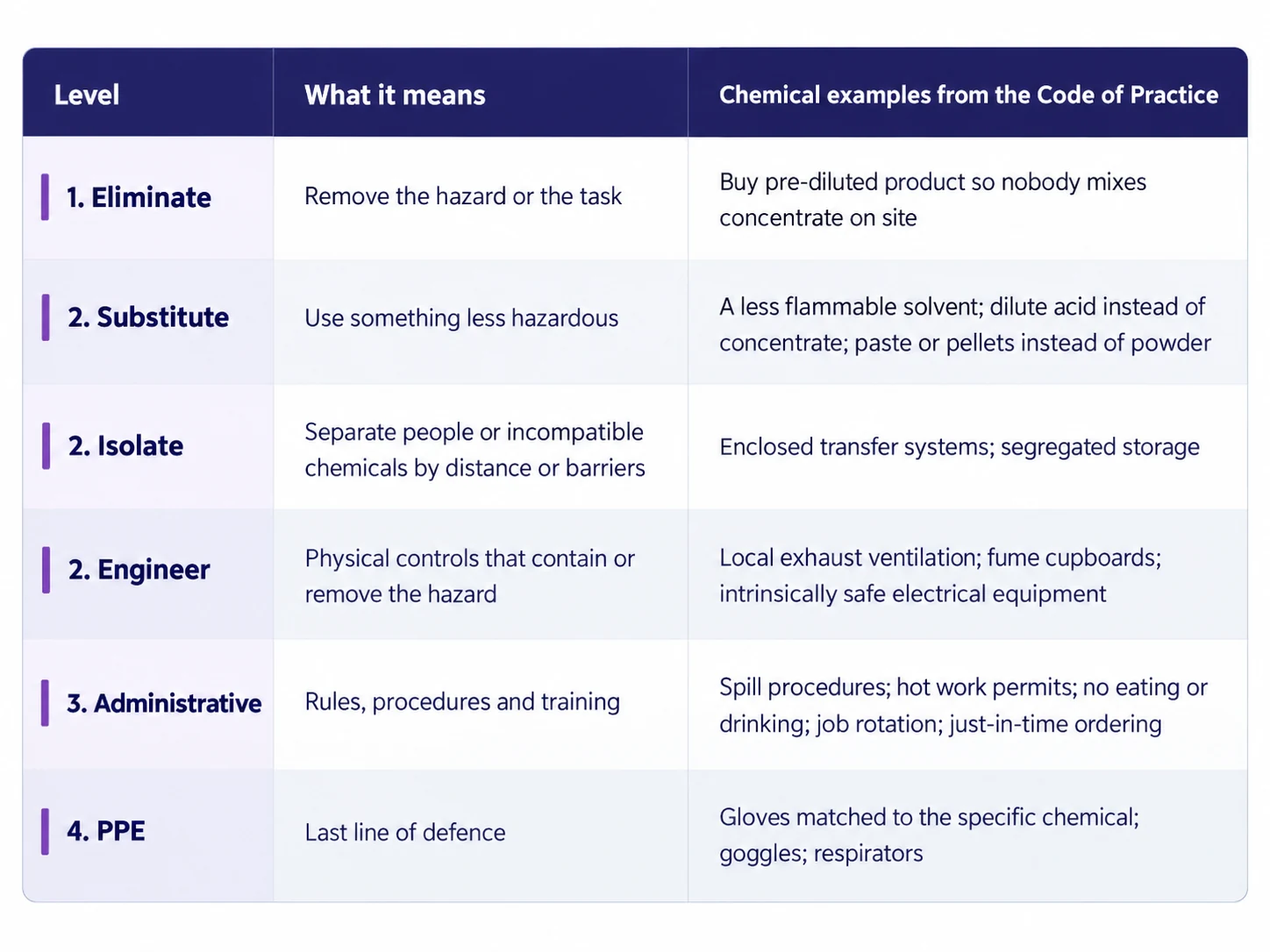
Swipe sideways to see the full table.
Substitution, isolation and engineering controls sit at the same level, and you can combine them.
Segregation: keeping incompatible products apart
Segregation is isolation applied to chemicals, and many storage incidents start here. The Code of Practice's practical points:
- Separate incompatible chemicals by distance, barriers or both. Distance is preferred where it avoids the need for extra controls.
- Never store a chemical above or below something it is incompatible with on the same shelving.
- Keep hazardous chemicals away from food, food packaging, medication, cosmetics and personal items.
- Give incompatible products separate spill containment. A shared bund can bring them together in a spill.
- Check the relevant Australian Standard, for example AS 1940 for flammable liquids or AS 4326 for oxidising agents.
Other controls the Code of Practice highlights
- Spill containment sized for the largest container or the largest foreseeable spill
- Keep containers closed when not in use: open containers are a leading cause of spills and vapour build-up
- Transfers carry more risk than static storage: control overflow, static and vapour, and have eyewash and showers nearby
- Stability: keep products within their temperature range and dispose of anything past its expiry date
- Impact protection: keep containers away from forklift routes, or protect them with bollards
Plan for emergencies. Keep the right spill kit, eyewash and fire equipment close to where the product is stored and used, and make sure your emergency plan covers it.
When should you review a chemical risk assessment?
A risk assessment is not a one-off. Under the WHS Regulations, you must review your controls and revise them where needed, when:
- a control isn't working, for example after an incident, spill or near miss
- something changes that could create a new or different risk: a new product, a new task, a new layout, more stock, or a new neighbour in the store
- you identify a new hazard
- consultation with workers shows a review is needed
- a health and safety representative asks for one
The Code of Practice adds useful warning signs. One is air monitoring results above about half the exposure standard (the exposure limit from 1 December 2026). Another is health monitoring indicating a worker has been affected.
A set review date (yearly is common) is good practice, but change is the real trigger. The most common miss is a new product arriving and sitting next to something it shouldn't.
Have each assessment signed off by someone with authority to approve the controls and keep it with your hazardous chemicals register so you can show an inspector.
How do the rules differ by state and territory?
The process above is the same everywhere. What differs is how much legal weight the Code of Practice carries, and what extra dangerous goods rules sit alongside it. NSW and Queensland now require you to comply with the Code of Practice or prove an equal or higher standard. Victoria runs a separate system. Elsewhere, the Code of Practice is strong evidence of what is reasonably practicable.
| Jurisdiction | Code of Practice to follow | Main laws | Legal weight of the Code of Practice | Also watch |
|---|---|---|---|---|
| NSW | Managing risks of hazardous chemicals in the workplace | WHS Act 2011 (NSW), WHS Regulation 2025 (NSW) | Mandatory since 1 July 2026 (s 26A): comply, or prove an equal or higher standard. | Officers' due diligence now covers Code of Practice compliance. A separate agricultural and veterinary chemicals Code of Practice commenced March 2026 |
| QLD | Managing risks of hazardous chemicals in the workplace Code of Practice 2021 | WHS Act 2011 (Qld), WHS Regulation 2011 (Qld) | Mandatory since 1 July 2018 (s 26A): comply, or prove an equal or higher standard. | Codes of Practice expire five years after approval, so check you have the current one. A 2026 Productivity Commission report recommended removing s 26A |
| VIC | Compliance code: Hazardous substances and Code of practice: Storage and handling of dangerous goods | OHS Act 2004, OHS Regulations 2017, Dangerous Goods Act 1985, Dangerous Goods (Storage and Handling) Regulations 2022 | Not mandatory, but following a compliance code means you are taken to comply with the duty it covers | Separate "hazardous substances" and "dangerous goods" regimes. WorkSafe Victoria notes both documents are not yet updated for the 2022 storage regulations. |
| WA | Managing risks of hazardous chemicals in the workplace (2022) | WHS Act 2020 (WA), WHS (General) Regulations 2022 | Admissible evidence of what is reasonably practicable; another method is fine if equal or higher | Dangerous goods storage also sits under the Dangerous Goods Safety (Storage and Handling of Non-explosives) Regulations 2007, including manifests, site plans and placards |
| SA | Managing risks of hazardous chemicals in the workplace | WHS Act 2012 (SA) | Admissible evidence; another method is fine if equal or higher | SafeWork SA says risk controls in Australian Standards referenced by an approved Code of Practice must also be complied with. Storage and licensing also fall under the Dangerous Substances (General) Regulations 2017 |
| TAS | Managing risks of hazardous chemicals in the workplace (from 5 Dec 2018) | WHS Act 2012 (Tas), WHS Regulations 2022 (Tas) | Admissible evidence; another method is fine if equal or higher | WorkSafe Tasmania runs a hazardous chemicals storage licensing scheme |
| ACT | Managing Risks of Hazardous Chemicals in the Workplace Code of Practice (approved 2022) | WHS Act 2011 (ACT), WHS Regulation 2011 (ACT), Dangerous Substances Act 2004 | Admissible evidence; another method is fine if equal or higher | WorkSafe ACT expects the manifest near the main entry unless ACT Fire & Rescue agrees otherwise |
| NT | Managing risks of hazardous chemicals in the workplace (varied Sept 2023) | WHS (National Uniform Legislation) Act 2011, WHS (National Uniform Legislation) Regulations 2011 | Admissible evidence; another method is fine if equal or higher | LPG and fuel gas also fall under the NT Dangerous Goods Regulations 1985 |
The national template for all WHS states is Safe Work Australia's model Code of Practice. A model Code of Practice has no legal effect until a jurisdiction approves it.
NSW: Codes of Practice are now a legal duty
Until 1 July 2026, a NSW Code of Practice was evidence of what a business should know and do. Now, under the new section 26A of the Work Health and Safety Act 2011 (NSW), complying with an applicable approved Code of Practice, or meeting an equal or higher standard, is a duty in itself. A breach can attract penalties separate from the general duty of care.
In practice:
- The burden has shifted. If you depart from the Code of Practice, you need evidence that your approach is as good or better.
- It covers every approved Code of Practice, including the hazardous chemicals Code of Practice, not only the psychosocial hazards Code of Practice that drew most of the headlines.
- Officers are on the hook. Directors' due diligence now includes making sure the business complies with section 26A.
- A written risk assessment becomes your evidence. The Code of Practice still doesn't require it, but documenting it is the easiest way to show you met the standard.
NSW now mirrors Queensland, which has had the same duty since 2018. If you operate in both, the hazardous chemicals Code of Practice is effectively your minimum standard in each.
Victoria: a different system
Victoria never adopted the national WHS laws. It regulates chemicals under two regimes: hazardous substances (health risks, under the OHS Regulations) and dangerous goods (fire, explosion and other physical risks, under the Dangerous Goods Act). The process is very similar, but the terminology, thresholds and notification rules differ, so check the Victorian documents directly.
Operating in more than one state?
- Set one internal standard at the strictest level. Making the hazardous chemicals Code of Practice mandatory everywhere covers NSW and Queensland and is good practice elsewhere.
- Keep state add-ons in a short local appendix, such as Victoria's terminology and notifications, or WA's dangerous goods site plan.
- Check the version. Each jurisdiction approves and updates its Code of Practice on its own timetable.
Checklists and guides to go further
The risk assessment sits inside a wider set of duties: registers, SDSs, labelling, thresholds, manifests, segregation and emergency plans. These guides cover each one in more depth:
- The 10-minute site self-check for the NSW Codes of Practice duty
- Six things our DG consultants check first when they walk onto a site
- Are your SDSs actually compliant?
- Why knowing your DG thresholds is the first step
- Dangerous goods manifest requirements
- The segregation blind spot
- Why your chemical risk assessment should cover more than health exposure
Thresholds and obligations by state: NSW, QLD, VIC, WA, SA, TAS, ACT, NT.
Rendering it practical with DGXprt
The Code of Practice expects the person doing the assessment to read the SDS, understand the work and spot incompatible neighbours. In practice, that person is rarely a dangerous goods specialist.
DGXprt Product Risk Assessments were developed with customer input to close that gap. The tool starts from the product's SDS and dangerous goods data, suggests hazards and controls for you to review and edit, and checks the other products held at the same site for incompatibilities. You rate the risk before and after controls, and approve.
to see a product risk assessment completed end to end.
Sources
- Model Code of Practice: Managing risks of hazardous chemicals in the workplace, Safe Work Australia
- Managing risks of hazardous chemicals in the workplace: Code of practice, WorkSafe WA, 2022
- WHS codes of practice, SafeWork NSW
- NSW approved safety codes of practice are now mandatory, King & Wood Mallesons, July 2026
- NSW WHS codes of practice now legally binding on PCBUs, Baker McKenzie
- Guide to the Work Health and Safety Act 2011, Workplace Health and Safety Queensland
- Compliance code: Hazardous substances and Code of practice: Storage and handling of dangerous goods, WorkSafe Victoria
- Codes of practice, SafeWork SA
- Managing risks of hazardous chemicals in the workplace, WorkSafe Tasmania
- Hazardous chemicals code of practice approval 2022, ACT Legislation Register
- Managing risks of hazardous chemicals in the workplace, NT WorkSafe
This guide is a plain-language summary for general information, current as at October 2026. It does not replace your state or territory's Code of Practice, WHS or OHS Act, or regulations.